


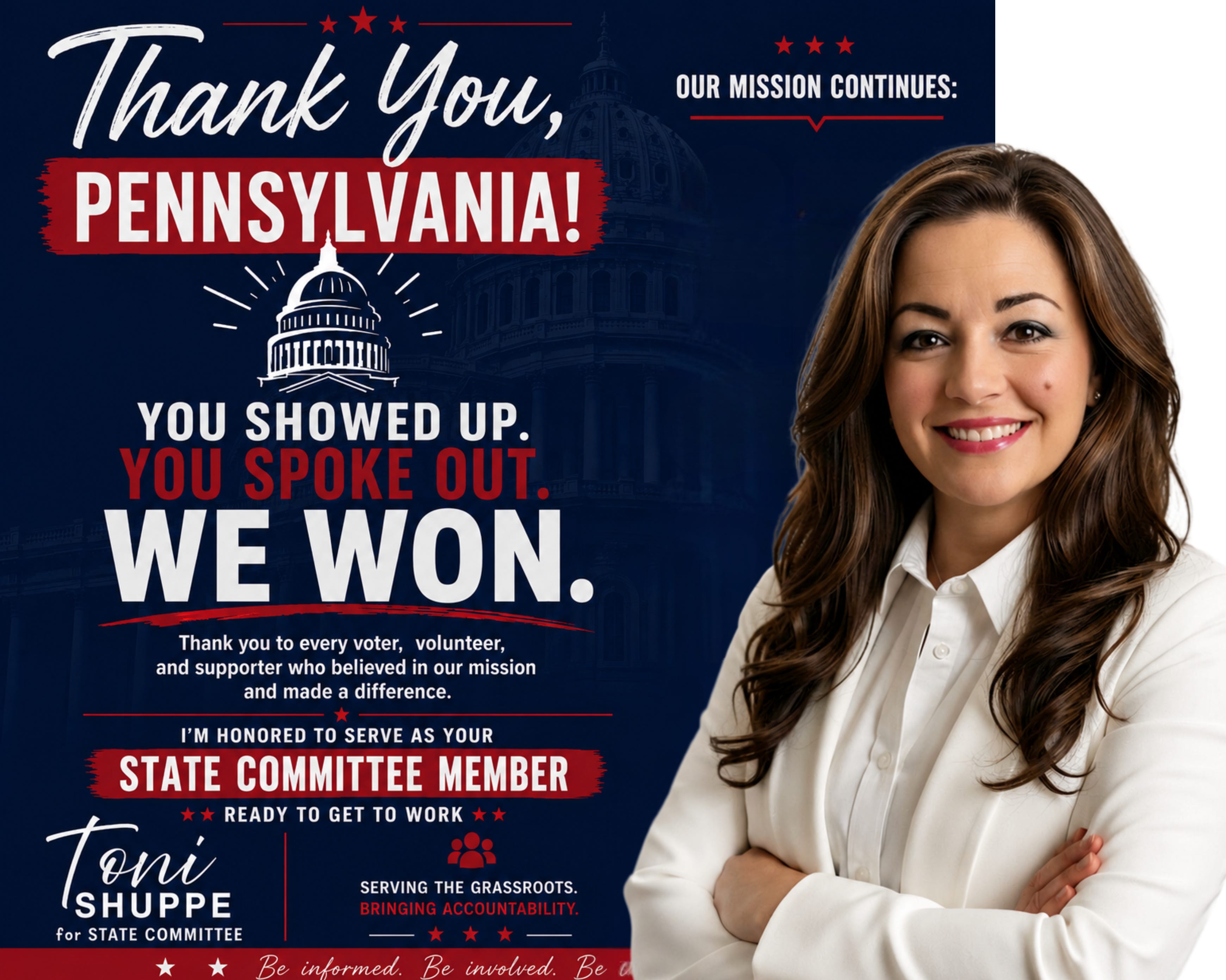
It’s official! Last night, I was elected to serve on the Pennsylvania Republican State Committee for Beaver County.
First and foremost, thank you to everyone who voted for me, encouraged me, shared my posts, prayed for me, or simply believed in me enough to support this next step. I truly mean that.
Ironically, while votes were being counted back home in Pennsylvania, I was sitting in Texas at a Patriot Academy staff retreat after voting early before my trip. Throughout the day, I found myself checking my social media for updates… mostly in between meetings and conversations about leadership, grassroots engagement, and the future of the conservative movement.
In many ways, it felt fitting.
Because what happened yesterday wasn’t just about one local race in one county. Across the country, conservatives were watching a much bigger story unfold.
Some results left people excited and hopeful. Others left many disappointed and frustrated. I can honestly say I am feeling all of the above.
A lot of conservatives, me included, are discouraged over Thomas Massie being unseated. At the same time, many grassroots activists, me included again, celebrated seeing Brad Raffensperger primaried out in Georgia after years of controversy surrounding his dreadful role in the 2020 election heist.
And that mix of emotions says a lot about where the grassroots movement is right now.
People are engaged.
People are paying attention.
And maybe most importantly, people are realizing that local and state politics matter far more than many of us were ever taught.
That brings me back to State Committee.
Over the last 24 hours, I’ve had several people ask me the same question:
“What exactly does a State Committee member do?”
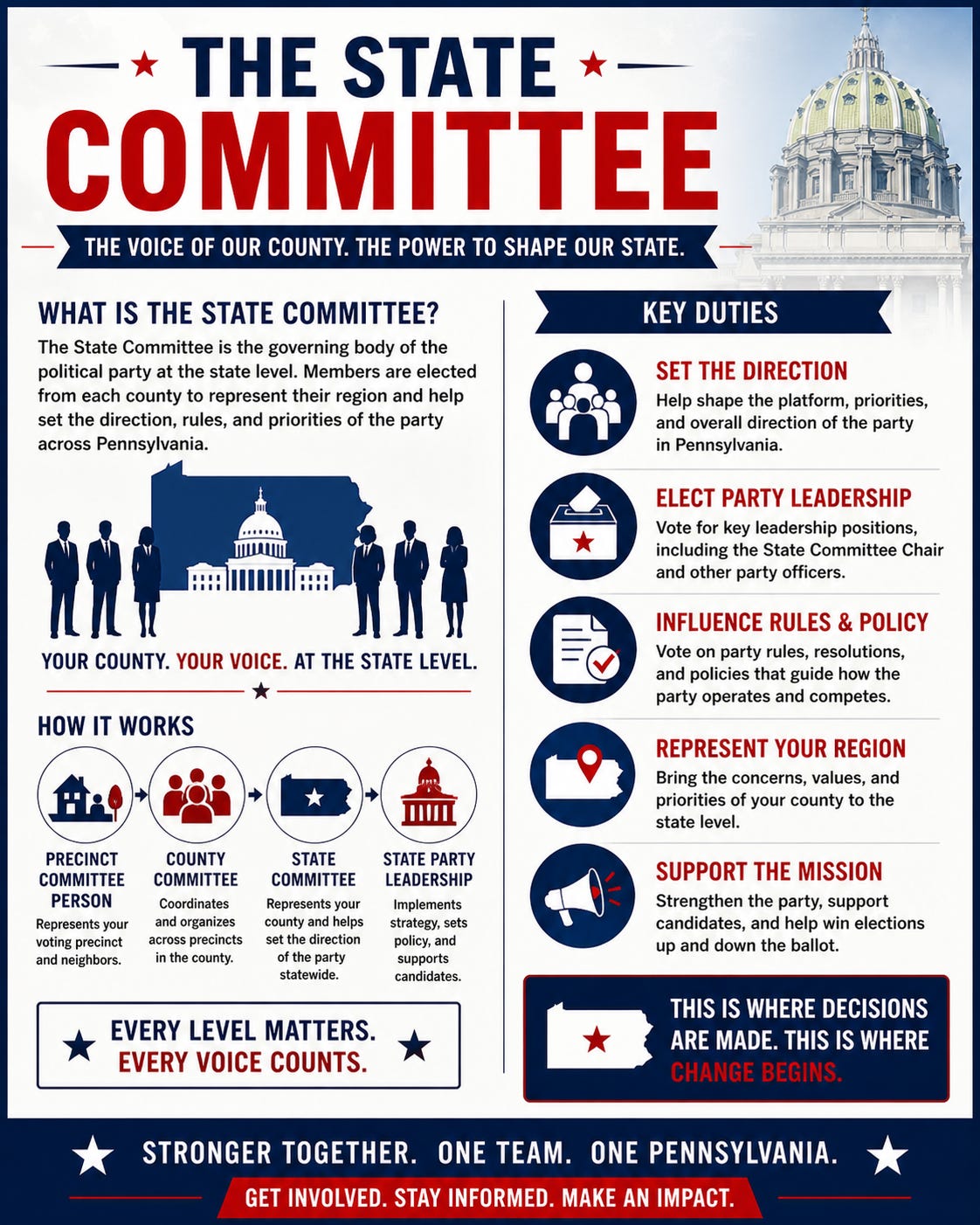
State Committee members help shape the direction of the political party at the state level. They vote on party leadership, participate in internal party decisions, help organize efforts locally, and serve as a bridge between the grassroots and party leadership.
It’s not the flashy side of politics.
Most people will never watch a State Committee meeting on television.
There are no dramatic campaign ads about it.
And most voters walk into the polls without realizing those names even appear on the ballot.
But these roles matter.
They matter because parties are ultimately built from the bottom up — county by county, precinct by precinct, neighborhood by neighborhood.
For years, many Americans focused almost entirely on presidential politics while ignoring the local infrastructure that actually shapes candidate recruitment, messaging, election operations, and community engagement.
That’s changing now.
But one thing that deeply concerned me yesterday was voter turnout.
Pennsylvania’s Republican turnout was incredibly low, and that should concern everyone regardless of which faction of the Republican Party they identify with.
If we want to have any real chance of success heading into the midterms, we cannot afford widespread voter disengagement — especially in primary elections.
Primaries are where grassroots voters have the greatest opportunity to shape the direction of the party.
They are where incumbents can be challenged.
Where new voices can emerge.
And where voters can hold elected officials accountable when they feel their concerns are no longer being represented.
One race I watched particularly closely was Senator Camera Bartolotta’s primary challenge from Al Buchtan.
I’ve had my issues with Senator Bartolotta over the years (or Senator Porn Star as I affectionately call her) and I was personally interested in seeing a competitive challenge in that race. But what stood out to me wasn’t simply the result — it was the amount of institutional force brought in to protect incumbency.
Hundreds of thousands of dollars were spent.
Mailers were sent attacking the challenger.
Even the State Party became involved.
Whether you agreed with the challenger or not, I think Republicans should seriously reflect on whether party resources should be used to intervene in primaries against grassroots challengers. And I WILL make my voice heard on that matter at my first State Committee meeting this summer.
Because if voters begin to feel that outcomes are predetermined by money, party infrastructure, and insider influence, many will simply disengage altogether.
And that is a dangerous place for any political movement to be.
The grassroots movement is strongest when ordinary people believe their participation actually matters.
That means we need more engagement, not less.
More informed voters.
More local involvement.
And far greater turnout in off-year and primary elections.
Because by the time the general election arrives, many of the most important decisions have already been made.
At the risk of sounding like a broken record, one of the biggest lessons I’ve learned over the last six years is this:
The fix is local.
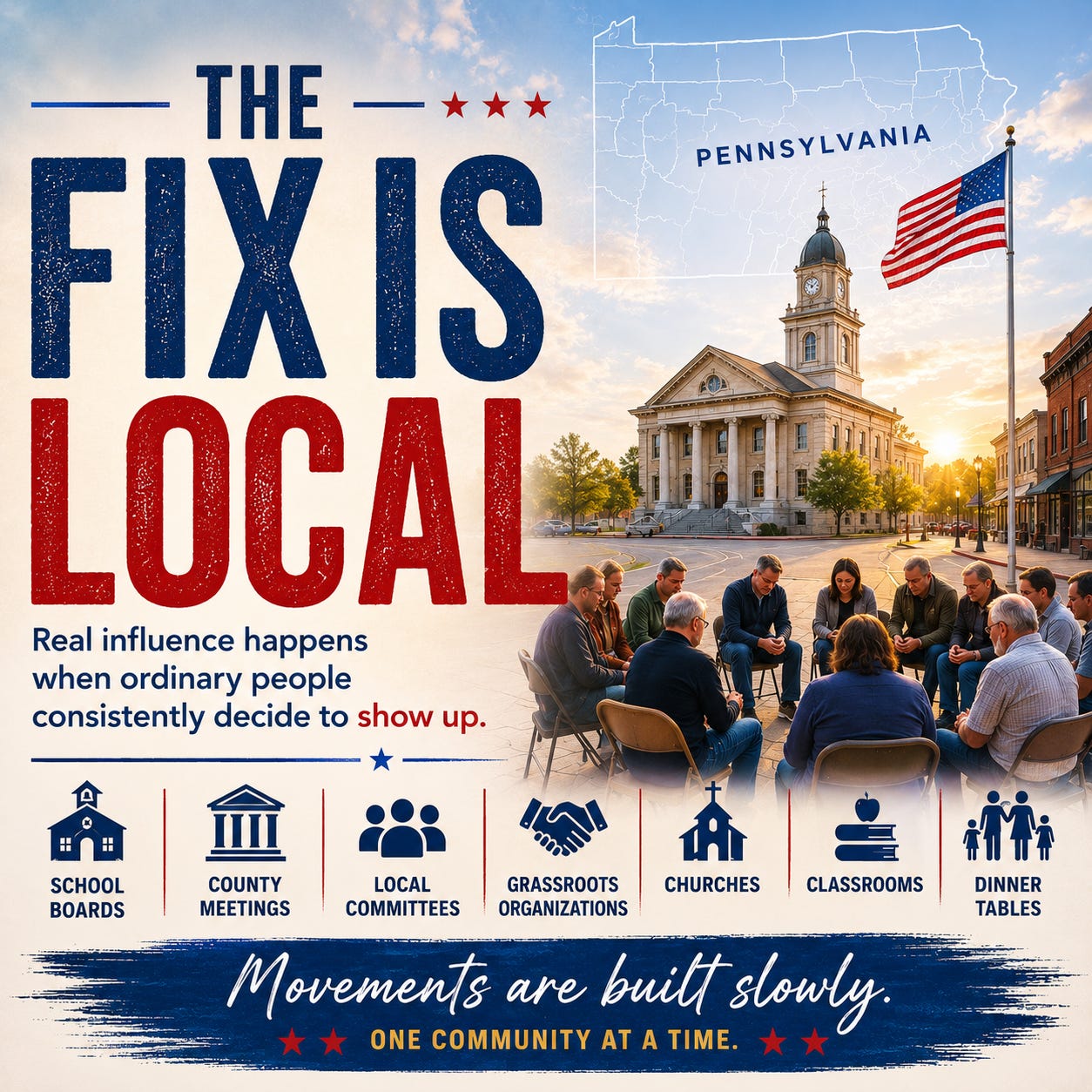
Real influence doesn’t just happen in Washington, D.C.
It happens at school board meetings.
County commissioner meetings.
Local committees.
Grassroots organizations.
State parties.
Churches.
Classrooms.
And dinner tables.
It happens when ordinary people consistently decide to show up.
That’s part of why this trip to Texas felt so meaningful too. Over the last two days, I’ve had conversations with people from all over the country who are asking the same questions many of us are asking in Pennsylvania:
How do we rebuild healthy communities?
How do we raise courageous kids?
How do we stay engaged without burning out?
How do we create lasting change instead of just reacting emotionally to headlines every day?
Another important thing I’ve learned is that none of this can be sustained alone.
People need community.
They need education.
They need encouragement.
And they need other grounded, informed people who are willing to stay engaged locally without getting consumed by the outrage cycle.
That’s one reason I continue encouraging people to get involved with the True The Vote Now community and other local grassroots organizations. Whether your passion is election integrity, Constitution education, local government, or simply learning how the process actually works, finding a healthy community of engaged citizens matters.
Because isolated people burn out.
Connected people build.
But those are all bigger questions than one election.
And honestly, that perspective helped me yesterday as I was watching the results I didn’t like come in.
Of course, every candidate wants to perform well. I’m human too. But leadership maturity means learning not to measure your value entirely by vote totals, social media metrics, or public recognition.
Movements are built slowly.
Trust is built slowly.
Influence is built slowly.
And sometimes the most important work happens quietly, behind the scenes, long before anyone notices.
So today, I’m grateful.
Grateful for everyone who supported me.
Grateful for the opportunity to serve.
Grateful for the people across this country who still care enough to stay engaged locally.
And grateful to be part of a movement that is still very much alive.
The older I get, the more I realize that saving the Republic was never going to happen through one election cycle, one viral moment, or one personality.
It happens when ordinary people decide to faithfully keep building — one community at a time.
Congrats Toni! I’m sure you’ll do a great job as always 👏👏
Proud of you!!!