


We’ve talked about what the filibuster is.
We’ve talked about whether it should be reformed, preserved, or eliminated.
Now let’s get practical.
The Senate is scheduled to gavel back in this afternoon at 3pm.
When it does, here’s what actually has to happen for the SAVE Act to move forward.
No drama. No cable news spin.
Just process… and a little bit of sarcastic mom humor.
Step 1: Does Leadership Bring It to the Floor?
As of February 20th, according to a post on X from Mike Lee, John Thune has indicated he is willing to bring the SAVE Act up for a vote.
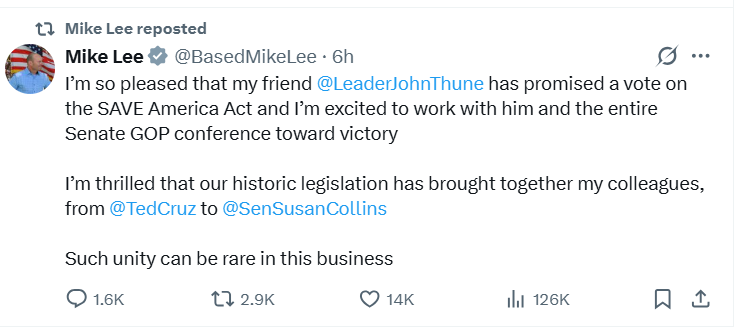
That’s significant.
But “willing” and “scheduled” are two different things.
The Majority Leader controls the Senate calendar, and if it’s not on the calendar, it’s not happening.
So, the first thing to watch is simple:
Does it get formally brought to the floor?
Step 2: Motion to Proceed
Before the Senate can debate the bill itself, it must agree to take it up.
This is called a “motion to proceed.”
Sometimes this step is smooth.
Sometimes it’s where the first real resistance shows up.
If opponents attempt to block even taking up the bill, the 60-vote cloture rule can apply here too.
Yes.
Sometimes you need 60 votes just to start talking about something.
If you’re thinking, “That feels like a lot of steps,” you’re not wrong.
The Senate was designed to be deliberate.
Step 3: Debate Begins
If the motion to proceed passes, the Senate moves into debate.
This is where passionate speeches happen.
This is where amendments may be offered, which is sometimes how awful changes slip into otherwise good bills.
This is also where public framing starts to matter.
Because debate isn’t just about persuasion inside the chamber.
It’s about shaping perception outside of it.
And perception influences cloture votes.
Hopefully by now you’re starting to understand how messy the political process is and how easily it can get dirty when you have people with no morals in positions of power. It’s hard enough not to compromise when you DO have a moral compass. Imagine what happens when Congress is filled with a bunch of degenerates.
Spoiler alert - That’s basically what’s happened over the last 60 years.
Step 4: The Cloture Vote (This Is the Moment)
At some point, leadership will file a cloture motion to end debate.
This is the 60-vote threshold we’ve been discussing all week.
If 60 senators vote to invoke cloture—Debate ends. The bill moves toward final passage.
If fewer than 60 vote yes—Debate continues. And practically speaking, the bill stalls.
Not because it failed a final vote, but because it never got there.
This is the difference most headlines blur.
Step 5: Final Passage (51 Votes)
If cloture succeeds, the Senate then votes on final passage.
That requires only a simple majority.
Fifty-one votes.
This is why you keep hearing phrases like:
“It has the votes.”
The question that matters right now is this—Does it have 60 to end debate?
If Cloture Fails — Then What?
If cloture fails, leadership has options:
• Negotiate changes.
• Apply public pressure.
• Attempt another cloture vote later.
• Or move on to other legislation.
What they typically cannot do — without changing Senate precedent — is simply force a final vote with 51.
That would require crossing into the debate we covered in Article 2.
And that’s a much bigger institutional decision.
This Is Where Citizens Actually Matter
Not in a theatrical way.
In a procedural way.
• Offices track call volume.
• Staff brief senators on constituent pressure.
• Media narratives affect whether cloture votes feel politically safe.
• Leadership watches momentum carefully.
Especially for senators in competitive or purple states, cloture votes are not just about policy.
They’re about optics.
If ending debate feels politically safe, senators are more likely to vote yes.
If it feels radioactive, they hesitate.
That’s reality.
What Can You Do?
If you care about the SAVE Act — or simply about understanding the process instead of reacting emotionally — here are practical steps:
1️⃣ Call Your Senators
Be calm. Be clear. State your position on both the bill and ending debate.
2️⃣ Share Educational Content
Most Americans don’t understand the 60-vote rule. Education lowers hysteria and raises clarity.
3️⃣ Watch the Cloture Numbers
Don’t just read “blocked” or “failed.”
Look for: How many voted to end debate?
4️⃣ Understand the Difference Between Debate and Passage
A bill can have majority support and still stall procedurally.
5️⃣ Stay Steady
Procedure moves slower than social media. That’s not weakness. That’s design.
Here’s what I hope this series has done for you
Instead of watching the SAVE Act saga unfold like a breaking-news spectacle, you’ll watch it like someone who understands the mechanics.
Because secure elections require good law. Good law requires process. And process requires citizens who are paying attention.
Educated action beats emotional reaction every time.
Thank you, Toni. A concise summary.
Do you think it lands on Trump’s desk, or not?