A few months ago, I found myself wrestling with something I couldn’t quite reconcile.
In political circles, I kept hearing warnings about Islam.
People I’ve grown to love and trust were describing it as a political ideology masquerading as a religion and that its ultimate goal is the destruction of Western civilization.
The more I listened, the more uncomfortable I became.
Not because I wanted those claims to be false, but because they don’t match my personal experience.
Here’s the reality—over the course of my life, I’ve known quite a few Muslims.
I had a Muslim uncle.
My mother and father, when they were alive, had doctors who were Muslim.
I grew up with and went to school with Muslims.
In all of these instances, I had conversations with Muslims that were thoughtful, respectful, and sincere.
The people I knew simply didn’t resemble the picture I was hearing described.
So, I found myself facing a choice.
I could just accept what my trusted circle was saying and try to bury the uncomfortable feeling in my stomach, or I could start asking questions and reading for myself.
I chose the second option.
And that decision launched me into what has become one of the most fascinating studies I’ve ever undertaken.
Four Dots Connected
As I’ve been reading, I’ve started documenting what I call my “Connecting Dots” moments—discoveries that made me stop and say:
“Wait... what?”
So far, I’ve connected four major dots.
Dot #1: The Crucifixion

Most Christians assume Muslims believe the same basic story about Jesus that we do.
They don’t.
Muslims do not believe Jesus died on the cross.
The moment I learned that, I realized we weren’t talking about a minor disagreement.
We’re talking about a foundational difference.
If Jesus did not die on the cross, Christianity falls apart.
If He did, then Islam’s understanding of Jesus must be questioned.
That single dot opened an entire chain of more questions and yes I’m taking A LOT of notes on this journey.
Dot #2: The Son of God
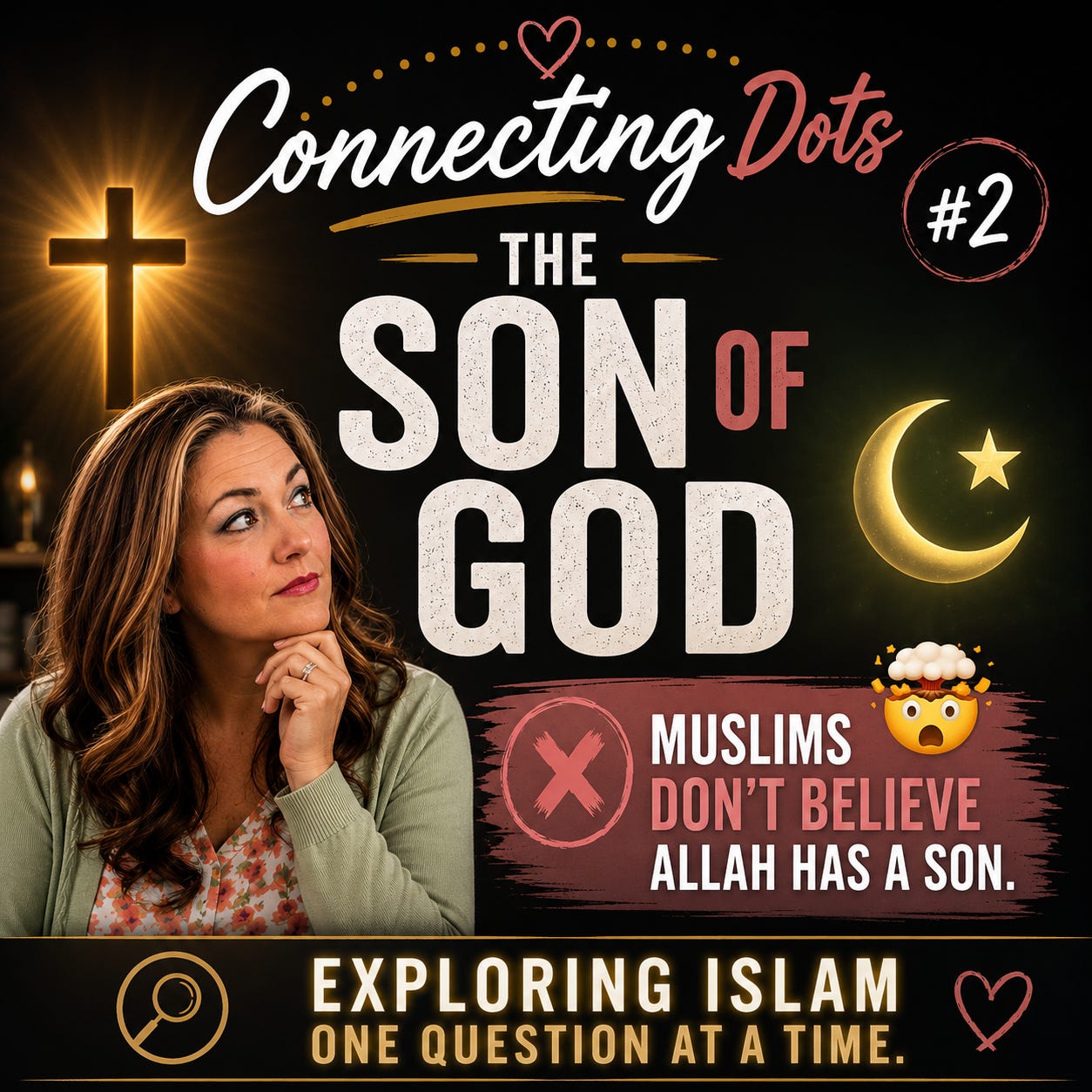
The second surprise was discovering how strongly Islam rejects the idea that God has a Son.
To Christians, “Son of God” is one of the most familiar descriptions of Jesus.
To Muslims, it is considered incompatible with God’s nature.
Suddenly I realized Christians and Muslims often use similar language while meaning very different things.
Dot #3: Who Is Jesus?
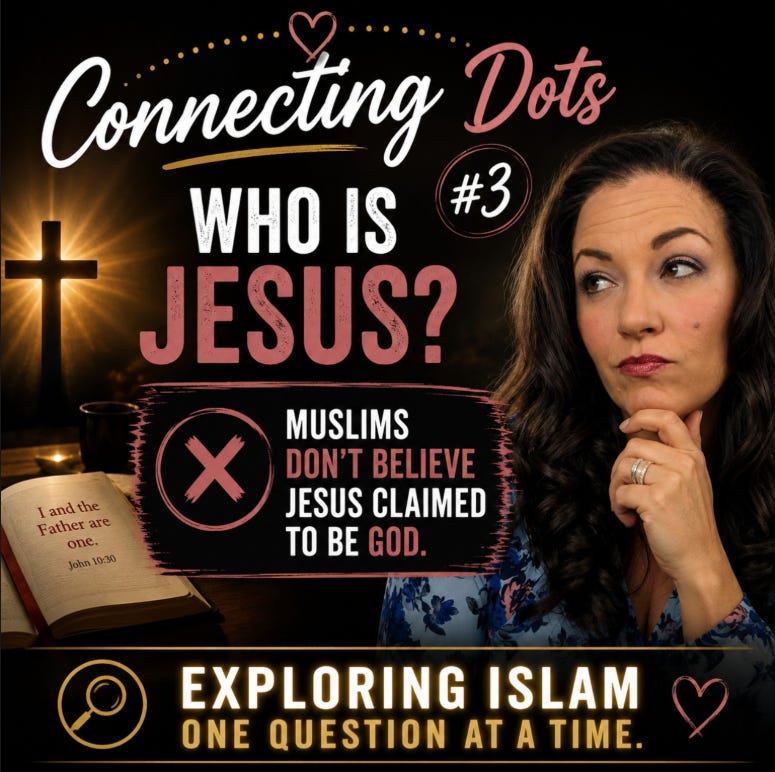
Perhaps the most surprising discovery was learning that Muslims deeply respect Jesus.
They honor Him.
They believe He performed miracles.
They believe He was born of a virgin.
Yet they do not believe He claimed to be God.
Again, another massive difference hidden beneath what initially sounds like agreement.
Dot #4: The Trinity
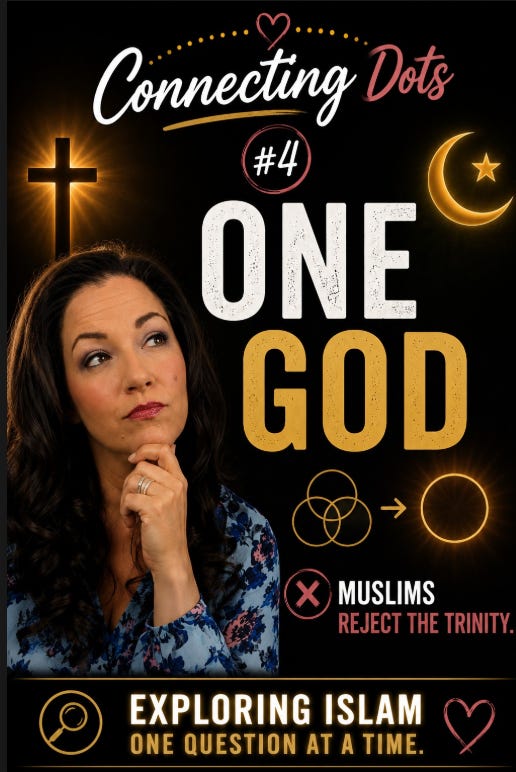
Most recently, I’ve been studying Islam’s rejection of the Trinity.
For Christians, the Trinity is one God revealed as Father, Son, and Holy Spirit.
For Muslims, that doctrine is viewed as compromising God’s absolute oneness.
The more I study, the more I realize that many of the debates between Christians and Muslims aren’t simply disagreements.
They’re disagreements that begin with completely different assumptions about who God is.
The Question I’ve Been Wrestling With
As I’ve continued reading, another thought keeps surfacing.
The average Muslim I’ve known personally doesn’t seem anything like the extremist examples that often dominate public discussion.
In fact, many seem remarkably similar to many Christians I know.
They love their families.
They care about their communities.
They genuinely want to honor God.
Yet at the same time, I’m beginning to see that there are deeper questions within Islam that many Muslims may never have seriously examined.
Reading Nabeel Qureshi’s story has been particularly eye-opening in this regard.
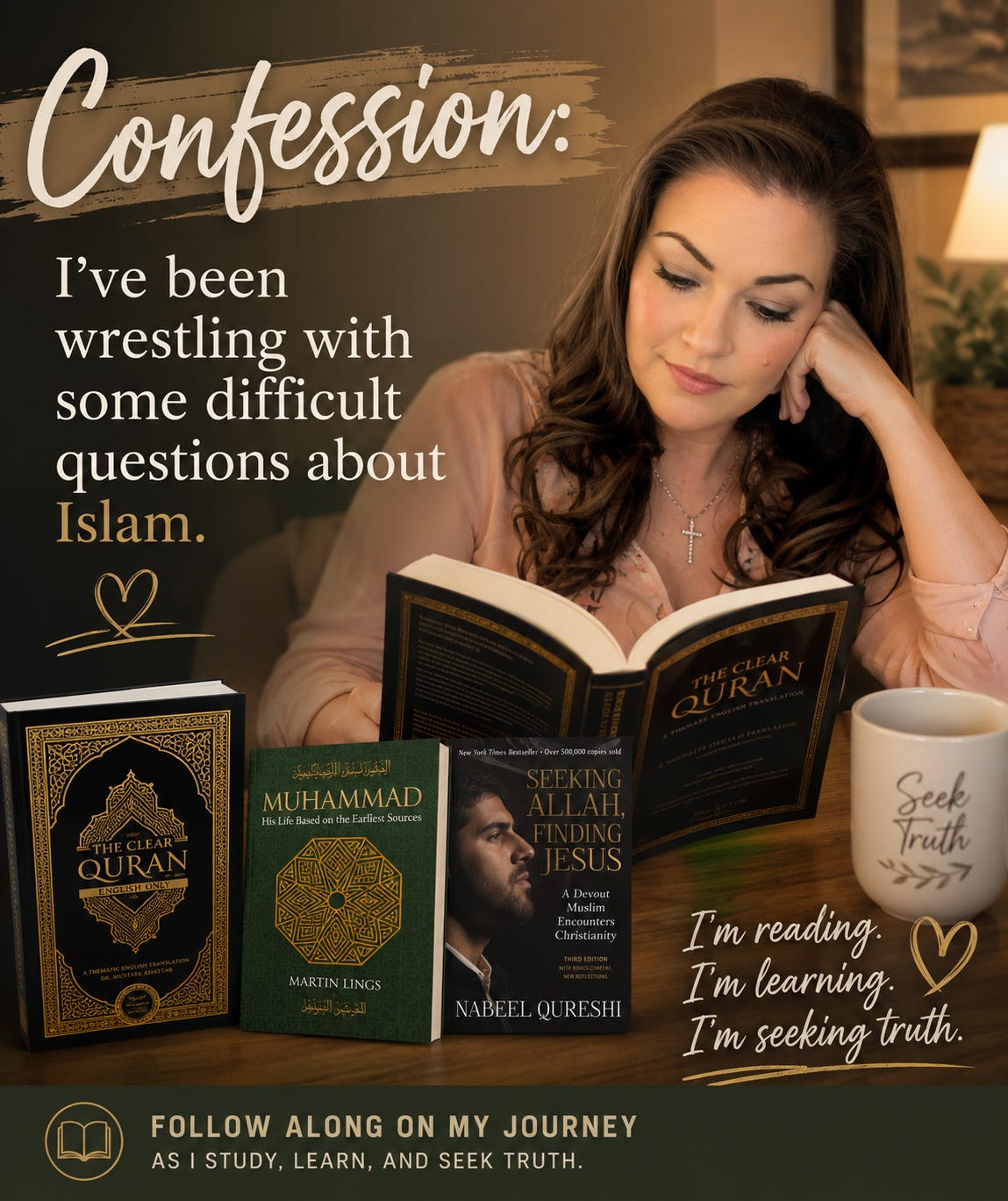
Nabeel wasn’t an ignorant man.
He was intelligent, sincere, devoted, and deeply committed to his faith.
Yet there were historical, theological, and philosophical questions he had never been challenged to investigate.
When he finally did, it changed everything.
That has caused me to wonder:
How many Muslims have never been invited to ask those questions?
And perhaps just as importantly...
How many Christians haven’t asked them either?
A Better Way Forward
Years ago, one of my business mentors shared a quote that has stayed with me ever since:
“A man convinced against his will is still a man unconvinced.”
The older I get, the more wisdom I see in that statement.
People rarely change because they are pressured, shamed, or yelled at.
People change when they become curious and feel safe enough to ask questions.
People change when they encounter truth for themselves.
That’s exactly what happened to Nabeel.
And it’s why I believe education is a better approach than fear.
If Christianity is true, then we should not fear investigation.
If Jesus is who He claimed to be, then truth can withstand scrutiny.
Instead of merely talking about Muslims and their geopolitical agenda, perhaps we should spend more time talking with them, especially if they’re our neighbors, coworkers, colleagues, or friends.
Instead of assuming what they believe, perhaps we should learn what they actually believe.
Instead of trying to win arguments, perhaps we should learn how to ask better questions.
Because questions have a way of opening doors that arguments never will.
The Journey Continues
I’m currently finishing Seeking Allah, Finding Jesus by Nabeel Qureshi. a former Muslim who converted to Christianity and as a result lost his entire family. It’s heartbreaking and inspiring at the same time.
I’ve also begun reading Muhammad, His Life Based on the Earliest Sources by Martin Lings and I plan to continue with Nabeel Qureshi’s second book, No God but One, while working my way through the Qur’an itself.
In many ways, I feel like I’ve barely begun.
Four dots connected.
Dozens more emerging.
And more “wait, what?” moments than I ever expected.
I don’t know exactly where this journey will lead.
But I know this:
A man convinced against his will is still a man unconvinced.
That’s why understanding matters.
That’s why questions matter.
And that’s why this journey is far from over.