We Don’t Hate the Media Enough
There. I said it.
And before you write this off as just another emotional rant—stay with me.
Because this isn’t about feelings.
It’s about power.
🎯 A Case Study in Real Time
A post from True the Vote is circulating right now, alongside a tweet from Heather Mullins that perfectly illustrates the problem.
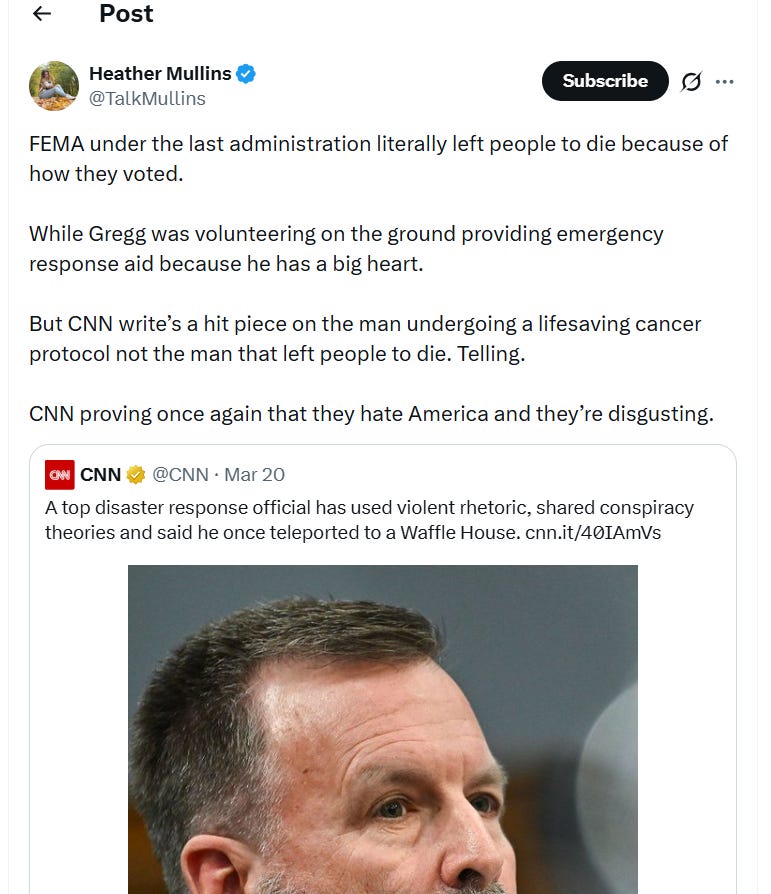
Mullins shared a headline from CNN that reads:
“A top disaster response official has used violent rhetoric, shared conspiracy theories and said he once teleported to a Waffle House.”
Read that again.
Because that headline is doing more than informing you.
It’s forming your opinion before you even have a chance to think.
🧠 MEDIA = Most Effective Devil in America
A while back, I saw a post using this acronym and it really resonated with me:
MEDIA = Most Effective Devil in America
At the time, it felt bold and enlightening.
Now it feels more obvious than ever.
Because what you’re looking at in that headline is not just reporting.
It’s narrative construction.
👤 Who Is Gregg Phillips—and Why Has He Been Targeted?
Before you accept the narrative being handed to you, it’s worth asking a basic question:
👉 Who is this person, really?
Gregg Phillips has spent years working in data systems, public policy, and government-related infrastructure.
More recently, he became widely known for his work alongside Catherine Engelbrecht through True the Vote—focused on election data, transparency, and citizen-led investigation.
But here’s the part you likely won’t see in a headline:
👉 Both Phillips and Engelbrecht were jailed—not convicted of a crime—but for refusing to disclose a confidential source.
Let that sink in.
They were held in contempt of court during litigation tied to election-related data investigations—specifically connected to a company called Konnech.
They did not comply with a court order that would have required them to reveal protected information.
And they went to jail for it.
Not for fraud.
Not for violence.
Not for criminal wrongdoing.
👉 For refusing to give up a source.
The case was later dropped.
🧩 Why That Matters
You don’t have to agree with everything they’ve said or concluded.
But you should at least recognize what that represents:
👉 A willingness to face jail time rather than compromise a source
👉 A level of conviction that goes beyond political talking points
That doesn’t make someone right.
But it does make them worth taking seriously.
What Is True the Vote?
True the Vote has spent over a decade working on election integrity and government accountability.
Their work has included:
large-scale voter data analysis
citizen training initiatives
investigative efforts into election systems
They’ve also been at the center of major legal battles.
One of the most significant:
👉 A prolonged case against the Internal Revenue Service over alleged political targeting of nonprofit organizations.
That case resulted in a settlement that helped establish clearer protections against viewpoint-based targeting of groups.
⚠️ Why You Haven’t Heard This Framed This Way
Now ask yourself:
👉 Why isn’t that the context you’re given?
Why isn’t the story:
“Individuals jailed for protecting a source”
“Organization that challenged IRS targeting”
“Long-running involvement in election data analysis”
Instead, you get:
“violent rhetoric”
“conspiracy theories”
“teleported to a Waffle House”
That contrast is the story.
⚖️ This Isn’t a Lie—It’s Something More Subtle
Now go back to the headline.
What does CNN choose to highlight?
“violent rhetoric”
“conspiracy theories”
“teleported to a Waffle House”
Not:
years of work
involvement in disaster response
current real-world actions
That omission matters.
Because…
👉 What’s left out is often more important than what’s included
🔍 The Power of Selection
This is how modern media influence works.
Not primarily through fabrication—
But through selection and emphasis.
Choose the most sensational details
Ignore the most substantive ones
Lead with what shapes perception fastest
And because most people never read past the headline…
👉 The framing becomes reality.
🧩 Why This Matters
Mullins’ tweet isn’t just reacting emotionally.
It’s asking a critical question:
👉 Why this angle? Why this focus? Why now?
Because priority reveals agenda.
And when the media consistently prioritizes:
character framing over context
ridicule over substance
narrative over nuance
…it stops informing the public.
And starts directing it.
⚠️ This Is Bigger Than One Story
This isn’t about defending one man.
It’s about recognizing a pattern.
You’ve seen it:
You witness something directly
You read how it’s reported
And the two don’t match
That disconnect is not random.
It’s structural.
Something Else Worth Noting
Both Engelbrecht and Phillips have also been open about their faith. They are not hiding who they are or what they believe.
And yet, in a culture where people often invoke faith publicly, it’s worth asking why expressions of belief are sometimes embraced—and other times mocked or used as a credibility weapon.
That inconsistency is part of the broader pattern.
🚨 This Is Why We Don’t Hate the Media Enough
Not hate in a reactionary sense.
But in terms of:
👉 properly identifying the threat
👉 adjusting how we consume information
👉 refusing to outsource our understanding of reality
Because right now, too many people still:
trust headlines at face value
react before verifying
assume coverage equals truth
And that’s exactly how this system maintains its power.
🛠️ The Antidote Isn’t Rage—It’s Discipline
If MEDIA is the Most Effective Devil in America…
Then the answer isn’t outrage.
It’s awareness.
And habits:
Watch the process, not the press releases
Ask: What’s missing?
Look for primary sources
Slow down your reactions
Notice emotional manipulation
Because once you see it…
You can’t unsee it.
Final Thought
The Founders warned us about tyranny from government.
But they couldn’t have imagined a system where reality itself could be shaped…
through headlines.
We are living in that system now.
And if we don’t learn how to navigate it—
We won’t just lose debates.
We’ll lose our ability to recognize truth.
So no…
We don’t hate the media enough.
Because if we did—
We’d stop consuming it passively.
And start questioning it relentlessly.