I sent this to my paid subscribers yesterday after getting the same question multiple times:
“Is this even constitutional?”
Most people are reacting to what feels unfair.
But very few are stepping back to ask what the Constitution actually says about any of this.
That’s what I break down in this piece.
You can read the opening below. The full article is for my paid subscribers.
Something is brewing in Pennsylvania right now…
If you’ve been anywhere near grassroots circles lately, you’ve probably felt it.
Frustration.
Confusion.
A little bit of “what just happened?”
Because the GOP made early endorsements for Governor and Lieutenant Governor…
And for many people, it felt like the primary was decided before it even began.
I’ve heard it over and over:
“How is anyone else supposed to have a chance now?”
And naturally, that leads to a bigger question, which I got this week from someone who attended my April 25th event:
“Is that even constitutional?”
I had the same gut reaction
If I’m being honest…
My initial response was probably similar to yours.
I don’t agree with early endorsements in primaries.
I wouldn’t have voted for this one.
And I completely understand why people feel like it shuts the door on other candidates before voters ever get a real say.
But then I stepped back and asked a different question:
👉 What does the Constitution actually say about this?
Here’s the part that surprises most people
The Constitution says…
Nothing.
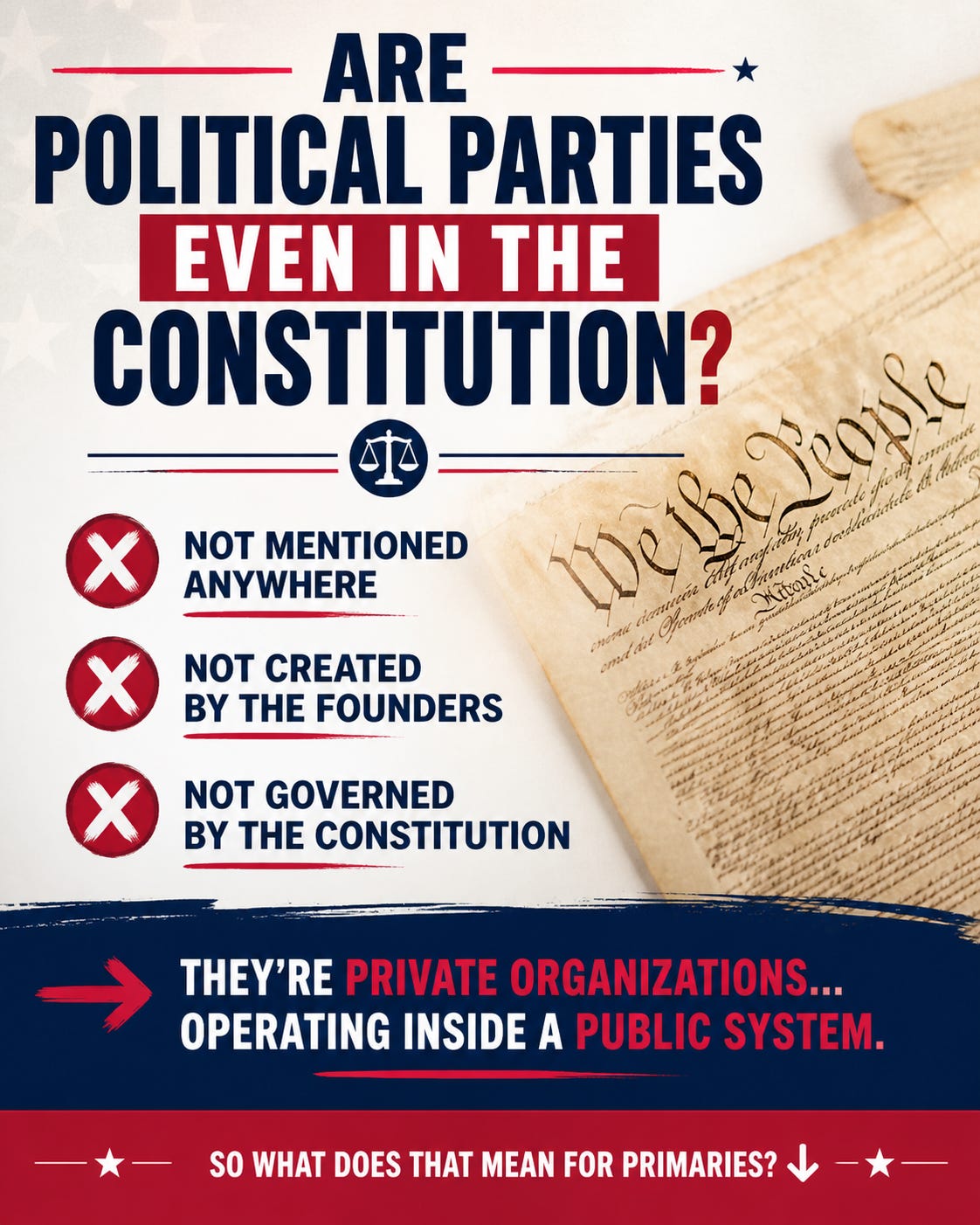
Political parties are not mentioned. Not once.
The rest of this breakdown—including how we got here, why it matters for Pennsylvania, and what we can actually do about it—is for my paid subscribers.
If you’ve been following this work and want to go deeper, your support helps me keep doing exactly this—breaking down complex issues in a way that actually makes sense.
Not in the original document.
Not in the amendments.
Which means something really important:
👉 Political parties are not a constitutional institution.
They’re something we built on top of the system.
That wasn’t the original plan
In fact, the Founders were deeply wary of what they called “factions.”
James Madison warned in Federalist No. 10 that organized groups could pursue their own interests over the good of the country.
And George Washington didn’t mince words in his farewell address—he warned political parties would lead to division and power struggles.
And yet…
That’s exactly where we are.
How we got here
Political parties formed almost immediately anyway.
Alexander Hamilton and the Federalists
Thomas Jefferson and the Democratic-Republicans
What started as loose ideological alliances eventually became the highly structured party system we have today.
But here’s the key:
👉 They developed outside the Constitution—not because of it.
So what does that mean for early endorsements?
Legally speaking, political parties are considered private organizations.
Which means they have First Amendment rights like:
Free speech
Freedom of association
So yes…
✔️ They can endorse candidates
✔️ They can do it early
✔️ They can try to influence the outcome
Even in a primary.
And yet… it still feels off
Because primaries aren’t purely private.
They’re:
Run by the state
Funded by taxpayers
Used to determine who appears on the ballot
So, when a party makes an early endorsement, it creates a very real tension:
“If this is a public election… why does it feel like the outcome is being shaped before voters ever weigh in?”
That frustration is valid.
But it’s not necessarily unconstitutional.
It’s a reflection of how the system is structured.
Here’s where my perspective shifted
I still don’t love early endorsements in primaries.
That hasn’t changed.
But I’ve also realized something important:
👉 These decisions are often more nuanced than they appear from the outside.
There are factors most of us don’t see:
Strategic considerations
Candidate viability
Timing pressures
Internal party dynamics
That doesn’t mean we have to agree with the decision.
But it does mean we should be careful about assuming it was simple—or malicious.
Because the truth is…
There are no perfect solutions.
Only decisions made in real time…
With imperfect information…
By imperfect people.
And hindsight?
Hindsight is always 20/20.
So what do we do with that?
We stay engaged.
We ask questions.
We learn how the system actually works instead of just reacting to it.
And we decide—individually and locally—how we want to influence it moving forward.
Final thought
There’s a quote I come back to often:
“Duty is ours. Results are God’s.”
— John Quincy Adams
We don’t control every decision that gets made inside party structures.
But we do control how we respond.
How we engage.
How we lead in our own communities.
And here’s what that means for me
Complaining doesn’t fix the system.
Getting involved does.
That’s why I’m running for State Committee.
Take a few minutes to find out who’s running in your area.
If you feel strongly about endorsements in primaries, ask candidates where they stand—and vote accordingly.