


Constitution Day came and went last week, and apparently I wasn’t quite finished with it. 😂
Because sometime after writing about the Constitution, I stumbled across a little clause tucked away in Article I that I had never really stopped to think about before.
And you guys know what happens when I find something like that.
Rabbit hole.
This particular rabbit hole started with Article I, Section 10:
“No State shall...make any Thing but gold and silver Coin a Tender in Payment of Debts.”
Gold and silver.
In the Constitution.
I knew that clause was there. But I’m not sure I had ever really stopped to ask why.
So I started digging.
They Had Already Watched Money Fail
One of the things I’ve learned from studying the Founders is that we sometimes read the Constitution as though a group of really smart men simply sat down and dreamed up what good government should look like.
That’s not what happened.
They were responding to things they had actually lived through.
And when it came to money, what they had lived through wasn’t pretty.
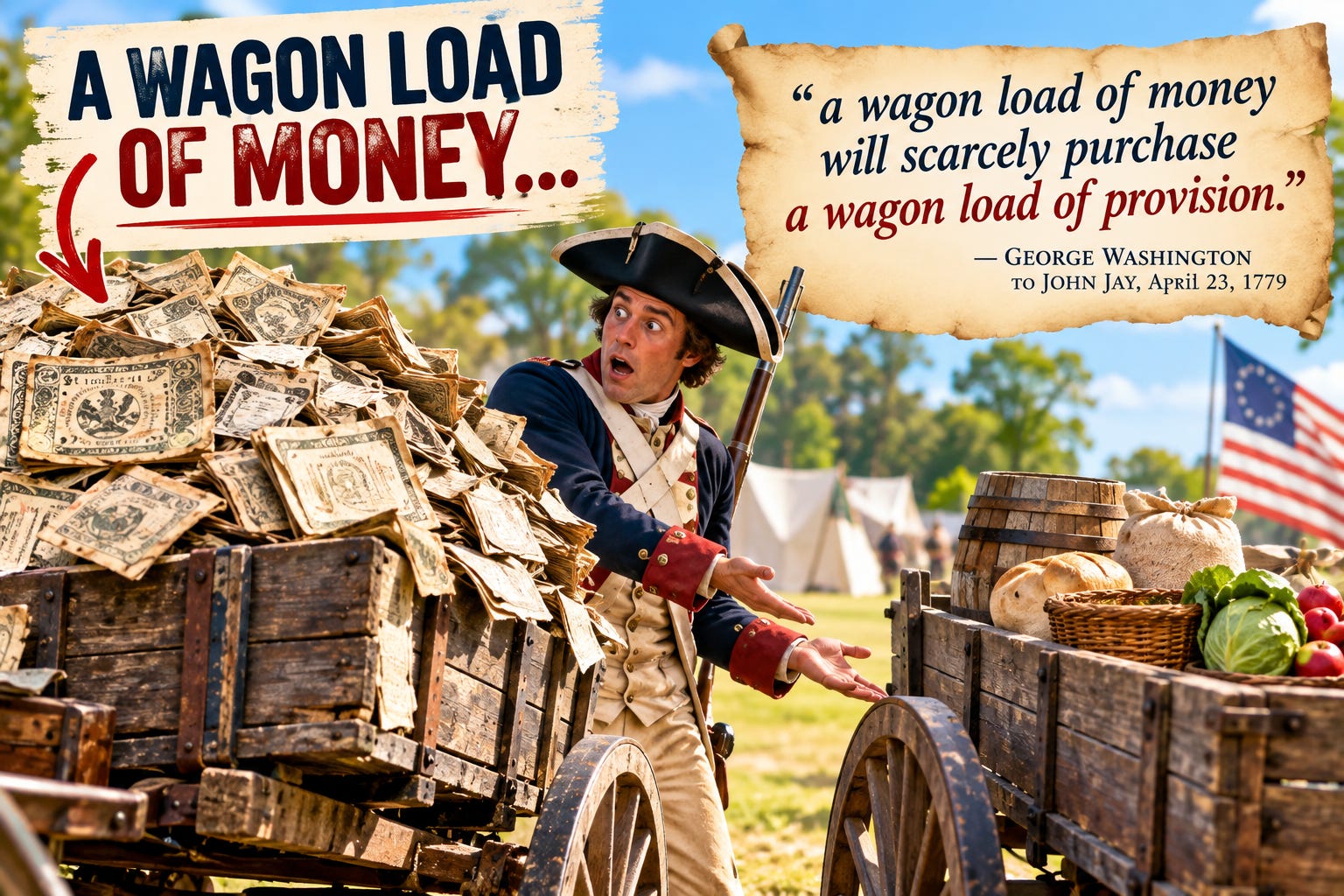
During the Revolutionary War, the Continental Congress issued enormous quantities of paper currency—the Continental—to finance the war.
As more money entered circulation and confidence in it deteriorated, its value collapsed.
By April 1779, George Washington wrote to John Jay that the depreciation had become so severe that:
“a wagon load of money will scarcely purchase a wagon load of provision.”
Think about that.
Imagine being paid for your work and watching the money you earned lose its purchasing power before you could even use it.
That wasn’t theoretical for the men fighting the Revolution.
That same year, soldiers from four Massachusetts battalions petitioned their government because depreciation had consumed roughly seven-eighths of their pay.
They were literally fighting for American independence while the money they were being paid was becoming nearly worthless.
That’s where the expression “not worth a Continental” came from.
Suddenly that little sentence in Article I starts to make a lot more sense.
Then I Found the Coinage Act
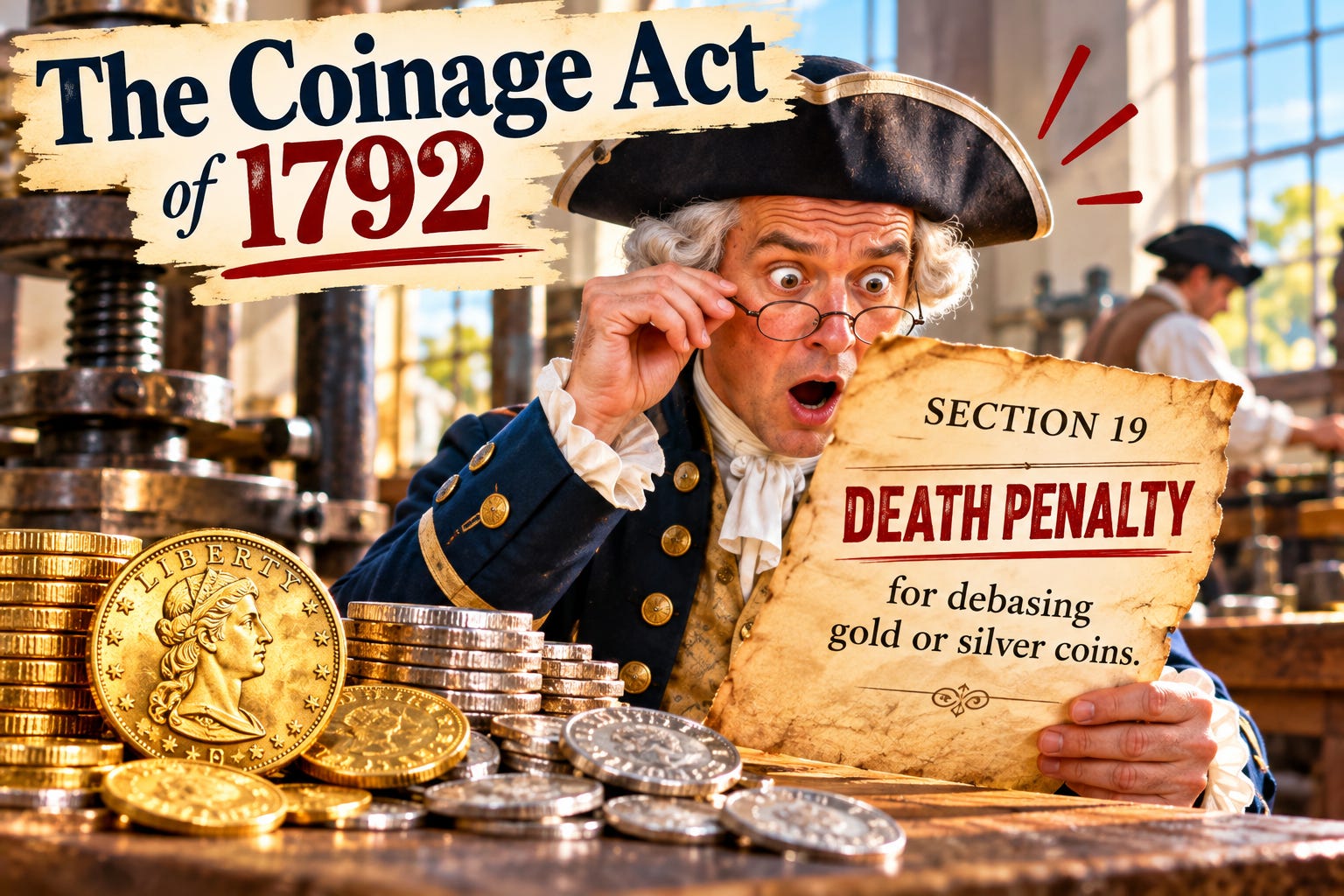
In 1792, just a few years after the Constitution was ratified, Congress passed the Coinage Act.
It established the United States Mint and authorized gold and silver coins.
But Section 19 caught my attention.
The law provided that if certain Mint employees fraudulently debased the coins—essentially diminishing the precious metal they were supposed to contain—they could face the death penalty.
Okay.
Stop there for a second.
I had to read that twice.
They took the integrity of the nation’s money that seriously.
Why?
I think their recent experience gives us at least part of the answer.
They understood what happened when people worked, sacrificed and saved only to discover that the money they possessed no longer represented what they thought it did.
And that’s where this stopped being just an interesting history lesson for me.
What Exactly IS Money?
I have a confession.
For most of my adult life, I didn’t spend much time thinking about that question.
I earned money, spent money, and saved some money.
But I never really stopped to ask:
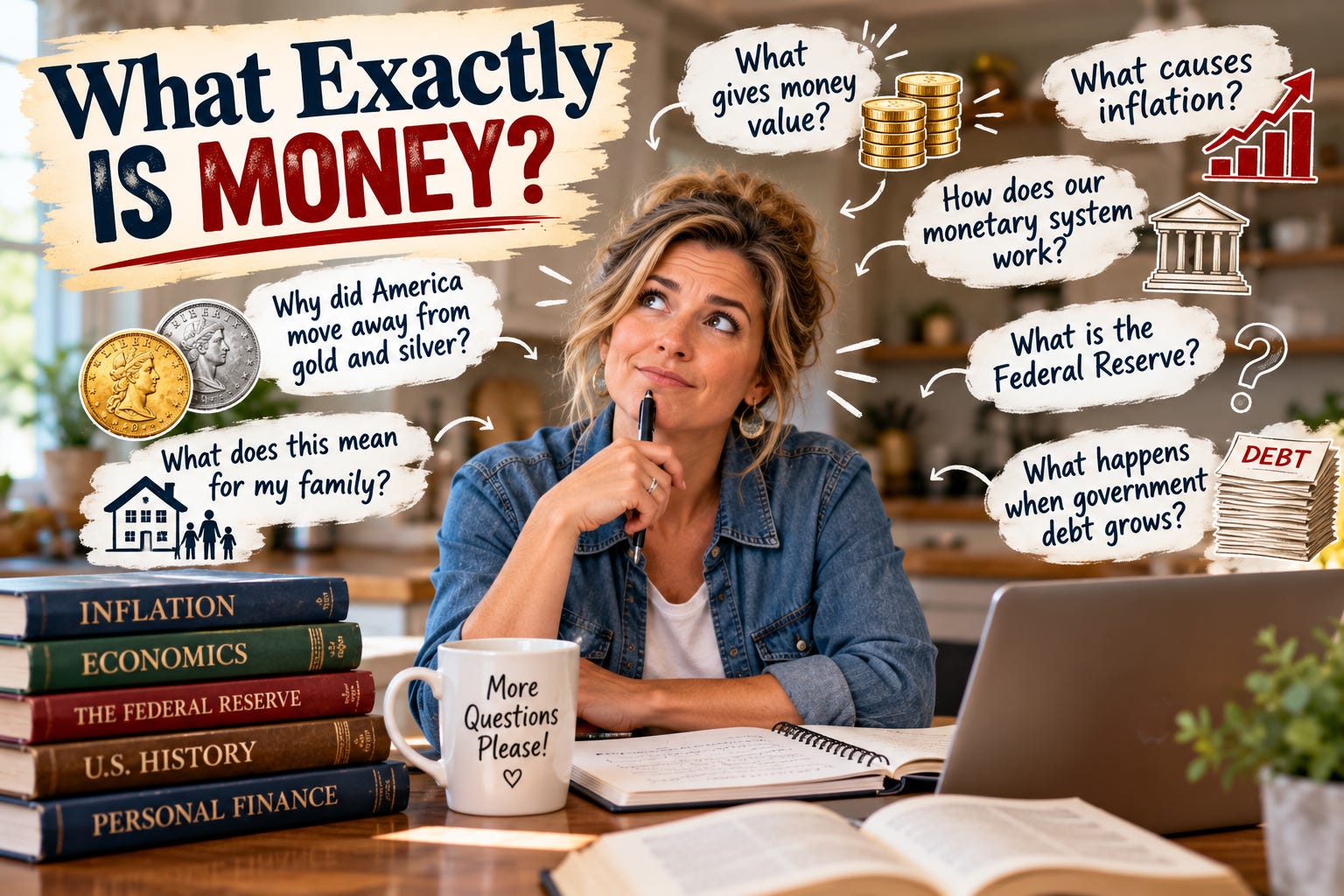
What actually gives money value?
What causes it to lose purchasing power?
What is inflation?
How does our monetary system work?
What is the Federal Reserve?
Why did America move away from gold and silver?
What happens when government debt continues growing?
And what does any of this mean for an ordinary family sitting around the kitchen table trying to save for retirement, send kids to college or someday buy a house?
Then 2020 happened.
And apparently I decided I needed to start questioning EVERYTHING.
The more I’ve learned about our founding, government and economics, the more I’ve realized how much I didn’t know.
And lately I’ve been thinking about this from another angle too.
What Are We Teaching the Next Generation?

I spend quite a bit of time around young people these days, and this is something I think we need to take seriously.
Young Americans aren’t imagining the financial pressures they’re facing.
A 2026 Pew Research Center survey found that 89% of adults under 40 believe buying a home is harder for young adults today than it was for their parents’ generation.
Federal Reserve data tell another part of the story. In 2025, nearly half of Americans under 30 were living with a parent, and 47% of adults ages 18–29 received financial help from someone outside their household to cover at least one expense.
Housing is expensive.
Groceries are expensive.
College is expensive.
Starting a family can feel overwhelming.
And when you’re 22 years old, working hard, doing what everyone told you to do, and still looking at the possibility that you may never be able to afford the life your parents had, frustration is understandable.
We shouldn’t dismiss that.
But here’s where I think we have a responsibility to go deeper.
When the System Feels Broken
We’ve also watched younger Americans become increasingly skeptical of capitalism and more open to ideas like socialism and democratic socialism.
The 2025 Harvard Youth Poll found that only 39% of Americans ages 18–29 expressed support for capitalism. Twenty-one percent supported socialism and 29% supported democratic socialism.
Interestingly, attitudes also differed according to financial circumstances. Young people who described themselves as financially struggling were less supportive of capitalism and somewhat more supportive of socialism and democratic socialism than young people who said they were doing well financially.
That doesn’t prove financial hardship causes someone to embrace socialism.
But I do think it should make us ask some questions.
Because if a generation doesn’t understand why everything has become so expensive, it’s awfully easy to conclude that the entire economic system has failed them.
And if we never teach them how money works, how inflation works, how debt works, how markets work, how government policy affects prices, how wealth is created, and how saving and investing work...
someone else will give them an explanation.
That’s why I think financial literacy is becoming a citizenship issue.
We shouldn’t simply tell young Americans, “Socialism is bad.”
We should be able to explain economics.
We should be able to acknowledge the very real financial challenges they’re facing while helping them understand the different ideas being offered as solutions—and the tradeoffs that come with them.
Education matters.
Which brings me all the way back to that little clause in the Constitution.

Article I, Section 10 doesn’t tell us how to structure our retirement accounts in 2026.
It doesn’t tell us to buy gold.
And our modern monetary system is obviously very different from the one the Founders lived under.
But that clause made me curious.
Why did they specifically mention gold and silver?
Why were they so concerned about the integrity of money?
What had they experienced that made this important enough to put into the Constitution?
And perhaps most importantly:
What can their experience teach us today?
Those questions have led me into another whole area of learning.
And one of the things I’ve started studying more seriously is precious metals.
Why I’ve Been Learning About Gold and Silver
I’ve told you guys before that I’m not a financial expert.
I’m learning.
And I’m certainly not going to pretend that buying gold or silver is some magic solution to America’s economic problems.
It isn’t.
Metals prices can rise and fall just like other assets, and every family has different financial circumstances and goals.
But I am interested in understanding tangible assets and why people have used gold and silver as stores of value for thousands of years.
I’m interested in understanding what role—if any—they should play in a family’s overall financial picture.
And I’m interested in becoming much more financially literate myself so I can help my own kids understand these things better than I did at their age.
That’s part of the reason I chose to partner with Revelation Gold Group as a sponsor of this Substack.
I wasn’t interested in simply putting advertisements at the bottom of my articles for companies I knew nothing about.
I wanted partners connected to things I’m genuinely interested in learning about and willing to explore alongside you.
Some people use precious metals as part of a retirement strategy, including certain self-directed retirement accounts. Others simply purchase physical gold or silver directly.
I’m still learning about all of it.
And if this article just sent you down the same rabbit hole it sent me down, Revelation has put together a free guide that can help you start learning too.
A conversation doesn’t obligate you to buy anything.
Read.
Ask questions.
Do your homework.
Understand the risks and the benefits.
Then make your own decision about what makes sense for your family.
Of course, none of this is individual financial advice, and precious-metals prices can move in both directions.
One Little Clause
That’s one of the things I love most about studying the Constitution.
You can read the same document over and over and suddenly stumble across one sentence that sends you into an entirely new area of American history.
Article I, Section 10 did that for me.
It reminded me that the Constitution wasn’t written by men sitting around imagining hypothetical problems.
They had lived through war.
Inflation.
Worthless currency.
Unpaid soldiers.
Economic instability.
Their experiences shaped what they wrote.
And more than two centuries later, I think those experiences are still worth understanding.
Maybe one of the best things we can do for the next generation isn’t simply tell them which economic system to support.
Maybe we need to teach them enough about money, history and economics that they can understand the choices for themselves.
So don’t take my word for any of this.
Go read it.
Study it.
Ask questions.
Follow the rabbit hole.
You never know where one little clause in the Constitution might lead you.
Duty is ours. Results are God’s.