Over the last week, Americans have once again found themselves arguing over election results.
This time, the controversy centers around California, where Spencer Pratt’s LA mayoral campaign became an unexpected case study in election confidence.
On election night, Pratt appeared likely to advance to the general election. Days later, as additional ballots continued to be counted and reported, that lead began to evaporate.
For many Californians, the experience was confusing.
The issue isn’t simply whether Pratt will ultimately win or lose.
The issue is that most people have no idea why the numbers are changing, where the newly counted ballots are coming from, how they are being verified, or how long the counting process will continue.
And when citizens can’t explain what’s happening, confidence inevitably suffers.
That’s why the real story isn’t Spencer Pratt.
The real story is transparency.
Most Americans—including many election officials, poll watchers, candidates, journalists, and activists—cannot clearly explain how votes travel from the polling place to the election-night numbers displayed on television.
And that’s a problem.
A Simple Question
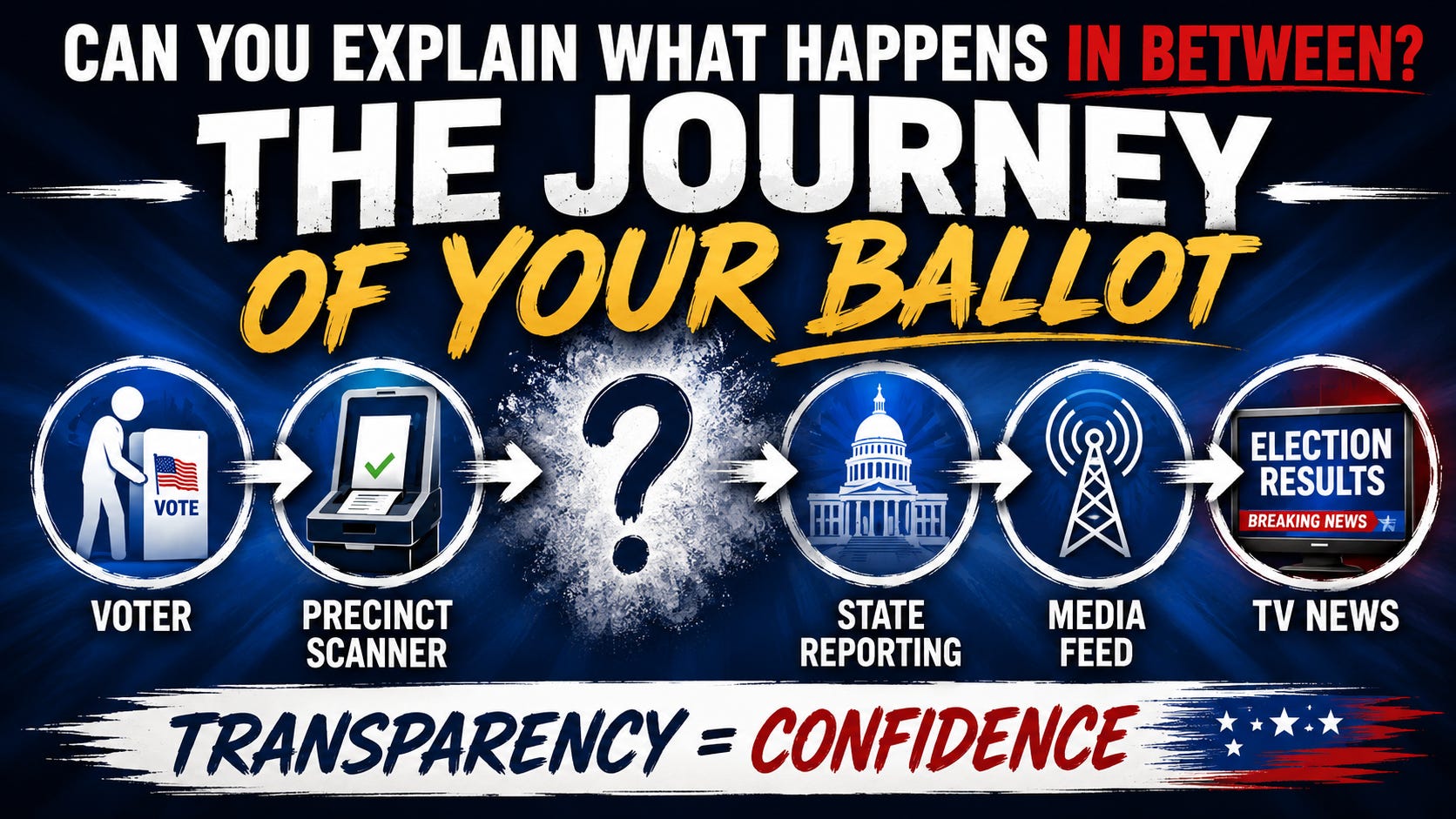
Imagine a voter walks into their precinct on Election Day.
They sign in.
They cast their ballot.
The scanner accepts it.
Now what?
Where does that vote go?
How does it get added to the county total?
How does the county total reach the state?
How does the state total reach the media?
Who transmits the data?
What software is involved?
What reports are generated?
What safeguards exist?
Who verifies the numbers?
How many Americans could answer those questions with confidence?
Not many.
Yet we’re expected to trust a process that most citizens can’t even describe.
The Pennsylvania Mystery
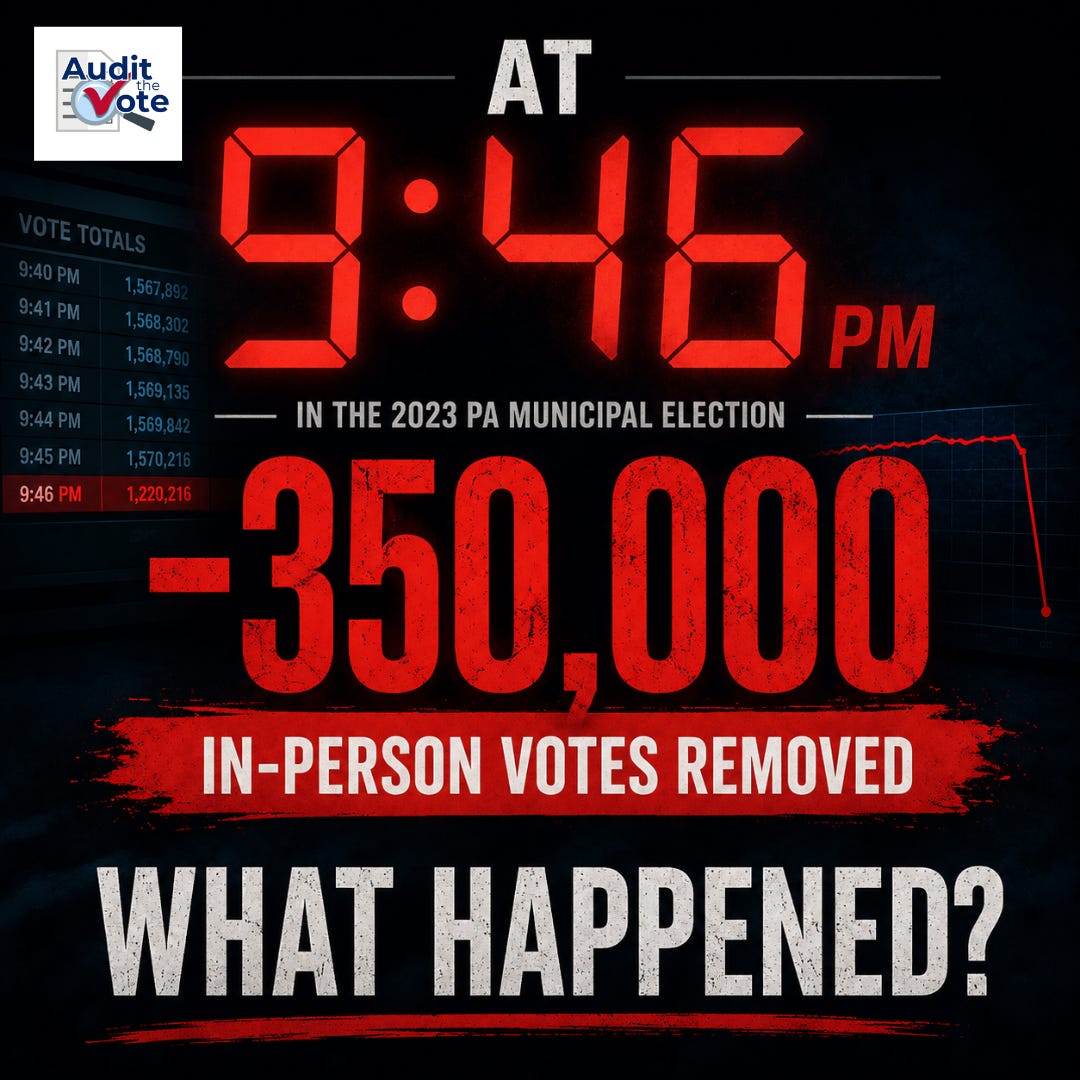
Back in Pennsylvania’s 2023 municipal election, Audit The Vote PA observed and documented something that perfectly illustrates the problem.
At approximately 9:46 PM, Republican Supreme Court candidate Carolyn Carluccio’s reported total suddenly dropped by more than 350,000 in-person votes.
What You're About to Watch:
Before going any further, take a look at this short video made by Audit The Vote PA’s data guru, Vico Bertogli.
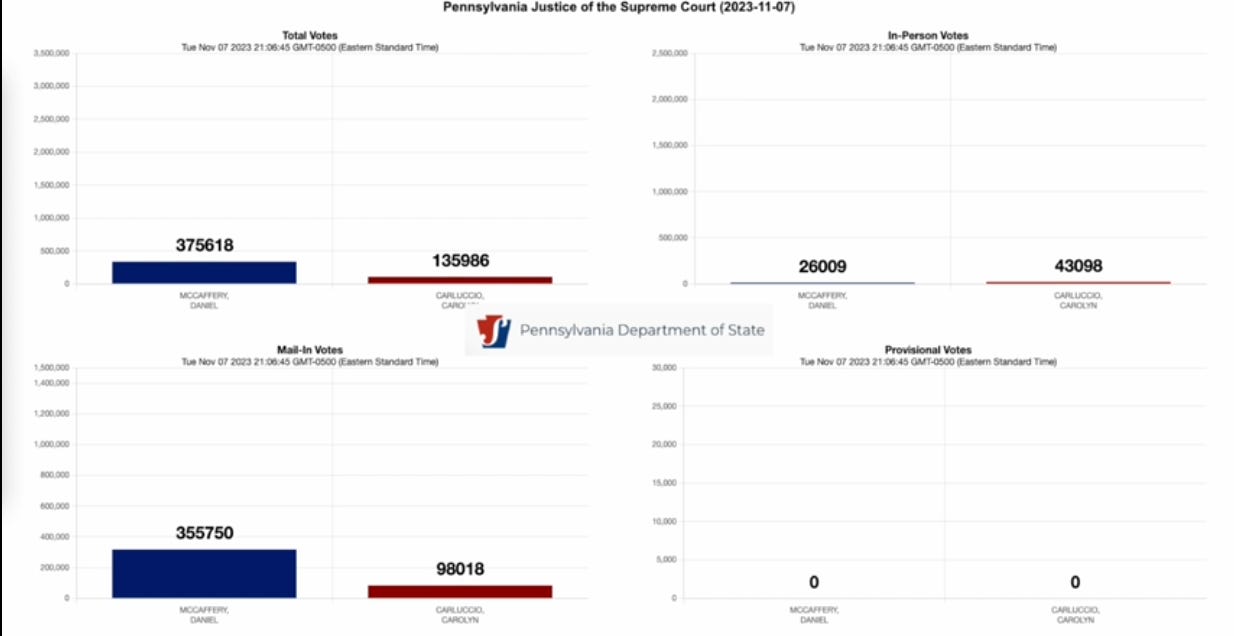
At first glance, the video can be confusing, so let me explain what you're seeing.
The screen is divided into four quadrants:
Top Left: Total votes reported
Top Right: In-person Election Day votes
Bottom Left: Mail-in votes
Bottom Right: Provisional votes
In Pennsylvania, these categories are reported separately because they are counted separately.
Mail-in ballots are processed independently from Election Day ballots.
Provisional ballots are reviewed and counted after Election Day but before certification.
As a result, watching these categories separately can help observers understand how vote totals change throughout the evening.
Now watch the top-right quadrant closely.
That's the in-person vote total.
At approximately 9:46 PM, the Republican Supreme Court candidate's in-person vote total suddenly drops by more than 350,000 votes.
The impact is easy to miss because the numbers are changing so quickly and you’re not looking at total votes. You are actually looking at one specific category of votes… the in-person count.
The important point isn't simply that the number changed.
The important point is that the public has no way to independently determine why it changed.
Was it a reporting error?
A data correction?
A file replacement?
A tabulation issue?
A media reporting problem?
An aggregation issue somewhere between the county and the state?
No one—including many people deeply involved in elections—can tell you.
Therein lies the transparency problem.
Election reporting systems can contain errors. Data can be corrected. Files can be updated.
The real question was:
Why did it happen?
And perhaps more importantly:
Who could explain it?
When citizens, namely Audit The Vote PA volunteers, asked for a straightforward explanation, they encountered a maze of agencies, vendors, election officials, media organizations, and reporting systems.
Very few people seemed capable of tracing the exact path of the data from beginning to end.
That should concern everyone.
Trust Requires Understanding
One of the most frustrating realities in election administration is that Americans are constantly told to trust the process.
But trust isn’t created by demanding confidence.
Trust is earned through transparency.
When people understand a process, they are far more likely to trust it.
When they don’t understand it, suspicion naturally grows.
That principle applies everywhere.
We wouldn’t accept a bank that couldn’t explain how money moves between accounts.
We wouldn’t accept an accountant who couldn’t explain where numbers came from.
We wouldn’t accept a business that refused to show its books.
Yet when it comes to elections, citizens are often told that asking questions is itself evidence of bad intentions.
That’s backwards.
Questions are how confidence is built.
California’s Current Lesson
The controversy unfolding in California demonstrates exactly why transparency matters.
Some observers have pointed to strange-looking reporting updates and questioned whether the numbers make sense.
In at least one highly publicized case, election data displayed by media outlets appeared to show one candidate receiving no votes during a reporting update. Later explanations suggested the issue involved how vote batches were transmitted and displayed by media reporting systems rather than the votes themselves.
Whether one accepts that explanation or not isn’t really the point.
The point is that very few citizens understand the chain of custody for election reporting data.
Most people don’t know where the numbers originate.
Most people don’t know who aggregates them.
Most people don’t know how they are transmitted.
Most people don’t know who verifies them.
And because they don’t know, every unusual reporting event creates confusion.
The Reform Nobody Should Oppose
After spending years working in election integrity, people often ask me what reform I think would have the biggest impact.
My answer might surprise them.
TRANSPARENCY.
Not more talking points.
Not more press releases.
Not more demands that people simply trust experts.
TRANSPARENCY.
Show the public exactly how results move from precincts to counties.
Show the public how counties report to the state.
Show the public how media organizations receive election-night results.
Show the public the systems, reports, audits, procedures, and safeguards.
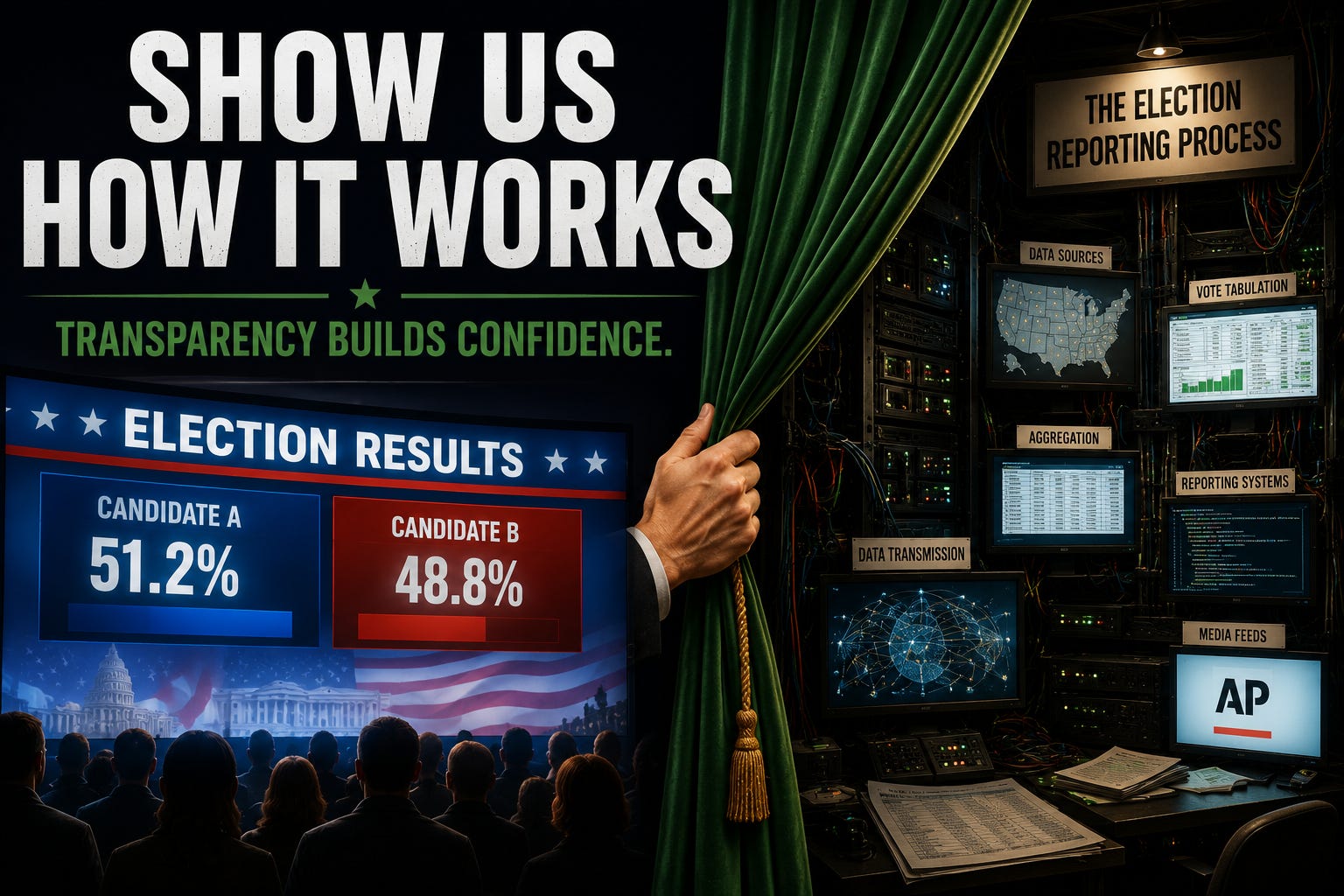
Create a process so transparent that an ordinary citizen can follow the journey of a vote from the scanner at their precinct all the way to the numbers displayed on their television.
If the process is sound, transparency will strengthen confidence.
If the process contains weaknesses, transparency will expose them so they can be fixed.
Either outcome benefits the republic.
Sunshine Builds Trust
The greatest threat to election confidence isn’t necessarily fraud.
It’s mystery.
A healthy Republic doesn’t require blind faith from its citizens.
It should provide enough transparency that ordinary Americans can understand how their elections work.
Until we can clearly explain how votes travel from the precinct to the headline, millions of Americans will continue asking questions.
And honestly?
They should.