


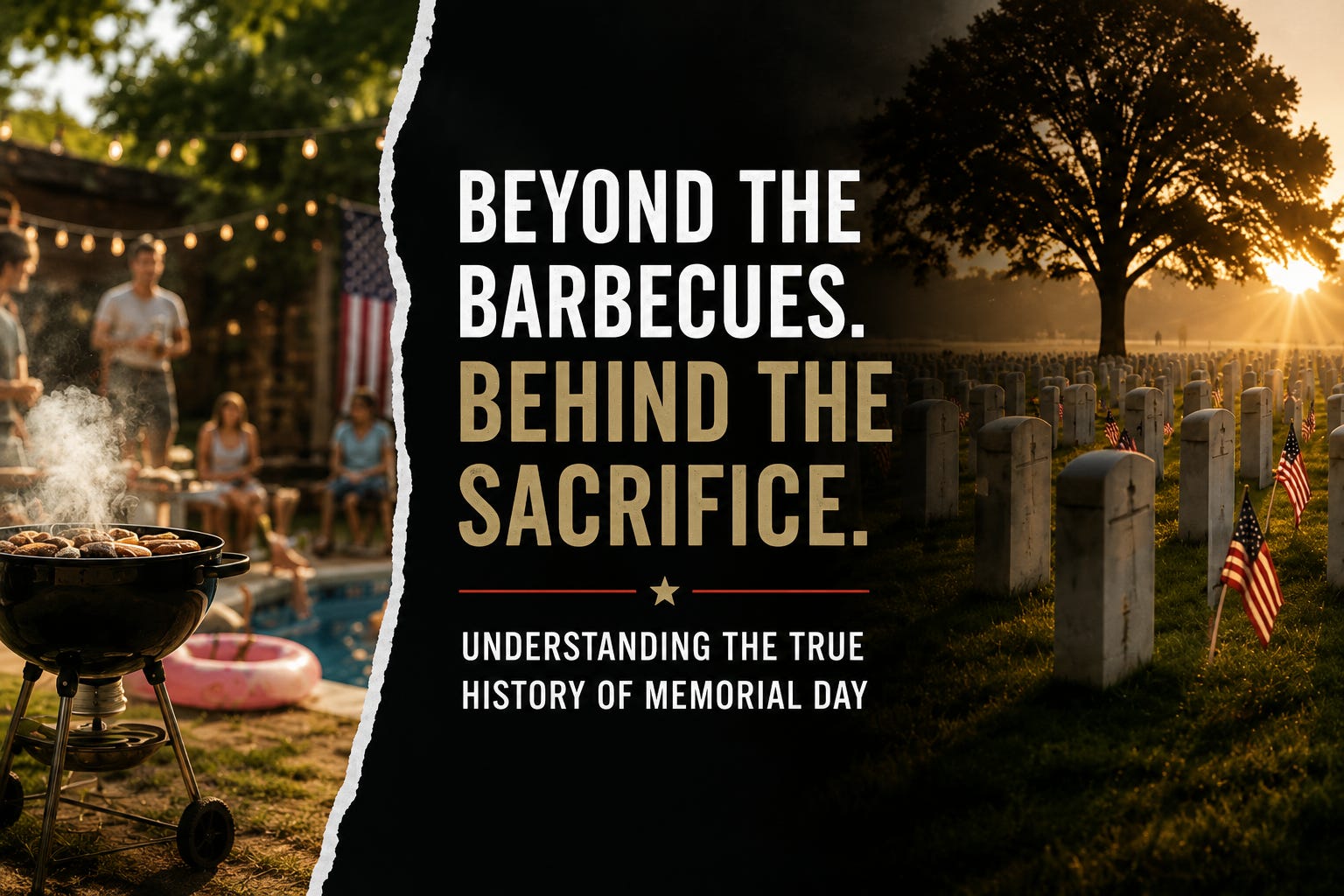
Every year, Memorial Day arrives with cookouts, parades, pool openings, and mattress sales.
Most Americans know the basic idea behind the holiday:
We honor those who died serving our country in war.
But far fewer people know why Memorial Day exists…
or how deeply connected it is to the story of America itself.
And honestly, I think that matters.
Because one of the greatest lessons I’ve learned over the last six years is this:
If we do not understand the past, we become incredibly easy to manipulate in the present.
People who do not know history are often forced to interpret current events through emotion, headlines, slogans, or political narratives instead of through wisdom and perspective.
That’s dangerous.
Understanding history gives context.
It sharpens discernment.
It helps us recognize propaganda.
And it reminds us that freedom has never been free.
That’s part of why Memorial Day matters so much.
The Origins of Memorial Day
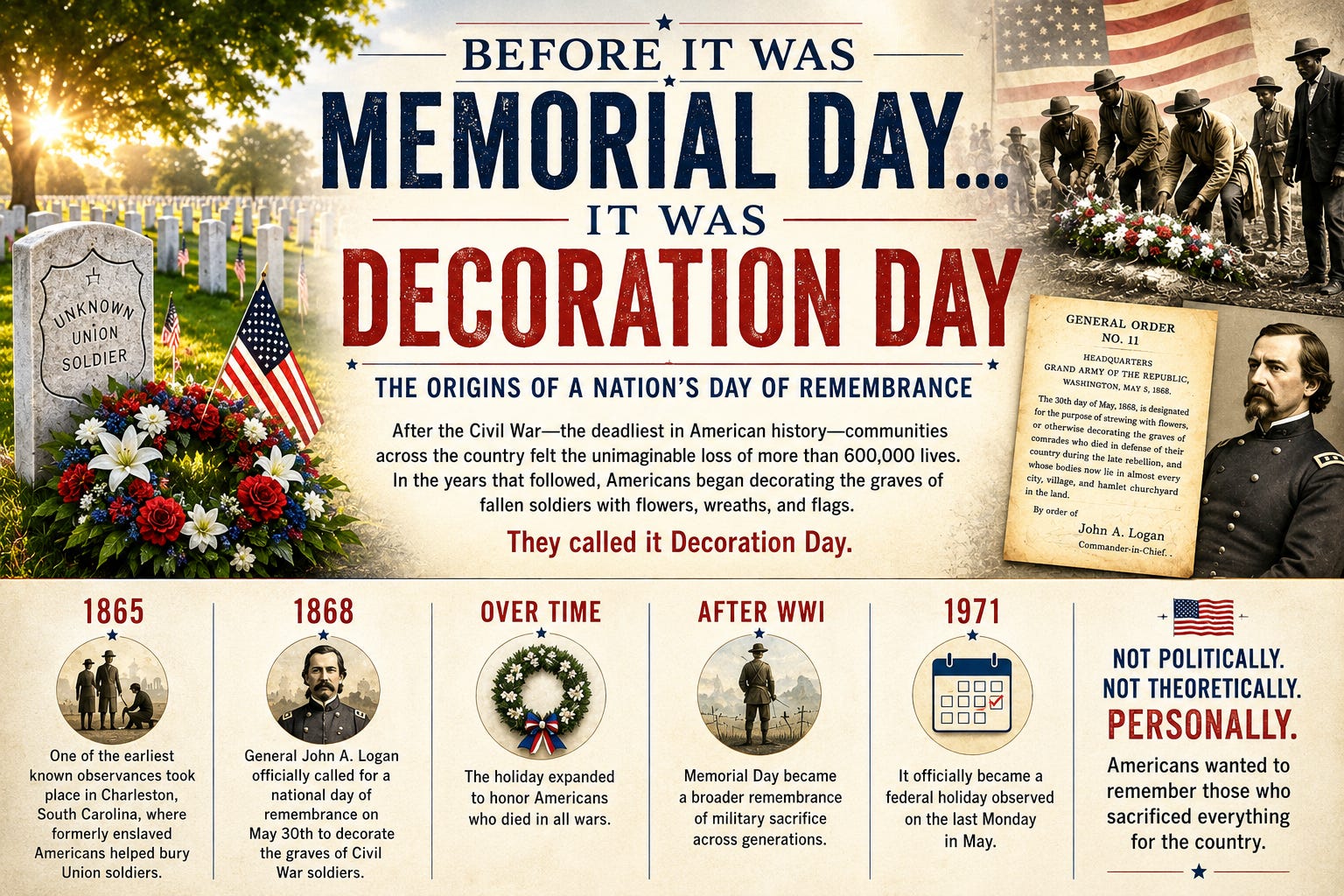
Memorial Day did not originally start as a federal holiday.
After the Civil War — the deadliest war in American history — communities across the country began holding tributes for fallen soldiers.
The Civil War claimed more than 600,000 American lives.
Families were shattered.
Towns were devastated.
The nation itself was deeply fractured.
People desperately needed a way to grieve.
In the years following the war, citizens began decorating the graves of soldiers with flowers, wreaths, and flags.
That’s actually where the original name came from:
Decoration Day.
One of the earliest known observances took place in Charleston, South Carolina in 1865, where formerly enslaved Americans helped properly bury Union soldiers who had died in a Confederate prison camp.
Other communities across the country held similar tributes around the same time.
There is still debate today over which town held the “first” Memorial Day observance, but what matters most is why people did it.
Americans wanted to remember those who sacrificed everything for the country.
Not theoretically.
Not politically.
Personally.
By 1868, General John A. Logan officially called for a national day of remembrance on May 30th, specifically to decorate the graves of Civil War soldiers.
Over time, the holiday expanded to honor Americans who died in all wars.
After World War I especially, Memorial Day became a broader remembrance of military sacrifice across generations.
In 1971, it officially became a federal holiday observed on the last Monday in May.
A Nation That Forgets Sacrifice Eventually Loses Perspective
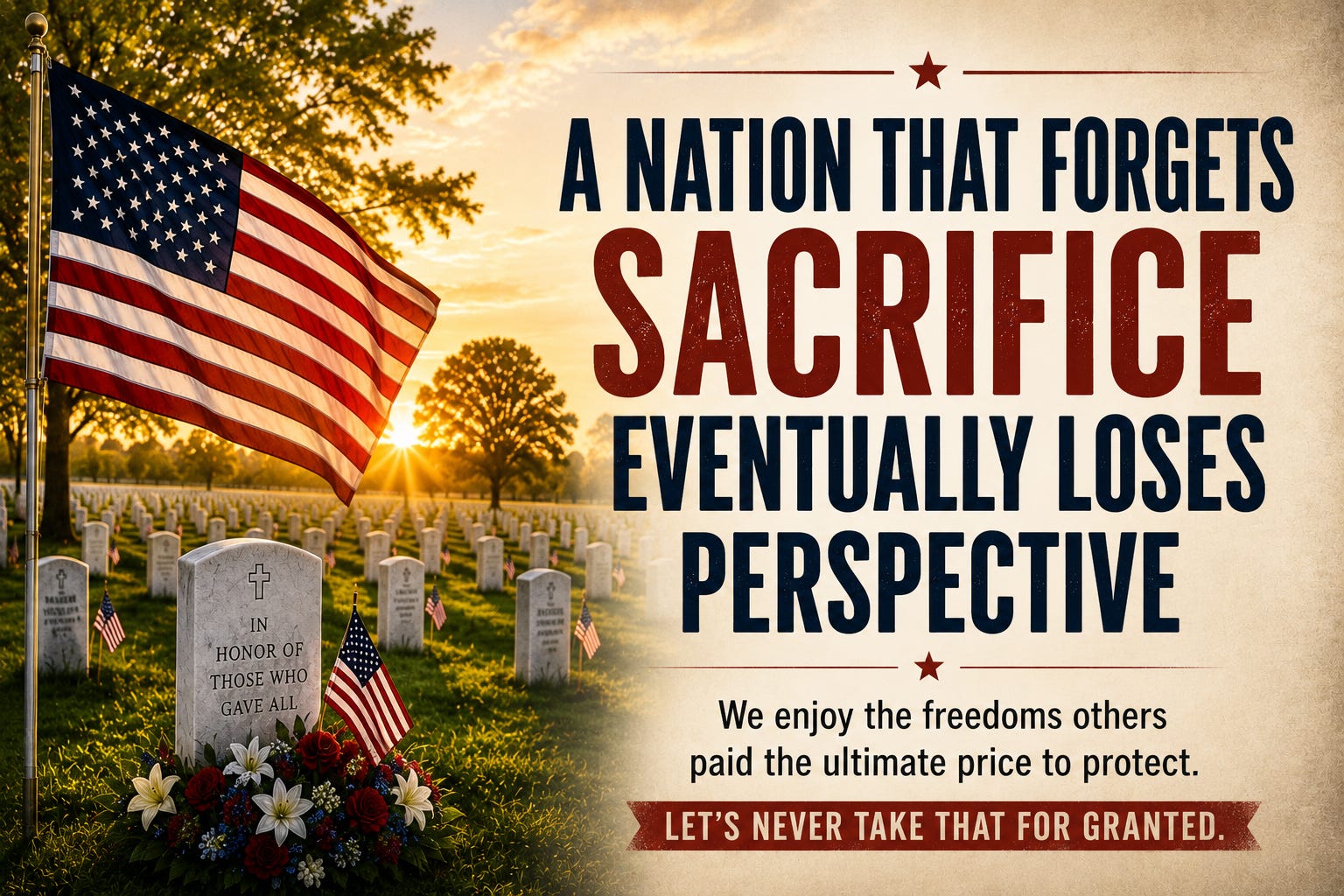
One thing I’ve noticed in modern America is that we often enjoy the benefits of freedom without stopping to think about the cost.
We inherited a country built by generations willing to sacrifice their comfort, their livelihoods, their reputations, and sometimes their lives.
And the farther we get removed from hardship and sacrifice, the easier it becomes to take liberty for granted.
That’s not criticism.
It’s just human nature.
But history helps correct that.
When you study the past, you realize America has endured incredibly difficult seasons before. We’ve had war, division, and economic collapse. We’ve seen political corruption and foreign threats… internal battles and cultural upheaval.
Yet generation after generation rose to meet those moments.
Not because they were perfect.
But because ordinary people chose duty over comfort.
That perspective is incredibly grounding in today’s political climate.
Why Historical Understanding Matters Today
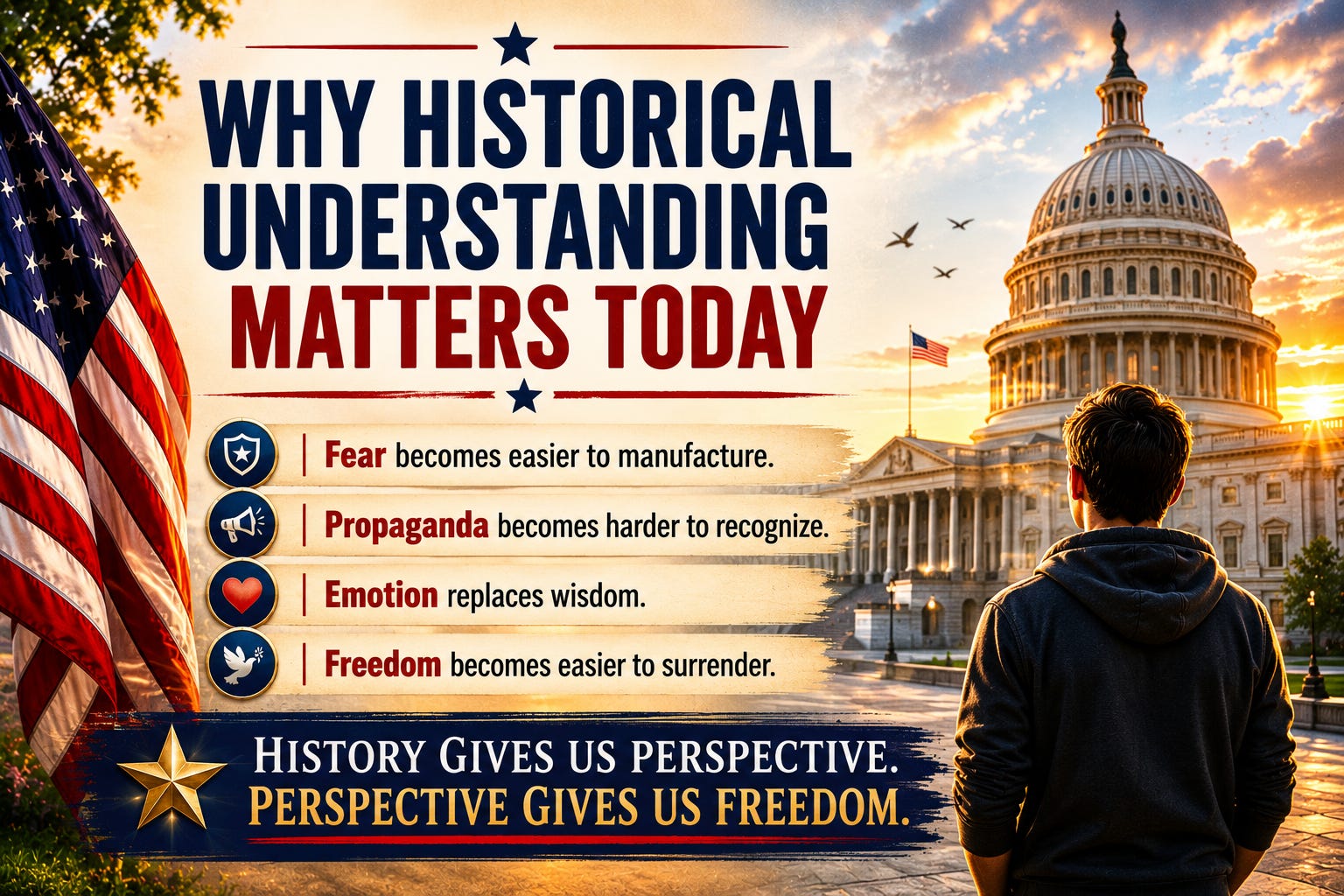
One of the reasons I spend so much time teaching history, civics, and the Constitution is because understanding the past helps us interpret the present more wisely.
Without historical context:
fear becomes easier to manufacture
propaganda becomes harder to recognize
emotional manipulation becomes more effective
and people become more willing to surrender freedom for the promise of safety or comfort
History gives us reference points.
It reminds us that media narratives are not new.
Political division is not new.
Corruption is not new.
Foreign conflicts are not new.
Government overreach is not new.
Neither is courage.
Neither is faith.
Neither is the power of ordinary people deciding to stand up locally and lead within their own communities.
That’s why I often say:
Education is key, and the fix is local.
Because preserving liberty requires an informed citizenry.
The Founders understood that.
And frankly, many Americans throughout history understood that better than we do today.
Memorial Day Should Challenge Us

I think Memorial Day should be more than a day off work.
It should challenge us to ask difficult questions:
Are we being good stewards of the freedom others died to preserve?
Are we educating the next generation well?
Do we understand the principles that hold a constitutional republic together?
Are we honoring sacrifice merely with words, or with responsible citizenship?
And maybe most importantly:
Will our children inherit a stronger republic because we were here?
That question matters.
Because every generation eventually faces its own defining moments.
Our grandparents faced World War II.
Our parents faced Vietnam.
We faced 9/11 and COVID.
And the next generation will face its own tests too.
When those moments come, emotional reactions alone will not be enough.
We need wisdom, discernment, and historical perspective.
We need strong local communities, faith, leadership, and courage.
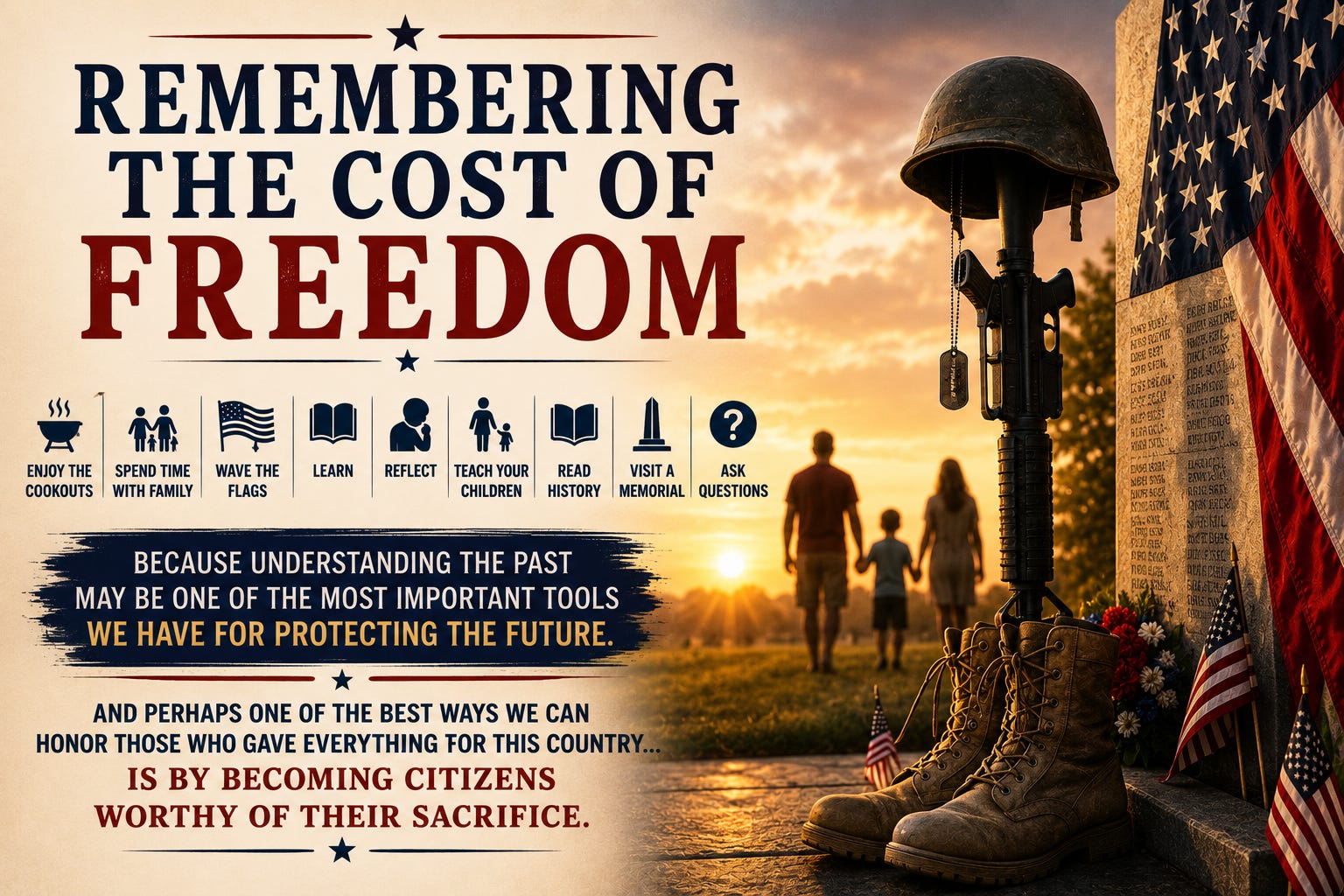
Remembering the Cost of Freedom
This Memorial Day, I hope we remember the fallen.
But I also hope we remember why remembering matters.
A nation disconnected from its history becomes vulnerable.
A nation that forgets sacrifice loses gratitude.
And a people who no longer understand liberty often fail to recognize when they are losing it.
So enjoy the cookouts.
Spend time with family.
Wave the flags.
But also take a moment to learn.
Reflect.
Teach your children.
Read history.
Visit a memorial.
Ask questions.
Because understanding the past may be one of the most important tools we have for protecting the future.
And perhaps one of the best ways we can honor those who gave everything for this country…
is by becoming citizens worthy of their sacrifice.