Yesterday when I picked my girls up from school, one of the first things out of my eight-year-old’s mouth was that she needed something green to wear on March 17th so she could properly celebrate St. Patrick’s Day.
She was ecstatic about the holiday.
The only problem?
She had absolutely no idea what it was actually about.
Now, when your kids spring something like this on you with less than 24 hours to prepare, what do moms do best?
In our house, we phone a friend… and in this case that friend was Daddy.
Thankfully, my husband came to the rescue and agreed to take my little monkeys to the dollar store that evening to pick up some St. Patrick’s Day paraphernalia. My day was already packed, and I simply didn’t have the bandwidth for one more unexpected errand.
But once that crisis was averted, the real fun began.
The kids started peppering me with questions.
Who was St. Patrick?
Why do we wear green?
What does the shamrock mean?
And I realized something slightly embarrassing.
I didn’t have very good answers.
So, I did what I always do when curiosity strikes…
I started digging.
And that’s how this article was born.
As I started reading about the real St. Patrick, I realized something else.
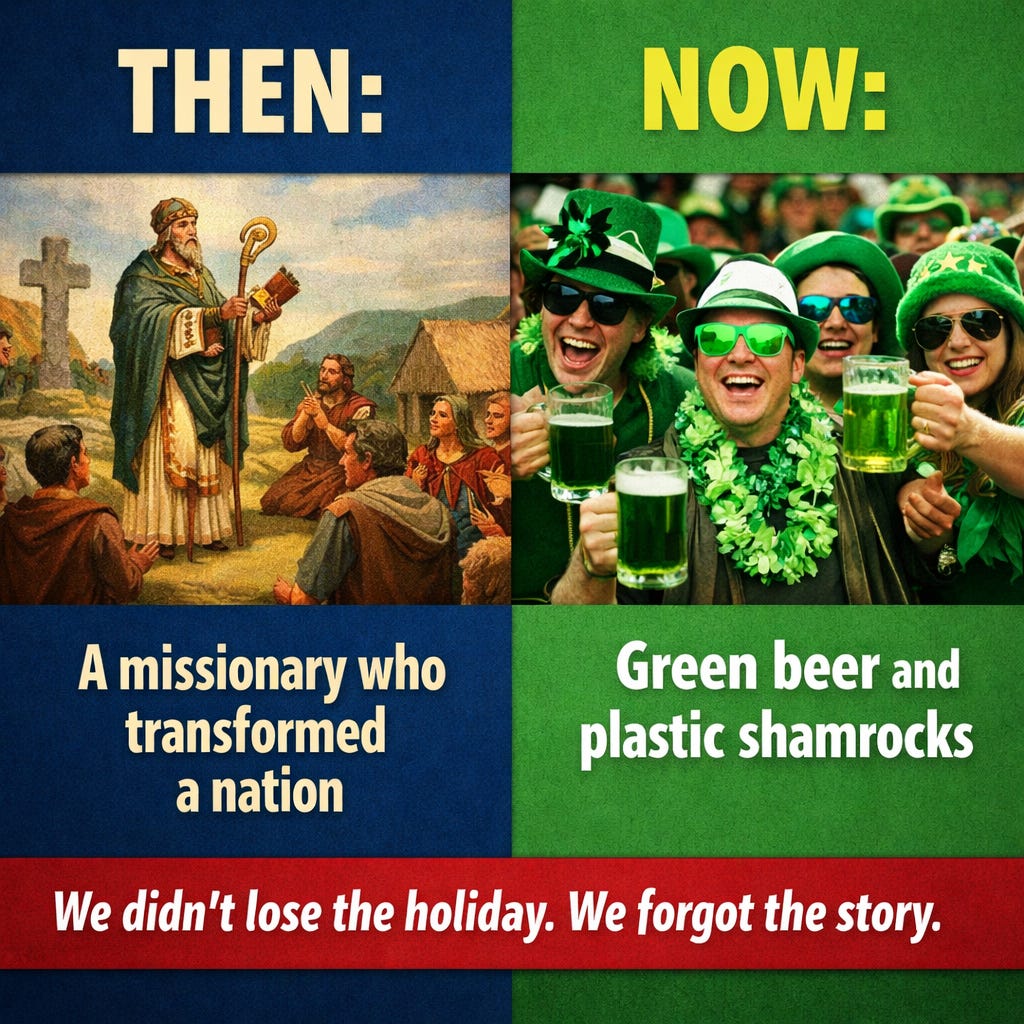
Somewhere along the way, we turned the story of a Christian missionary who transformed an entire nation… into an excuse for green decorations and drinking parties.
Which raises an uncomfortable question.
How many of the traditions we celebrate today have been stripped of their meaning simply because we stopped asking what they were originally about?
Who Was St. Patrick Actually?
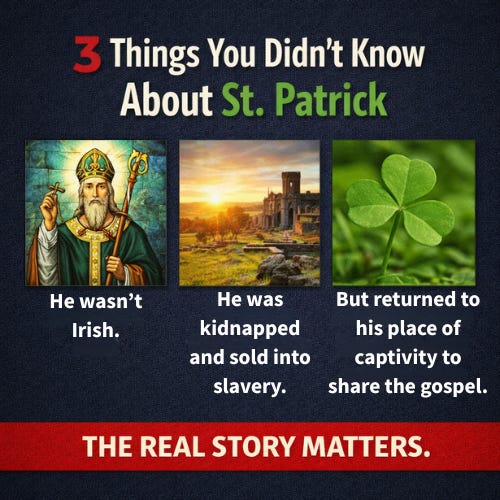
Patrick Wasn’t Irish. He was born in Roman Britain in the late 300s.
When he was about sixteen years old, Irish raiders kidnapped him and carried him across the sea where he was sold into slavery.
For six years he worked as a shepherd.
During that time, something unexpected happened.
Patrick found faith.
In his own writing, The Confession of St. Patrick, he said that during those lonely years in the fields of Ireland, he prayed constantly.
“The love of God and the fear of Him grew in me more and more.”
Eventually he escaped and made it back to Britain.
Most people would never return to the place where they had been enslaved.
Patrick did.
Years later he believed God was calling him back to Ireland — not as a slave, but as a missionary.
And he spent the rest of his life there.
The Bonfire That Defied a King
Ireland in the 400s was ruled by tribal kings and influenced heavily by Druid paganism.
One famous story tells of Patrick lighting a Paschal fire on the Hill of Slane to celebrate Easter.
The problem?
The High King of Ireland was holding a pagan festival nearby at the Hill of Tara, and no fire was supposed to be lit before the king’s ceremonial flame.
Patrick’s act was considered open defiance.
He was summoned before the king.
Instead of executing him, the encounter reportedly impressed the king enough that Patrick was allowed to continue preaching throughout Ireland.
And from that moment forward, Christianity began spreading across the island.
The Shamrock and the “Snakes”
Patrick is often credited with using the three-leaf shamrock to explain the Trinity:
Father
Son
Holy Spirit.
Another legend says he drove all the snakes out of Ireland.
Ireland likely never had snakes after the Ice Age.
Most historians believe the story is symbolic — representing Patrick confronting pagan beliefs and spreading Christianity.
But Patrick’s real legacy was something even greater.
He trained leaders.
Patrick established churches, trained clergy, and helped build Christian communities across Ireland.
Within a few generations, Ireland became one of the most vibrant centers of Christianity in Europe.
Irish monks later carried Christianity and classical learning back across the continent during the early medieval period.
In other words…
Patrick helped launch a movement that influenced Western civilization.
How Did He Become a “Saint”?
Patrick did not become a saint through the modern Catholic canonization process.
That process didn’t exist yet.
He lived in the 5th century (400s), when saints were often recognized by popular acclaim.
Because Patrick:
Converted large parts of Ireland to Christianity
Established churches and trained clergy
Became widely respected by the early Irish church
…Christians in Ireland began referring to him as “Saint Patrick” after his death around 461 AD.
Over time his reputation spread throughout the Christian world.
So he was essentially recognized as a saint by the early church community itself, not through a formal Vatican process.
What Was His Original Last Name?
Patrick didn’t really have a modern last name.
Romans used multiple names, and historians believe his birth name was:
Maewyn Succat
When he became a Christian missionary, he adopted the Latin name:
Patricius
“Patricius” means “nobleman” or “father figure.”
That Latin name eventually became Patrick in English.
So How Did We End Up With Green Beer?
Here’s the uncomfortable truth.
Most people celebrating St. Patrick’s Day today have no idea who Patrick was.
A day that once commemorated a missionary who brought Christianity to Ireland has largely become an excuse for partying and drinking.
And that should make us pause for a moment.
Because when a culture forgets the meaning behind its traditions, it becomes easy to replace truth with entertainment.
Or worse…
To turn something that once celebrated faith into something that distracts from it.
The enemy doesn’t always destroy truth by attacking it directly.
Sometimes he simply buries it under ignorance, noise, and distraction.
And before long, people are wearing shamrocks without knowing what the shamrock meant.
This Is Exactly Why I Started the Remnant Report
One of the reasons I’m launching my new podcast, Remnant Report, is because of moments like this.
Our culture is losing the stories that shaped it.
Not because those stories aren’t powerful.
But because too few people are telling them.
History is filled with men and women who stood for truth, faith, and courage — and their stories deserve to be remembered.
When we recover those stories, something important happens.
We start to remember who we are.
So maybe this year we celebrate St. Patrick’s Day a little differently.
Yes, enjoy the Irish music.
Wear the green if you want.
But maybe take a moment to remember the real story of the man behind the holiday.
A kidnapped shepherd who returned to the land of his captivity to preach the Gospel.
Not bad for the patron saint of green beer.
And if you’re interested in exploring more stories like this — stories that shaped our civilization but are often forgotten today — that’s exactly what we’ll be doing on Remnant Report.
Because if we want to rebuild culture…
We have to start by telling the truth about history again.