


If you’ve ever done a Costco run with kids, you know the drill.
Giant cart. Paper towels. Rotisserie chicken. At least one thing you didn’t plan to buy.
Well, apparently there’s a new thing.
Silver bars.
Not silver jewelry. Not silverware. Actual bars of silver, sold under Costco’s own Kirkland Signature brand.
I had to read that twice.
During Costco’s September 24 quarterly earnings call, chief financial officer Gary Millerchip rattled off some of the company’s new Kirkland Signature products.
Matcha green tea powder. Pretzel sandwiches. Ultra-filtered 2% milk.
And one-ounce silver bars.
One of these things is not like the others. 😂
Naturally, I went looking.
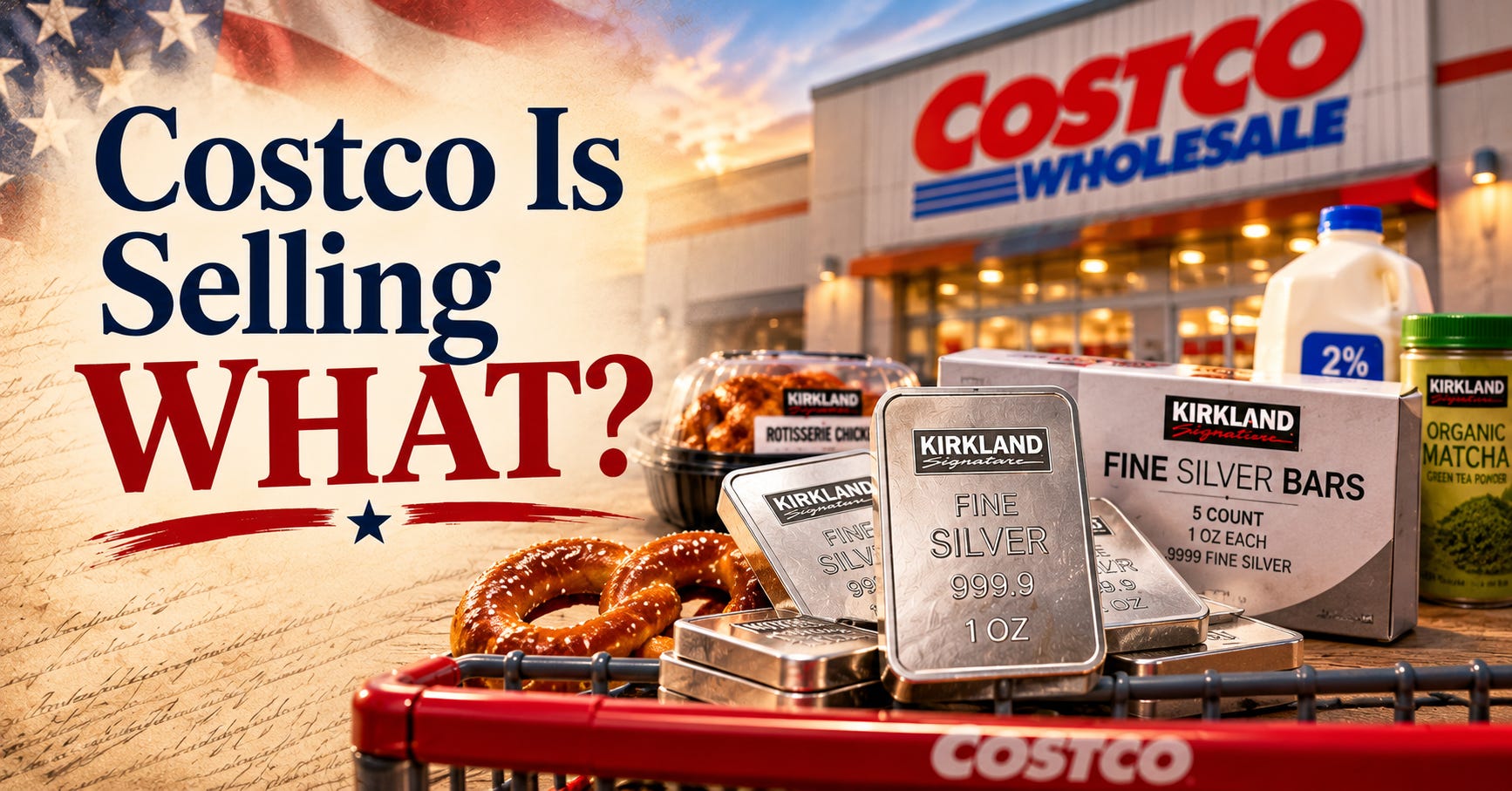
The Kirkland Signature silver bars are listed on Costco’s website in five-packs, each containing five one-ounce bars of .9999 fine silver.
They’re sold online, with purchase limits.
And this isn’t Costco’s first adventure into precious metals.
Back in 2023, the company reported selling approximately $100 million in gold bars during a single quarter. Those bars became so popular that reports described them selling out within hours.
Now Costco has put its own name on silver.
I find that fascinating.

Think about the typical Costco customer. Families buying groceries. Parents stocking up on household essentials. Small business owners buying supplies. Grandparents shopping for the next family gathering.
These aren’t necessarily people who spend their afternoons studying commodity markets.
They’re ordinary Americans.
Of course, Costco’s decision to sell silver doesn’t prove that every family is suddenly worried about the dollar. Retailers introduce products for all kinds of reasons, including customer demand and profitability.
But it does make me wonder what conversations are happening around kitchen tables across America.
Are people thinking differently about savings? Are they looking for alternatives to traditional investments? Are they simply curious about owning something tangible?
And what does it say about our financial culture that precious metals are now being sold alongside pretzels and paper towels?
While I’ve been exploring Costco’s newest product line, I also watched the October 7 debate between Pennsylvania Governor Josh Shapiro and State Treasurer Stacy Garrity.
And something about that debate kept bringing me back to the questions I’ve been asking about money.
The candidates discussed economic growth, government spending, gas taxes, healthcare, and election integrity.
All important issues.
But as I listened, I kept coming back to a more fundamental question.
What is government actually supposed to do?
Governor Shapiro repeatedly emphasized economic growth under his administration.
And every time the conversation returned to what government was doing to grow the economy, I found myself thinking about the distinction between government creating prosperity and government establishing the conditions in which prosperity can flourish.
Because I believe we’ve developed a serious education gap in this country when it comes to understanding the proper role of government.
And frankly, I think that gap is affecting nearly every political conversation we’re having.
Let me explain what I mean.
Of course, I want Pennsylvania’s economy to grow. I want businesses to thrive, families to prosper, and young people to have opportunities that allow them to build meaningful, productive lives.
But I don’t believe government’s primary responsibility is to engineer economic growth.
I believe its responsibility is to protect our God-given rights, uphold the rule of law, respect constitutional limits, and maintain the conditions in which free people can pursue opportunity.
There’s a difference.
Governments can build roads, enforce contracts, establish regulations, collect taxes, and make investments. Those decisions absolutely affect economic activity, sometimes positively and sometimes negatively.
But government doesn’t manufacture the products sitting on store shelves. It doesn’t invent every new technology, take every entrepreneurial risk, or make the millions of daily decisions that determine what people want to buy and sell.
People do that.
Businesses do that.
Entrepreneurs do that.
And I think we’ve developed a habit of looking to elected officials as though prosperity is something they dispense from the governor’s office.
Maybe we’ve forgotten that an economy isn’t a government program.
It’s millions of people making decisions, solving problems, serving customers, creating value, and exchanging goods and services.
The question I wish we’d spend more time discussing isn’t simply which governor can promise more economic growth.
It’s what government should do—and what it should leave to the people.

The debate also included a discussion about temporarily suspending Pennsylvania’s gas tax.
Stacy Garrity expressed support for suspending it, while Governor Shapiro emphasized that changing the tax would require action by the state legislature.
Let me be clear about something right up front.
I’m all for suspending the gas tax. In fact, I’d support eliminating it altogether.
Pennsylvanians are paying enough in taxes already, and I’d love to see some meaningful relief at the pump.
But here’s where the civics lesson comes in.
On the question of constitutional procedure, Shapiro is right.
Yes, I said it. Someone write down the date. 😂
The governor doesn’t get to wake up one morning and unilaterally rewrite Pennsylvania’s tax laws just because it’s a good idea.
That’s not how our system is supposed to work.
The legislature makes the laws. The executive branch carries them out. Those separate powers are an important safeguard against concentrating too much authority in one office.
And here’s the thing: I don’t want a governor I agree with exercising powers that I would object to a governor I disagree with exercising.
That’s not constitutional government. That’s just picking and choosing when the rules should apply.
But that doesn’t mean a governor’s hands are tied.
Governors can propose legislation, advocate for policy changes, negotiate with lawmakers, and use their public platforms to make the case for their priorities.
So there’s a difference between saying, “I don’t have the constitutional authority to do that by myself,” and saying, “Here’s what I’m willing to work with the legislature to accomplish.”
And frankly, I’d love to hear a serious conversation about not just suspending the gas tax for a few months, but whether Pennsylvania should eliminate it entirely—and how we would responsibly replace the transportation funding it currently provides.
Because good policy and constitutional procedure are not mutually exclusive. We should demand both.
We should know what our elected officials have the authority to do, what they don’t have the authority to do, and what they’re actually proposing to do.
Otherwise, how can we hold anyone accountable?

The debate also touched on Medicare, Medicaid, and the financial challenges surrounding healthcare.
And this is another area where I think we’ve lost sight of some pretty fundamental questions about the proper role of government.
Let me be clear. I absolutely believe we have a responsibility to care for people who are sick, struggling, elderly, disabled, or otherwise unable to care for themselves.
But I also believe we need to ask whose responsibility that is supposed to be.
Medicare and Medicaid were established in 1965, nearly two centuries after our nation’s Founding. Today, they’ve become enormous parts of our healthcare system, and millions of Americans depend on them.
But their existence raises a question that I don’t think we discuss nearly enough.
When did we begin looking to government to fulfill responsibilities that Scripture places on the Church, families, and individual believers?
Throughout the Bible, we’re instructed to care for widows, orphans, the poor, the sick, and those in need.
James 1:27 speaks of caring for orphans and widows in their distress. Acts 2 describes early believers sharing their possessions to meet one another’s needs. And in Matthew 25, Jesus speaks about feeding the hungry, welcoming strangers, and caring for the sick.
These weren’t instructions to establish a federal agency.
They were calls for God’s people to love and serve their neighbors.
And I think there’s something profoundly different about a community of believers voluntarily coming alongside a struggling family and a government program funded through compulsory taxation.
That doesn’t mean we can simply dismantle programs tomorrow and ignore the millions of people who currently depend on them. Nor does it mean churches have always done an adequate job meeting these needs.
But shouldn’t we at least be willing to ask whether we’ve gradually transferred responsibilities away from families, churches, and local communities and placed them in the hands of an increasingly centralized government?
And if we believe the Church has a responsibility to care for those in need, shouldn’t we also be asking whether we’re prepared to step up and actually do it?
Because I don’t believe the answer to every human need should automatically be another government program.
I believe the Church has an important responsibility here, and one we should take seriously.
Which brings me right back to the question I kept asking throughout the debate.
Have we become so accustomed to government doing things for us that we’ve forgotten what we’re supposed to be doing for one another?
Now, back to the silver.
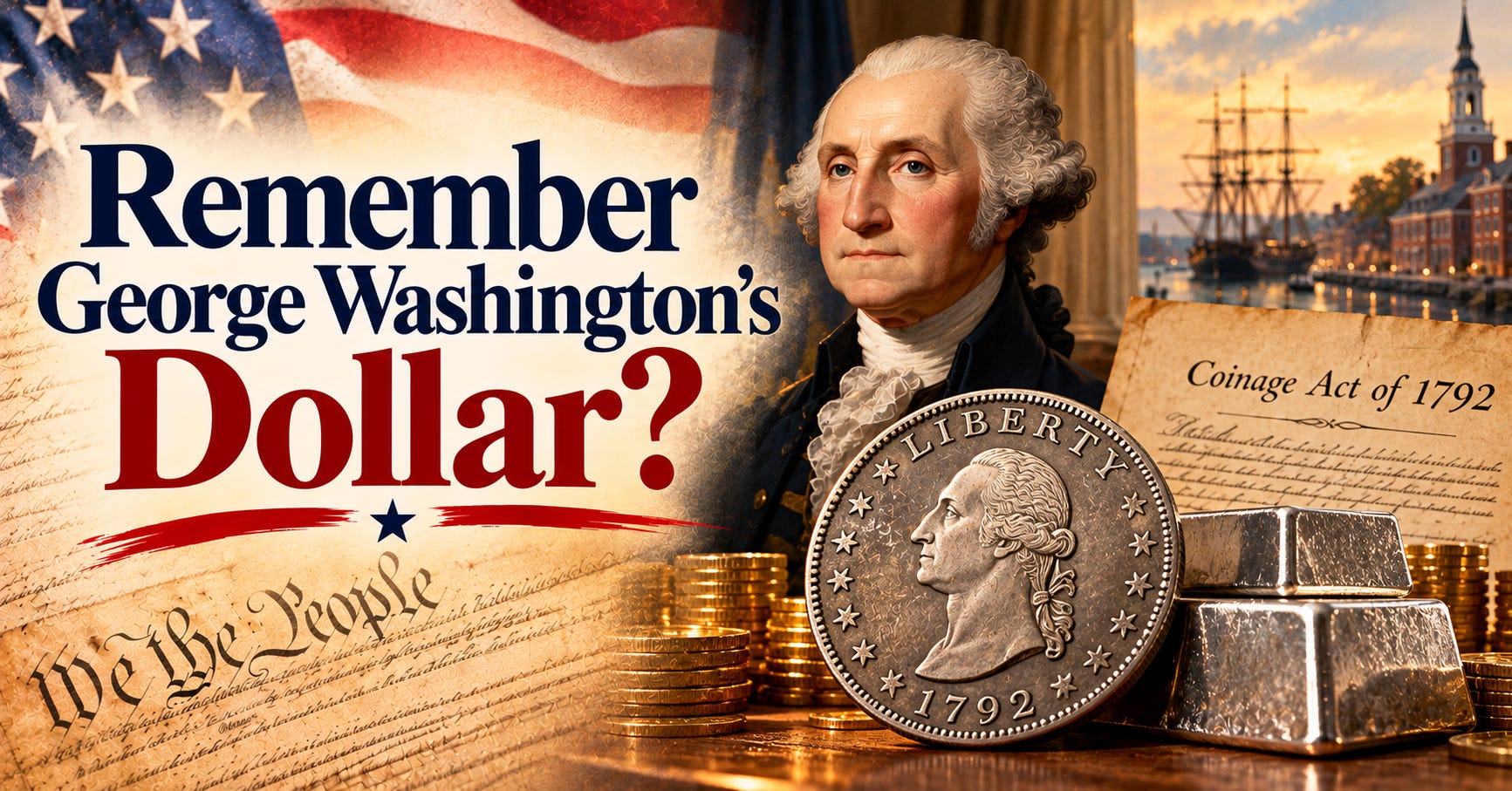
A few weeks ago, I wrote about the Coinage Act of 1792.
If you missed that article, it was called Wait… THAT’S in the Constitution?
That little historical rabbit hole started with a question about gold and silver and led me to a law signed by President George Washington on April 2, 1792.
The Coinage Act defined the United States silver dollar using a specified quantity of precious metal.
Specifically, 371¼ grains of pure silver.
That’s approximately 0.773 troy ounces.
At a silver price of approximately $61 per ounce, that quantity of silver would have a metal value of about $47 today.
Forty-seven dollars’ worth of silver in the original dollar.
Now, before anybody gets too excited, that’s not the same thing as saying one dollar in 1792 had $47 of today’s purchasing power. Silver prices change independently of the overall cost of living, and the historical comparison isn’t an inflation calculator.
But it’s still a remarkable illustration of how much our monetary system has changed.
The original American dollar was defined in terms of silver.
Today’s dollar is fiat currency. It isn’t redeemable for a fixed amount of gold or silver, and its purchasing power depends on economic conditions and the stability of the monetary system.
That doesn’t automatically make precious metals a better choice for every saver or investor.
But it does make monetary history worth understanding.
Maybe the Bigger Problem Is What We Don’t Know
Here’s where my two rabbit holes finally connected.
One started with a debate about government and the economy.
The other started with a silver bar at Costco.
But both led me to the same realization.
We spend an awful lot of time talking about money without necessarily understanding how it works.
We argue about taxes without always understanding who has the authority to change them.
We debate government spending without always discussing where the money comes from.
We talk about economic growth without always distinguishing between public investment and private enterprise.
We worry about inflation without always understanding what causes prices to rise or how different assets respond.
And we ask our children to prepare for financial independence without necessarily teaching them the history of money, the responsibilities of citizenship, or the fundamentals of personal finance.
I don’t think any of us ever finishes learning these things.
I certainly haven’t.
But I think asking better questions is a pretty good place to start.
Why I’m Still Asking Questions About Gold and Silver
My partnership with Revelation Gold Group has given me an opportunity to explore some of these questions in greater depth.
I’ve been learning more about physical precious metals, the history of money, and the different ways families approach long-term savings.
Revelation offers a free educational guide explaining how gold and silver work, including options for purchasing physical metals and holding eligible precious metals in certain retirement accounts.
If you’re curious, you can find it at ToniRevelation.com.
As always, do your homework. Precious metals can fluctuate significantly in value, and buying, storing, or holding them in retirement accounts may involve costs and restrictions. No investment is right for everyone.
I’m not a financial advisor, and this isn’t personalized financial advice.
I’m simply continuing to ask questions, learn, and share what I discover.

The next time you’re pushing that giant cart through Costco, take a look around.
There’s a lot more happening in that warehouse than you might realize.
A family buying groceries.
A small business owner buying supplies.
A parent trying to stretch the household budget.
And somewhere online, a Kirkland Signature silver bar.
Maybe it’s just another product Costco thinks its members will buy.
Or maybe it’s an invitation to ask some questions we haven’t thought about in a while.
What gives money value?
What creates lasting prosperity?
What responsibilities belong to government, and what responsibilities belong to us?
And what should we be teaching our children about all of it?
I don’t have every answer.
But I intend to keep asking.
Duty is ours. Results are God’s.