


Today brought genuinely encouraging news.
Senate Majority Leader John Thune went on media and stated that he is willing to take up the SAVE Act.
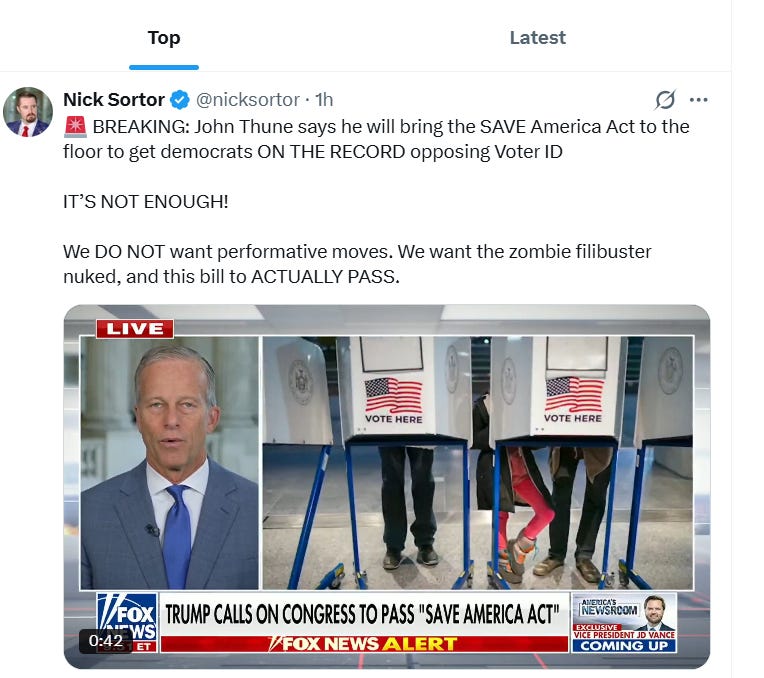
That matters.
In the Senate, leadership willingness is not a small thing. The Majority Leader controls what legislation comes to the floor, when it comes up, and under what process it moves forward. So when Senator Thune publicly signals openness to bringing the SAVE Act forward, it tells us something important:
The bill is on leadership’s radar.
That’s momentum.
But here’s where civic maturity comes in.
There is a difference between:
“I’m willing to take it up”
and“It has been formally scheduled on the Senate Calendar for floor consideration.”
Both are positive.
Only one is procedural reality.
And if we want to be informed citizens — not just headline consumers — we need to understand that distinction.
What the Majority Leader Actually Controls
The Senate Majority Leader plays a central role in shaping the floor agenda. In practical terms, the Majority Leader:
Calls up bills from the calendar
Files motions to proceed
Negotiates unanimous consent agreements
Structures debate time
So Senator Thune saying he is willing to take up the SAVE Act signals potential movement from discussion to scheduling.
But willingness does not automatically equal placement on the daily floor agenda.
That requires an additional procedural step.
What It Means for a Bill to Be “On the Senate Calendar”
The Senate maintains an official document called the Calendar of Business.
Think of it as the chamber’s master list of legislation eligible for consideration.
A bill can be placed on the calendar after committee action or under certain procedures. But even being on the calendar does not guarantee debate. Leadership must still schedule it for actual floor consideration.
So there are stages:
A bill exists.
It moves through committee.
It is placed on the Senate Calendar.
The Majority Leader schedules it for floor action.
The Senate begins debate.
Right now, we’ve heard encouragement related to stages three and four.
But we haven’t yet seen formal scheduling.
That doesn’t mean it won’t happen.
It just means we’re watching the next step unfold.
Why This Is Good News — And Why Process Still Matters
It’s important to celebrate progress.
Public acknowledgment from the Majority Leader means the issue has traction. That’s real.
But in the Senate, progress moves through documented procedure — not press clips.
That’s why the most grounded, empowered citizens don’t just read headlines.
They watch the calendar.
How to Check the Senate Calendar Yourself (In 60 Seconds)
If you want to stay informed without relying solely on commentary, here’s your new daily habit.
Each morning, type this exact phrase into AI:
“Is the SAVE Act on the Senate Calendar for today?”
Then verify it yourself.
Go to senate.gov
Click Legislation & Records
Select Calendar of Business
Open the most recent document
Use CTRL + F and search:
“SAVE”
The bill number
Or key terms like “voter” or “citizenship”
If you see it listed for floor consideration — that’s real movement.
If you don’t — it simply hasn’t been formally scheduled yet.
No panic.
No overreaction.
Just facts.
This is how you make yourself less susceptible to spin from either side.
Process is neutral.
Calendars don’t lie.
📣One Simple Action You Can Take Today
Senator Thune publicly stated he is willing to take up the SAVE Act.
That’s a meaningful step.
Now let’s respectfully ask the next logical question:
When will it be placed on the Senate Calendar?
Public accountability doesn’t require outrage.
It requires clarity.
Here’s something easy and constructive you can do today:
Go to Senator Thune’s social media and leave a respectful comment like this:
“Thank you for saying you’re willing to take up the SAVE Act. Can you share when you plan to place it on the Senate Calendar for consideration?”
That’s it.
No attacks.
No drama.
Just a procedural question.
When citizens ask process-based questions, leaders take notice.
And when many citizens ask the same reasonable question, it signals something powerful:
The public understands how the Senate works.
Encouragement plus accountability.
Momentum plus awareness.
That’s how serious civic engagement looks.
Bottom Line
Today’s statement from Senator Thune is encouraging.
It signals possibility.
It signals consideration.
It signals momentum.
Now we watch for the next step:
Formal placement and scheduling on the Senate Calendar.
And the best part?
You don’t have to wait for a pundit to tell you what’s happening.
Tomorrow morning, try it.
“Is the SAVE Act on the Senate Calendar for today?”
That’s how you stay informed.
That’s how you stay steady.
And that’s how you build citizens who can’t be easily manipulated.
Progress is real.
Process is real.
And now you know how to watch both.