


There’s been a major development in Pennsylvania that deserves your attention—and more importantly, your understanding.
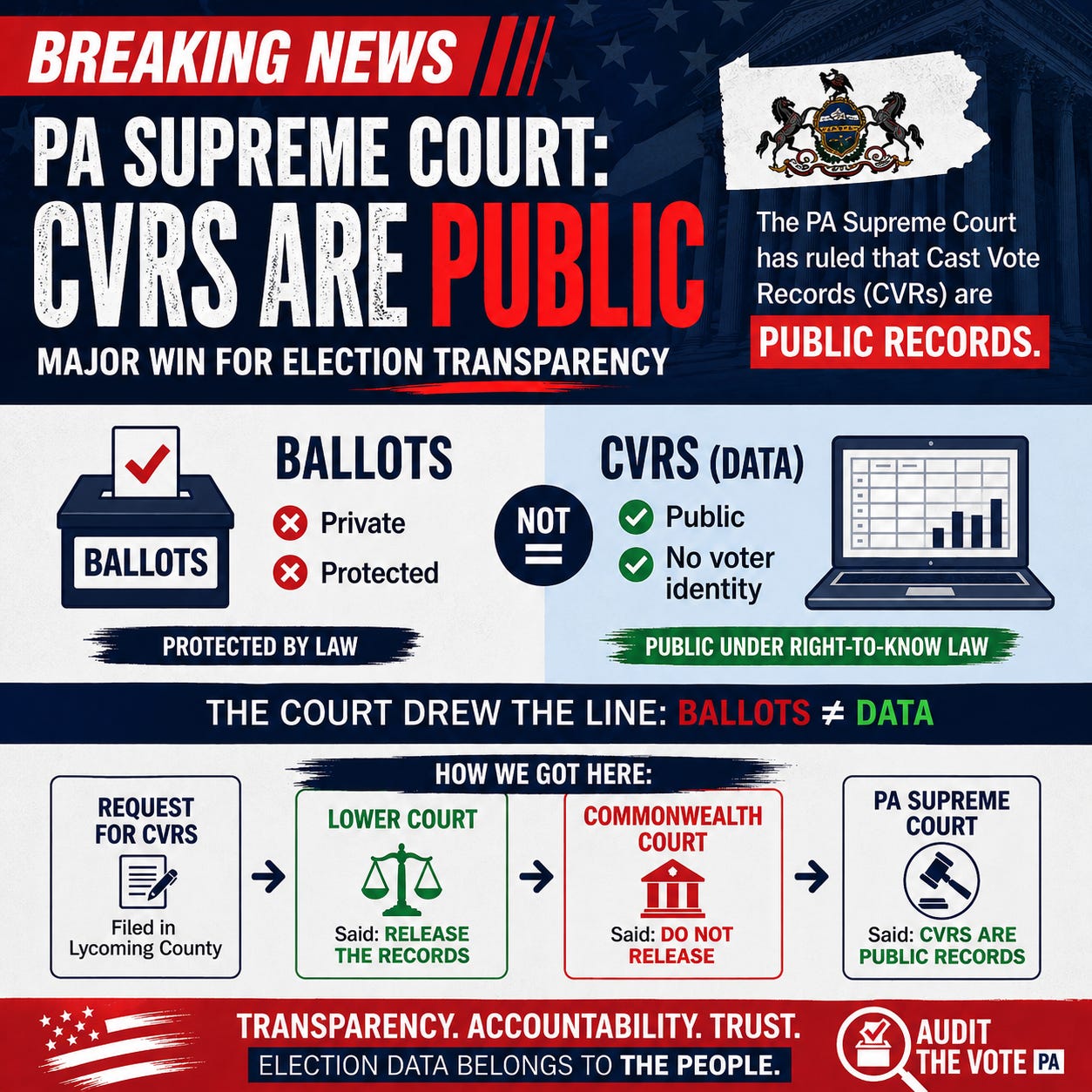
The Pennsylvania Supreme Court has ruled that Cast Vote Records (CVRs) are public records under the state’s Right-to-Know Law.
That’s a big win for transparency.
But like most things in election law, the headlines don’t tell the full story.
Let’s walk through this in a way that actually makes sense
.
First: What Are CVRs?
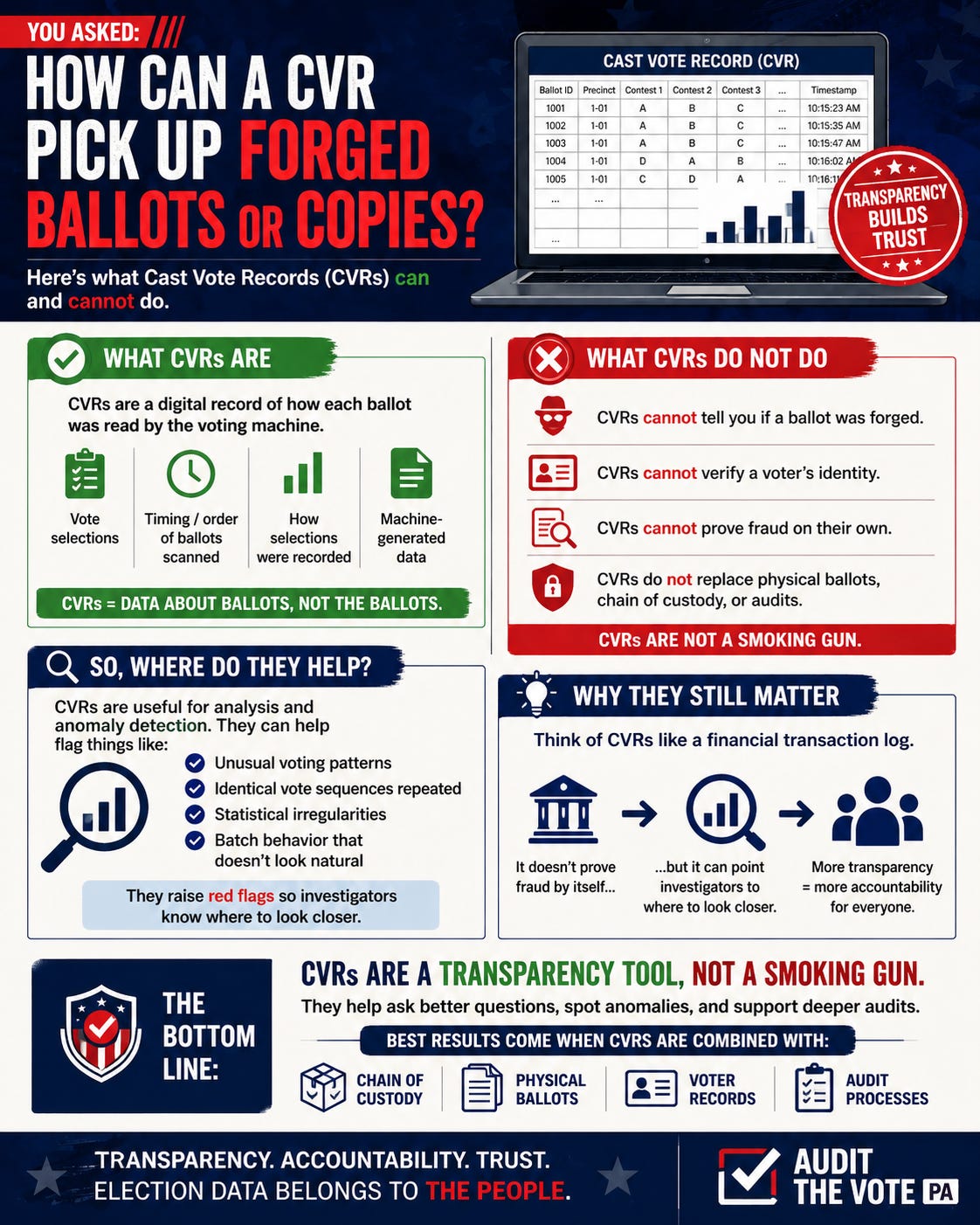
A Cast Vote Record (CVR) is a digital record created by a voting machine that shows how a ballot was interpreted.
Think of it like this:
👉 If a ballot is the paper vote,
👉 A CVR is the machine’s readout of that vote.
It’s data about the ballot, not the ballot itself.
What the Court Actually Ruled
The Pennsylvania Supreme Court said:
➡️ CVRs fall under the Right-to-Know Law
➡️ That means they are public records
➡️ And they can be requested and reviewed by citizens
This decision overturned a prior Commonwealth Court ruling that said CVRs should not be released.
So this wasn’t just a clarification—it was a reversal.
Why This Matters
At its core, this decision comes down to one thing:
Transparency.
When data about our elections is accessible, it allows:
Independent analysis
Verification efforts
Greater public confidence
More informed conversations
It doesn’t solve every problem—but it gives us more visibility into the process.
And visibility matters.
Let’s Clear Up a BIG Misunderstanding
One of the most important parts of this conversation:
CVRs are NOT ballots
Your ballot is still:
✅ Private
✅ Protected by law
✅ Anonymous
The court did not say ballots are public.
What is public is the data generated by machines about how ballots were read.
What CVRs Can (and Can’t) Do
This is where we need to stay grounded and honest.
What CVRs CAN do:
Show voting patterns
Track the order/timing ballots were scanned
Help identify statistical anomalies
Support deeper audits and analysis
What CVRs CANNOT do:
Detect forged ballots
Verify who a voter is
Prove fraud on their own
That last one is key.
CVRs are a tool—not a conclusion.
A Simple Way to Think About It
Think of CVRs like a financial transaction log.
If something looks off in your bank account, the log helps you:
👉 Spot unusual activity
👉 Identify patterns
👉 Decide where to investigate further
But the log itself doesn’t prove fraud—it just points you in a direction.
That’s exactly how CVRs function in elections.
How We Got Here
This case didn’t happen overnight.
Here’s the simplified path:
A request for CVRs was filed in Lycoming County
A lower court said: Release the records
The Commonwealth Court said: Do NOT release them
The PA Supreme Court stepped in and ruled:
👉 CVRs ARE public records
And that’s now the controlling decision.
What This Does NOT Mean
Let’s address a concern I know many people have:
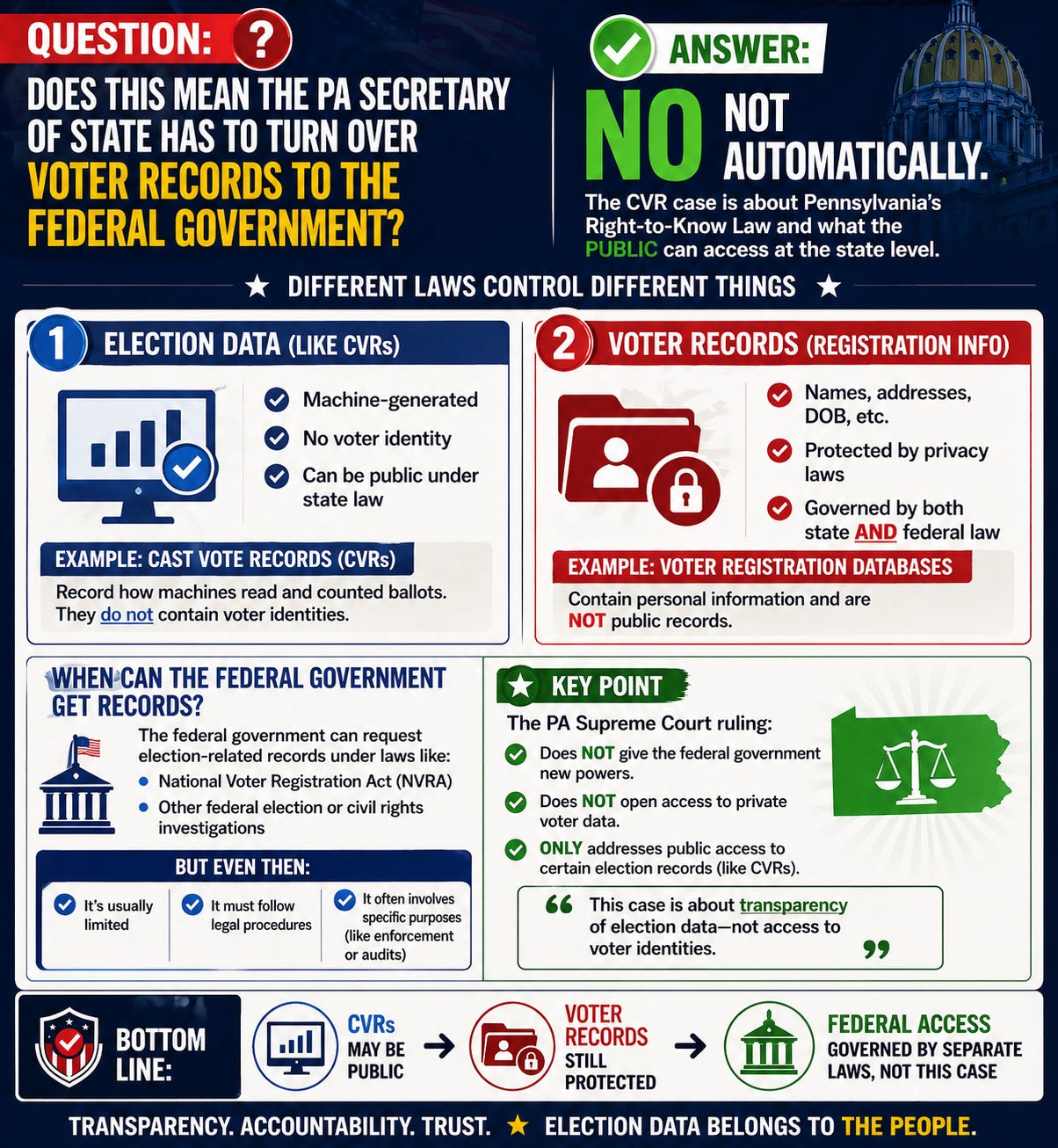
“Does this mean voter information is being handed over?”
No.
CVRs do not include voter identity
Voter records are still protected under separate laws
This ruling is about election data access, not personal information
The Bottom Line
This decision is a meaningful step forward for transparency in Pennsylvania elections.
More access → more accountability
More visibility → more informed citizens
More understanding → better conversations
But with that comes responsibility.
We have to use this information wisely.
Not to jump to conclusions…
But to ask better questions.
Where We Go From Here
This is where your role matters.
Transparency only works if people:
Pay attention
Learn how the system works
Engage at the local level
Because at the end of the day:
👉 Election data belongs to the people
👉 But it’s up to the people to understand it