


Yes, I know. Columbus Day was yesterday.
Apparently, I was a little late discovering Columbus.
But considering how much of his story I never learned in school, perhaps that’s appropriate.
Like most Americans of my generation, I grew up learning about Christopher Columbus, the Nina, the Pinta, and the Santa Maria. We learned that he sailed the ocean blue in 1492, searching for a shorter trade route to Asia, where Europeans hoped to obtain valuable spices and other goods.
And, of course, we learned that he discovered America.
Except he didn’t know he had reached a continent Europeans would later call America. He believed he had reached islands near Asia. And the lands he encountered were already inhabited by people whose ancestors had been living in the Americas for thousands of years.
But that’s not the part of the story that has captured my attention lately.
What surprised me was discovering what Columbus himself believed he was doing.
Because when you start reading his own writings, something remarkable emerges.
Christopher Columbus believed God had called him to his voyage.
Not simply to find spices. Not simply to establish trade routes. Not even simply to bring wealth and prestige to the Spanish monarchy.
He believed his journey was part of a much larger Christian mission.
And there’s an entire religious dimension to his story that I certainly don’t remember learning about in school.
The Columbus I Met in Elementary School
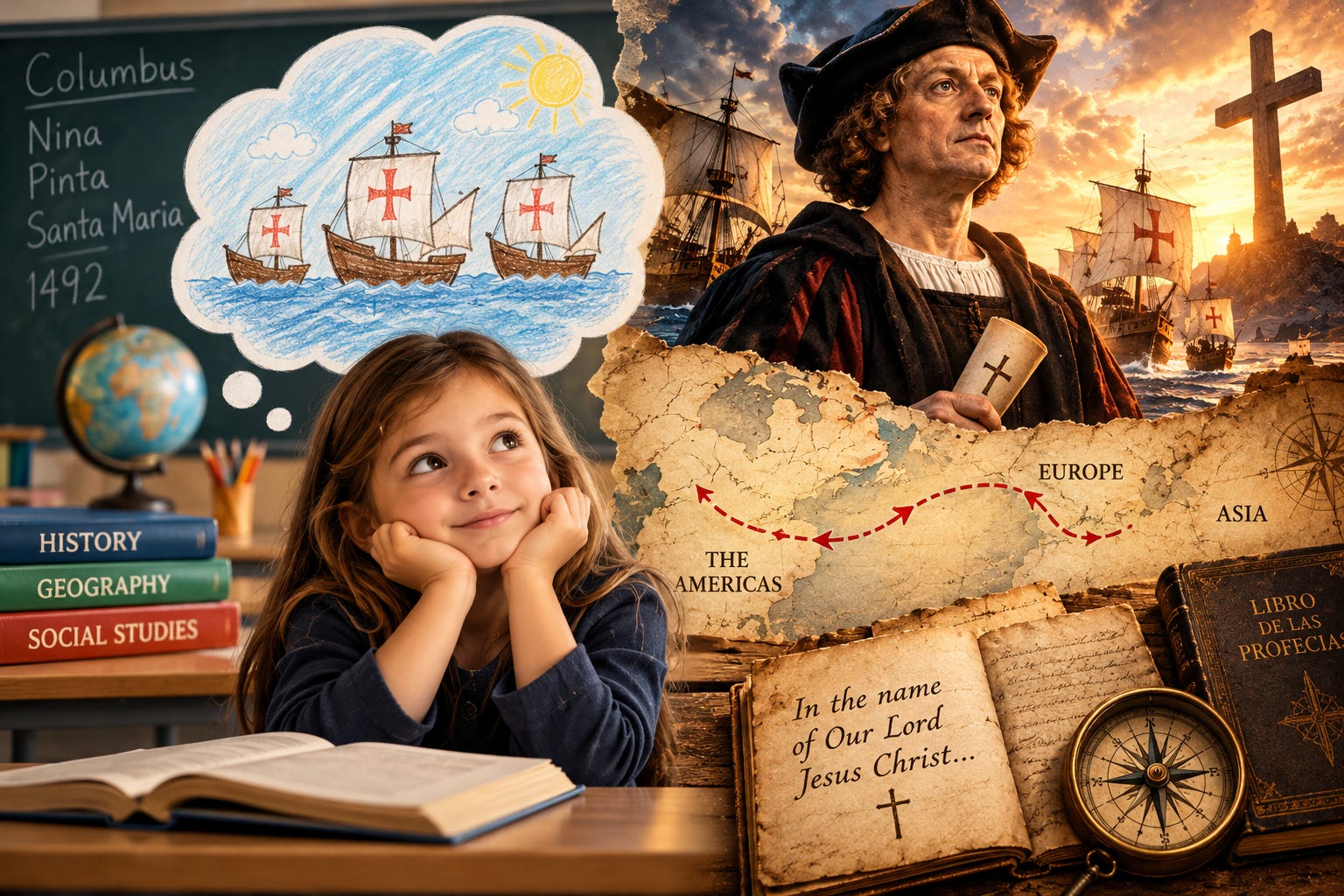
Think back to your elementary school history lessons.
What do you remember about Christopher Columbus?
Three ships. A brave explorer. A round Earth. A search for a new trade route to the East.
Perhaps you remember coloring pictures of sailing ships or memorizing the names of the vessels.
Some of us were even taught that Columbus set out to prove the Earth was round, although educated Europeans already knew that. The real disagreement concerned the size of the Earth and whether Asia could be reached by sailing west across the Atlantic.
Over the years, the story has changed considerably.
Today, Columbus is often discussed primarily through the lens of European colonization, the suffering of Indigenous peoples, and the consequences of his voyages.
Those consequences are real and deserve serious historical examination.
But I’ve noticed something interesting about the way we tell history.
We have a tendency to reduce complicated people to a single storyline.
In one generation, Columbus becomes the heroic explorer who discovered a new world.
In another, he becomes a symbol of conquest and oppression.
And somewhere between those competing narratives, we can lose sight of a rather important question:
What did Christopher Columbus actually believe he was doing?
Fortunately, we don’t have to rely entirely on someone else’s interpretation.
We have his writings.
And they’re fascinating.
Then I Started Reading What Columbus Actually Wrote
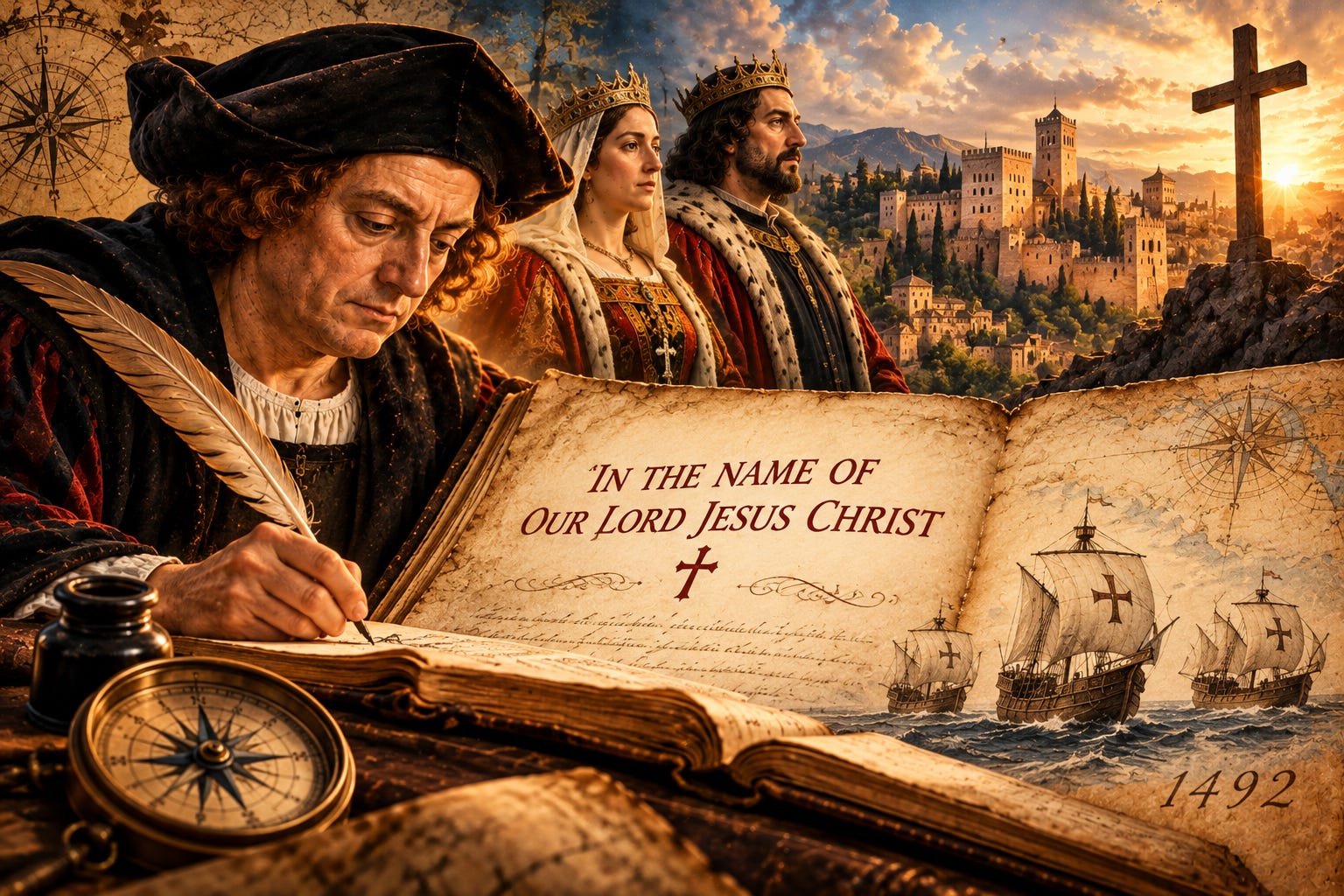
One of the most revealing documents is the surviving account of Columbus’s journal from his first voyage in 1492.
The original journal no longer exists, but much of its content was preserved through a later transcription and summary by Bartolomé de las Casas, a Spanish priest and historian.
The opening is striking.
Rather than beginning with a discussion of spices, sailing conditions, or navigation, the journal’s prologue begins:
“IN THE NAME OF OUR LORD JESUS CHRIST”
Columbus then discusses the Spanish monarchs, Ferdinand and Isabella, and their victory at Granada earlier that year.
Why does that matter?
Because Granada was the last major Muslim-ruled kingdom on the Iberian Peninsula. Its surrender in January 1492 marked the culmination of centuries of Christian reconquest in Spain.
And just months later, Columbus would sail west under the sponsorship of those same monarchs.
In his journal’s prologue, Columbus describes the monarchs’ interest in sending representatives to Asia and learning how its inhabitants might be converted to Christianity.
He specifically connects his expedition to the desire to spread the Christian faith.
Now, to be clear, Columbus was also seeking wealth, titles, territory, and a commercially valuable route to Asia. His own writings make that clear.
But Christianity wasn’t merely an incidental detail.
Religious purpose was part of how he explained the voyage from the very beginning.
That is a significant piece of historical context.
And it raises an interesting question.
If Columbus understood his mission in religious terms, shouldn’t that be part of how we teach his story?

Wait. Jerusalem?
Here’s where the story became even more surprising to me.
Columbus didn’t simply hope to spread Christianity to people living in distant lands.
He also envisioned using the wealth generated by his voyages to help finance the recovery of Jerusalem for Christendom.
Yes. Jerusalem.
As in the Holy Land.
As in the city that had been at the center of centuries of conflict between Christian and Muslim powers.
In a letter to the Spanish monarchs written after his first voyage, Columbus described a remarkable ambition.
He proposed that the wealth of his discoveries could eventually finance an army of 5,000 cavalry and 50,000 infantry for a campaign to take Jerusalem.
He even described this religious objective as a reason for undertaking his enterprise.
Think about that for a moment.
The man we learned about as an explorer searching for spices was discussing how the riches of his expedition might finance a military campaign to reclaim Jerusalem.
That certainly adds a dimension to the story that I don’t remember from my elementary school history book.
Of course, there is an important historical distinction here.
The strongest surviving statements about Jerusalem come from Columbus’s writings after his first voyage. Historians debate precisely how central this objective was to his original plans in 1492.
But the evidence establishes that Columbus eventually regarded the recovery of Jerusalem as a major part of his mission, and he suggested that the idea had been present from the beginning.
Whether his royal sponsors shared the same level of enthusiasm is another question entirely.
What fascinates me is that Columbus saw exploration, wealth, evangelization, and the future of Christendom as interconnected.
He wasn’t simply thinking about geography. He was thinking about biblical history.
The Book of Prophecies Nobody Told Me About
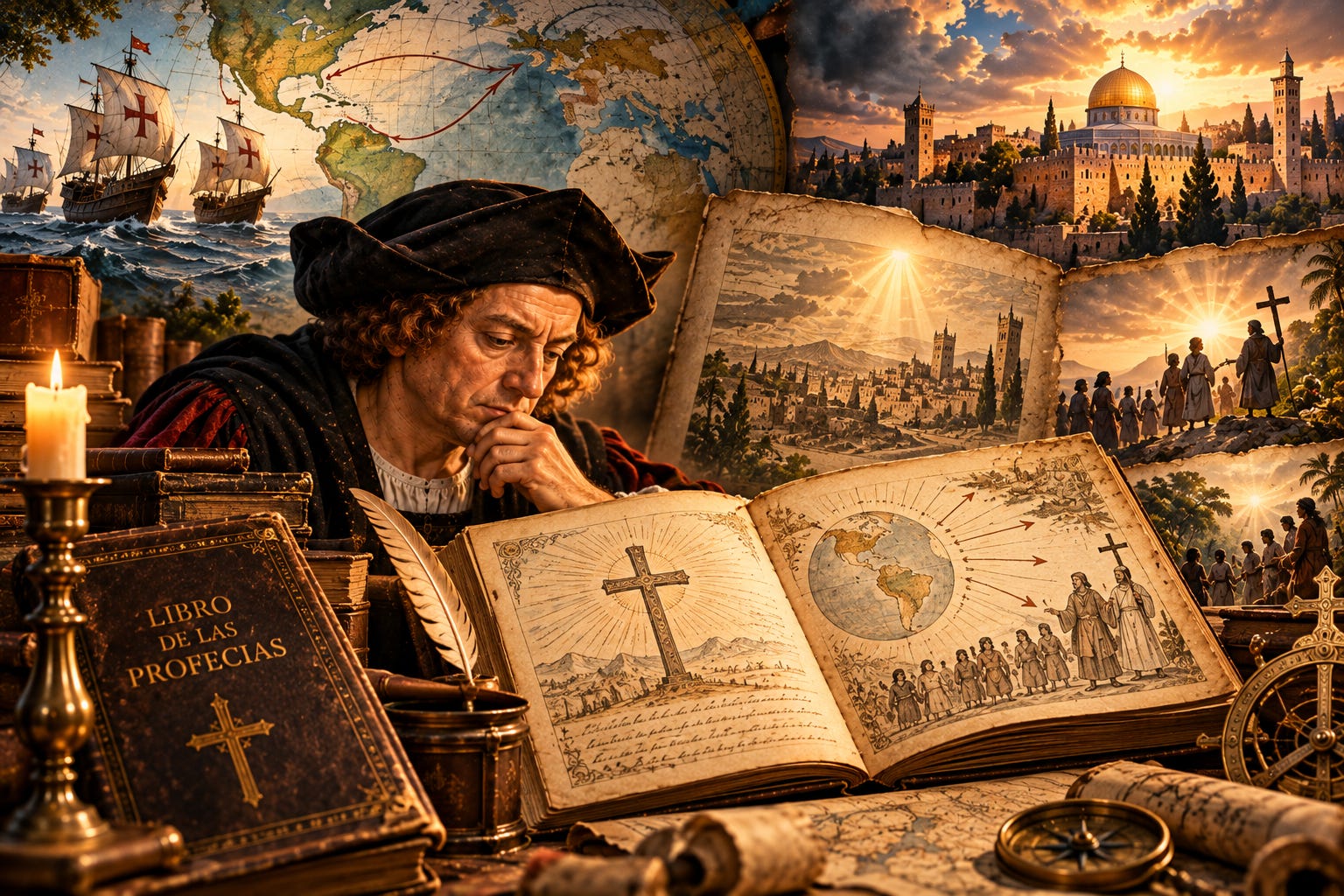
And then I learned that Christopher Columbus compiled something called the Book of Prophecies.
Have you ever heard of it?
I hadn’t.
Around 1501 and 1502, Columbus worked with others, including a Carthusian monk named Gaspar Gorricio, to assemble biblical passages and other religious writings that he believed helped explain his voyages.
This wasn’t a navigation manual.
It wasn’t a collection of maps.
It was a compilation of Scripture, religious commentary, and prophetic interpretations.
Columbus believed that certain biblical prophecies pointed toward the spread of Christianity throughout the world and the eventual recovery of Jerusalem.
And he came to see his own voyages as part of that unfolding history.
Imagine that.
A man who had crossed the Atlantic Ocean, encountered lands previously unknown to most Europeans, endured storms, experienced political conflict, and even returned to Spain in chains was spending time studying Scripture and trying to understand how his life fit into God’s plan.
He believed the events of his lifetime carried spiritual significance.
Now, whether his interpretation of biblical prophecy was correct is an entirely separate theological question.
Christians can certainly disagree about that.
But understanding what Columbus believed helps us understand the decisions he made.
It also reminds us that the world of 1492 was very different from the world we inhabit today.
For Columbus, religion wasn’t necessarily a separate compartment of life.
It shaped how he understood kings, kingdoms, history, exploration, and the future.
His worldview was deeply influenced by Christianity.
And that worldview deserves to be examined if we want to understand the man.
Did Columbus Really Believe God Had Called Him?
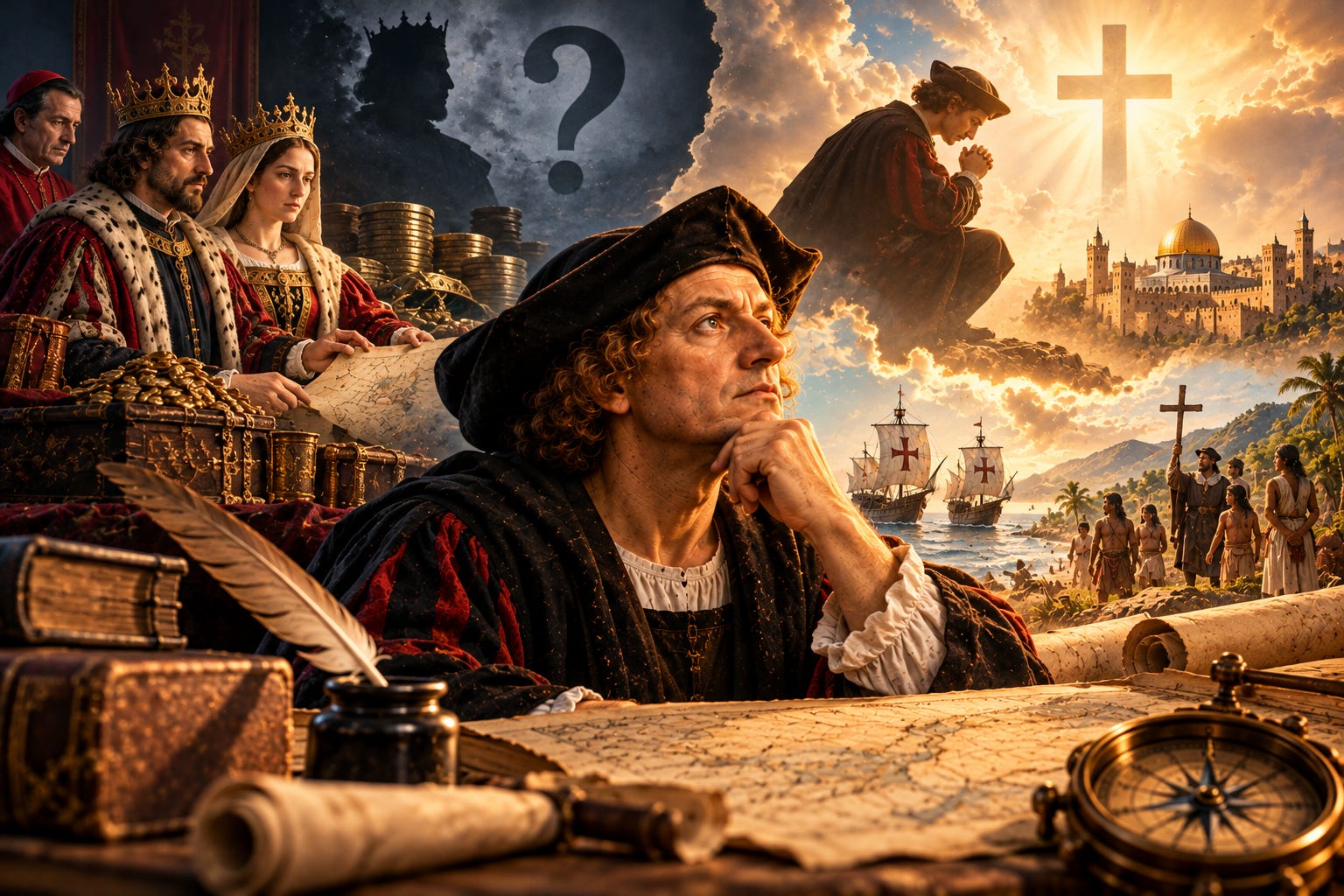
This may be the most fascinating question of all.
Was Columbus simply using religious language to persuade Catholic monarchs to finance his expeditions?
Was Christianity a convenient justification for seeking wealth and power?
Or did he sincerely believe he had been chosen by God for a particular purpose?
Historians have debated these questions for generations.
And I don’t pretend to know everything that was happening inside Christopher Columbus’s heart.
Only God knows that.
But I do find it difficult to dismiss the religious dimension of his life as nothing more than political theater.
His writings repeatedly return to Christianity, evangelization, Jerusalem, and divine providence.
His Book of Prophecies represents a considerable investment of time and thought into understanding his experiences through Scripture.
That doesn’t prove every motive was pure.
It doesn’t mean he always acted consistently with Christian teachings.
And it certainly doesn’t mean that believing God called someone to a mission automatically means God actually did.
But it does mean that his faith was a serious part of his understanding of himself and his work.
And that matters.
Because there’s a difference between evaluating whether someone’s actions were right and understanding why that person believed those actions were justified.
Good history requires us to do both.
Faith Doesn’t Erase Failure
Now, I want to address something important.
Exploring Columbus’s Christian faith doesn’t mean we have to pretend that everything he did was admirable. But it also doesn’t mean we should judge his actions without understanding the world he encountered.
Columbus didn’t arrive in a world where every Indigenous community lived peacefully alongside its neighbors. In his journal, he described meeting people who bore scars from conflicts with other groups. He also recorded accounts of hostile islanders and alleged cannibalism, although historians continue to debate the accuracy of some of those reports.
These were complicated societies with their own cultures, political relationships, rivalries, and conflicts. And Columbus was trying to understand them through the enormous language and cultural barriers separating them.
What I find particularly interesting is that Columbus also wrote about his desire to introduce these people to Christianity. In his first journal entries, he expressed the belief that they could be converted through kindness rather than force.
That matters when we’re trying to understand his intentions.
But intentions and actions aren’t always the same thing.
Columbus also acknowledged taking Indigenous people by force to serve as interpreters. Later, his administration of Hispaniola became the subject of serious complaints and an investigation ordered by the Spanish Crown. And his expeditions helped establish a colonial system that brought profound suffering to Indigenous populations.
Those facts deserve acknowledgment, too.
But here’s where I think we need to be careful.
We shouldn’t automatically attribute every abuse committed during centuries of European colonization to Christopher Columbus personally. Nor should we assume that every accusation made against him was necessarily accurate simply because it appears in a historical document.
The same standard of evidence should apply whether we’re examining his faith or his failures.
And as a Christian, I find another part of this story worth considering.
Scripture is filled with accounts of deeply flawed human beings. King David was a man after God’s own heart, yet his sins had devastating consequences. Peter loved Jesus and still denied Him.
The Bible doesn’t hide those failures. It records them.
Of course, recognizing that biblical figures were imperfect doesn’t excuse the mistreatment of other human beings. And believing that God has called someone to a mission doesn’t automatically mean every decision that person makes carries God’s approval.
But it does remind us that human beings are complicated.
Columbus could sincerely believe he was serving God while making decisions that contradicted the very Christian principles he professed.
Faith is not proof of perfection. And failure is not proof that faith was insincere.
We don’t have to turn historical figures into saints or monsters to study them honestly.
We can examine their beliefs, their accomplishments, their failures, and their consequences, while remembering that understanding someone’s motivations is not the same thing as endorsing their actions.
That’s what history is supposed to help us do.
What Happens When We Leave Faith Out of History?
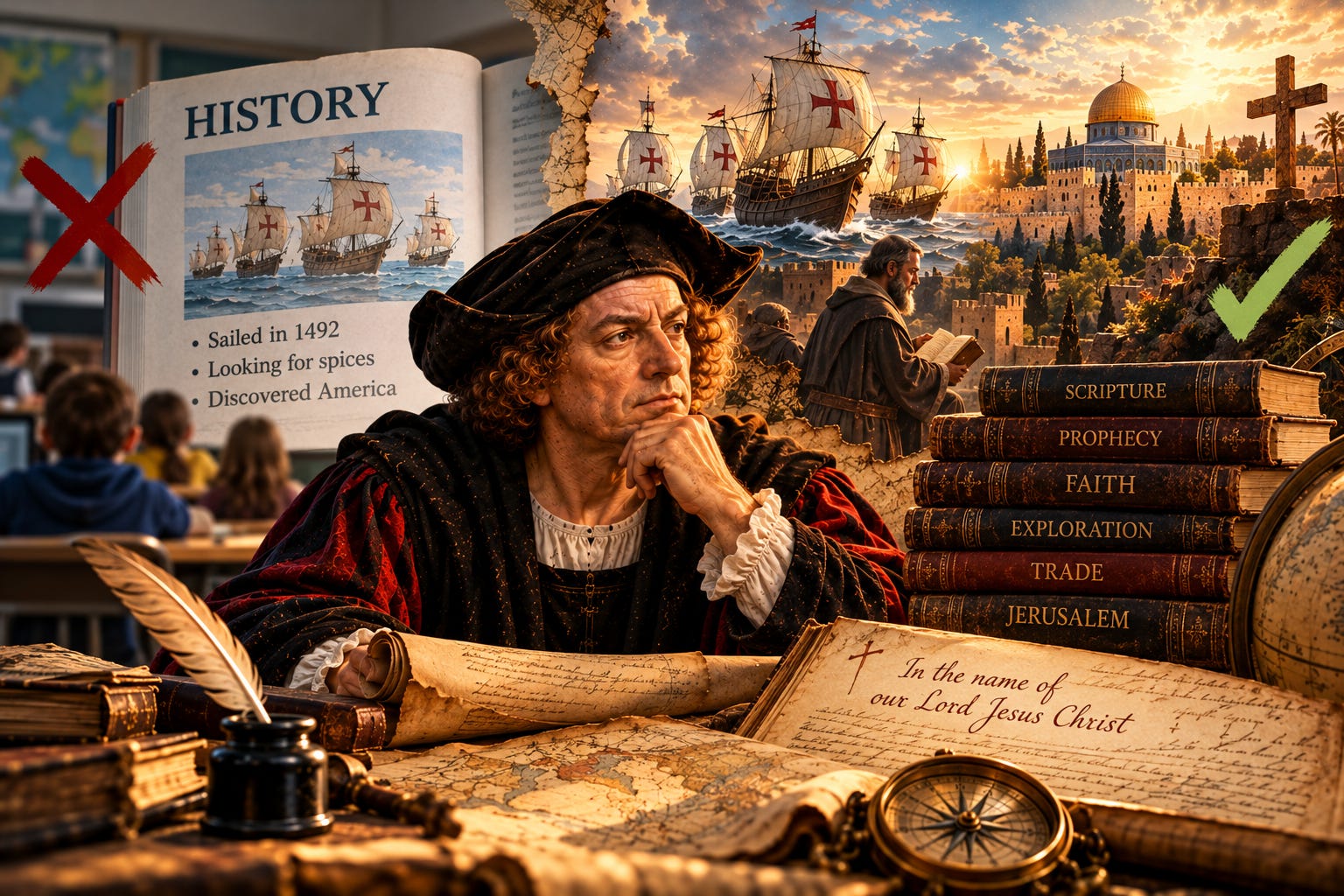
This is where the Columbus story connects to something I’ve been thinking about much more broadly.
What happens when we teach history without adequately explaining the religious beliefs of the people who lived it?
I’m not suggesting every historical event was motivated by Christianity.
Nor am I suggesting that religious motives were always noble.
History gives us plenty of examples of religion being used to justify terrible things.
But faith was a powerful force in shaping the worldview of countless historical figures.
It influenced their understanding of duty, sacrifice, authority, morality, and purpose.
And if we remove that dimension from the story, we risk misunderstanding why they made the decisions they did.
Columbus is a particularly interesting example because the religious and commercial dimensions of his voyages were so closely intertwined.
He wanted access to the riches of Asia.
He wanted recognition and authority.
He wanted to spread Christianity.
He wanted to see Jerusalem recovered.
And he believed his achievements were connected to divine prophecy.
That is a far more complicated story than simply saying he went looking for spices.
It is also more interesting.
As someone who has spent a great deal of time encouraging Americans to read our founding documents for themselves, I keep coming back to the same principle.
Primary sources matter.
If we want to understand the Declaration of Independence, we should read the Declaration.
If we want to understand the Constitution, we should read the Constitution.
And if we want to understand Christopher Columbus, perhaps we should spend some time reading Christopher Columbus.
Not just the paragraphs someone selected for a textbook.
Not just the social media posts that circulate every October.
His actual words, considered alongside the broader historical record.
Maybe We Should Start Asking Better Questions
Here’s what I find most interesting about all of this.
For years, I thought I understood the basic story of Christopher Columbus.
He wanted spices. He sailed west. He encountered the Americas.
End of story.
But the more I learn about his religious convictions, the more I realize how much context was missing from that simple narrative.
Columbus believed his life had a purpose that extended far beyond personal ambition.
He saw his voyages through the lens of Scripture.
He believed Christianity should spread throughout the world.
And he connected the wealth he hoped to acquire with the recovery of Jerusalem.
We can examine those beliefs without automatically endorsing his interpretation of God’s will.
We can acknowledge the suffering associated with his voyages without pretending his faith was irrelevant.
And we can recognize the enormous historical consequences of 1492 without reducing the man at the center of the story to a cardboard character.
Maybe that’s the lesson I find most valuable.
History isn’t supposed to be a collection of carefully selected facts designed to produce a predetermined conclusion.
It’s supposed to be an honest investigation into the past.
And sometimes that investigation reveals things we never expected.
So yes, I’m a day late for Columbus Day.
But perhaps there’s something appropriate about discovering a different side of Christopher Columbus 534 years after his famous voyage.
After all, the most interesting discovery I’ve made about Columbus lately has nothing to do with the coastline he encountered.
It has to do with the mission he believed God had given him.
And that seems like a pretty important part of the story to leave out.
Maybe the next time Columbus Day rolls around, instead of asking only whether Christopher Columbus deserves to be celebrated or condemned, we should begin with a different question:
What did he actually believe, and what do the historical records tell us about it?
That seems like a much better place to start.
Don’t Take My Word for It. Read the Sources.
If this part of Columbus’s story is new to you, I encourage you to explore the documents and historical research for yourself.
Columbus’s 1492 Journal: Fordham University’s Medieval Sourcebook
Columbus’s Letter to Ferdinand and Isabella: King’s College London, Early Modern Spain
The Book of Prophecies: Scholarly discussion of the manuscript and its biblical sources
Religious Motives for Columbus’s First Voyage: Daniel J. Wood’s historical research
Reading Columbus: University of California Press
History becomes much more interesting when we start asking questions and reading the evidence for ourselves.
Thank you I enjoyed your article and will share