Every year around this time, we gather with our families, eat entirely too much food, talk about what we're thankful for, and start making plans for Christmas.
But how many of us actually know the history behind the holiday we're celebrating?
If your education was anything like mine, you probably remember learning about the Pilgrims, the Indians, and a big feast where everyone sat down together and shared a meal. Maybe you even made a turkey out of a tracing of your hand in elementary school.
But there's SO much more to the story.
Josh Howerton recently had Tim Barton of WallBuilders on his Live Free podcast to discuss the history of Thanksgiving, and I wanted to share some of that history with you before we gather around our dinner tables tomorrow.
The more I dig into American history, the more fascinated I become by the role that faith played in shaping our nation. Thanksgiving is no exception.
And one of the most remarkable parts of this story involves a man whose name you've probably heard but whose life story you may never have actually learned.
Before There Was a Thanksgiving, There Was a Man Named Squanto
Have you ever stopped to wonder how the Pilgrims, having just arrived in a foreign land, encountered a Native American who could speak English?
Think about that for a minute.
His name was Tisquantum, better known to most of us as Squanto, and the circumstances that brought him to that moment are incredible.
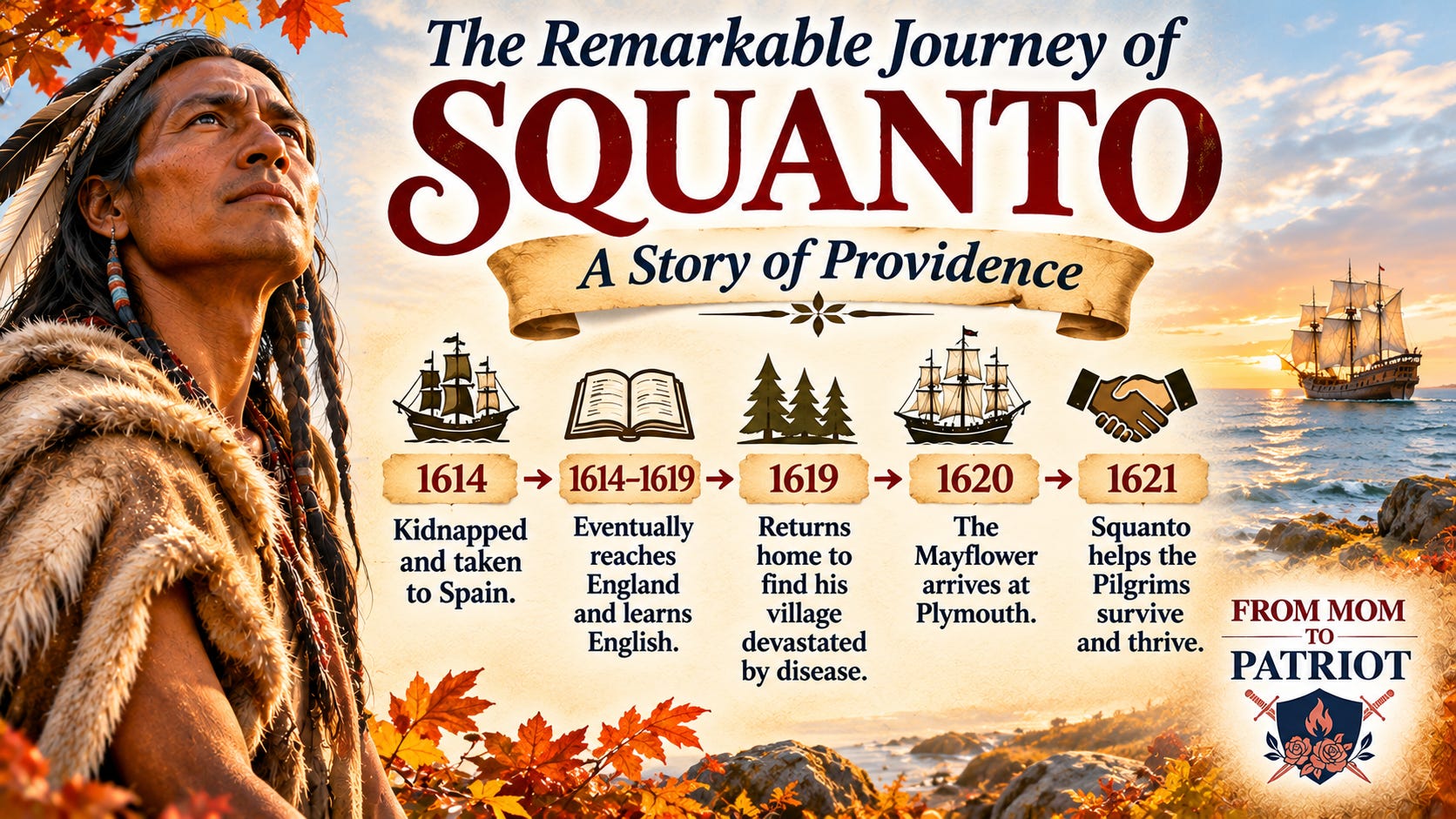
In 1614, six years before the Pilgrims arrived, Squanto was kidnapped by an English sea captain named Thomas Hunt. He was taken across the Atlantic Ocean to Spain, where he was to be sold into slavery.
Historical accounts indicate that Spanish friars intervened to help some of the captives. Squanto eventually made his way to England, where he learned the English language and ultimately secured passage back to his homeland.
Imagine what that homecoming must have been like after years of captivity and separation from everything he knew.
Except when Squanto finally returned in 1619, he discovered that an epidemic had devastated his village. Most, if not all, of his community had died.
After everything he had endured to get home, the home he remembered was gone.
And then, roughly a year later, a ship called the Mayflower arrived.
A Story of God's Providence
The Pilgrims arrived in 1620 with 102 passengers aboard the Mayflower. Many of them had left Europe in pursuit of religious freedom and the opportunity to establish a community where they could practice their faith according to their convictions.
Their journey was anything but easy.
They arrived as winter was approaching, with inadequate shelter, limited provisions, and little understanding of how to survive in their new environment. By the time spring arrived, roughly half of the passengers had died.
Imagine losing half of the people you had embarked on this journey with. Imagine burying family members, friends, and children while wondering whether you would even survive yourself.
Then, in the spring of 1621, the Pilgrims encountered Squanto.
Here was a man who understood the land, knew how to grow crops, understood the local resources, and, against extraordinary odds, spoke their language.
He helped the settlers learn to cultivate corn, locate food, and navigate their relationships with the Native people of the region. The Wampanoag leader, Massasoit, also entered into an alliance with the settlers that served the interests of both communities.
William Bradford, who became governor of Plymouth Colony, described Squanto in his historical account, Of Plymouth Plantation, as:
“A special instrument sent of God for their good beyond their expectation.”
As a Christian, I find this part of the story particularly compelling.
That doesn't mean what happened to Squanto was good. His kidnapping was a terrible injustice, and the loss of his community was a tragedy.
But it reminds me of something we see repeatedly throughout Scripture: God can bring good out of circumstances that, from our limited human perspective, seem unimaginably terrible.
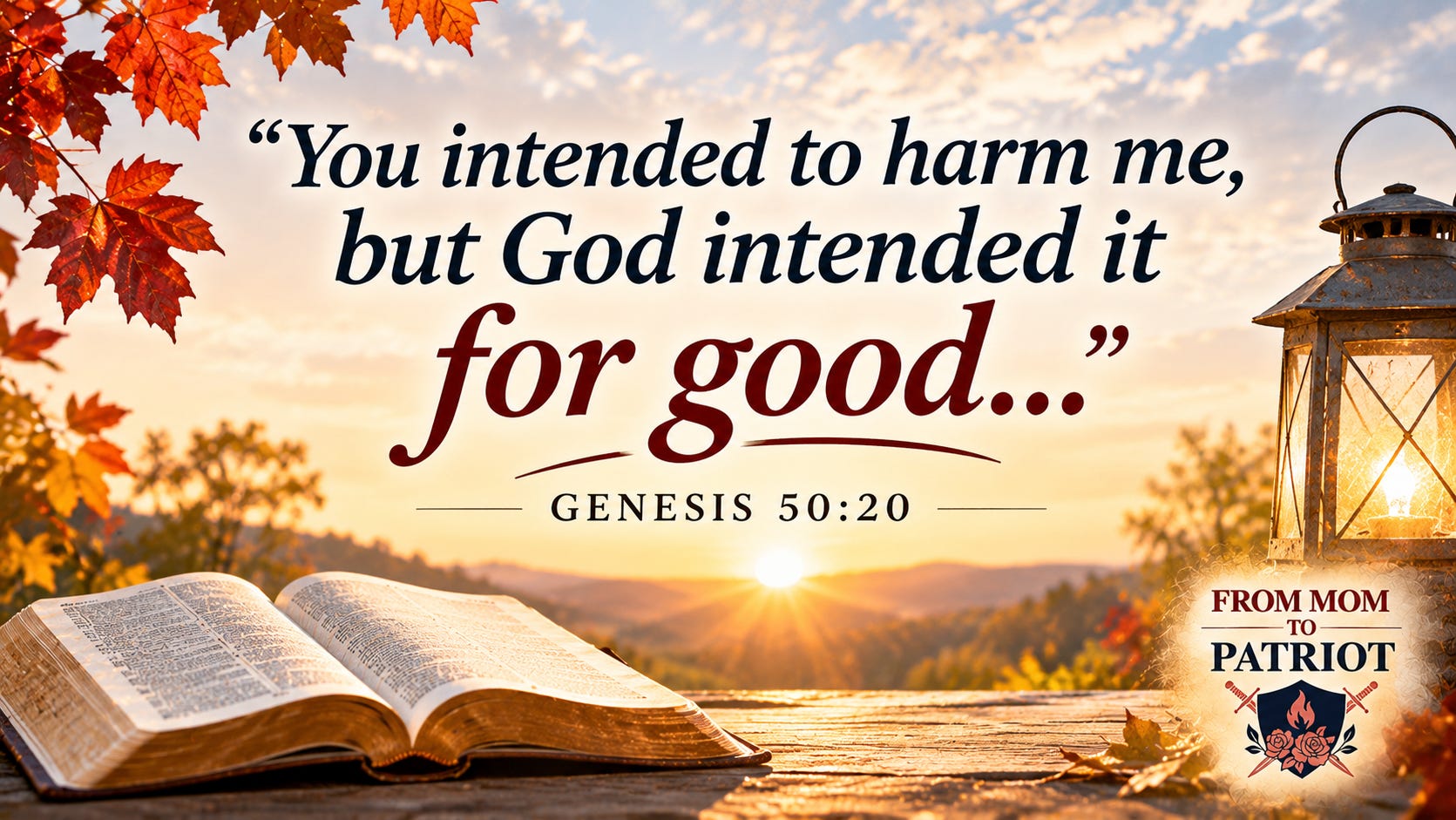
I'm reminded of what Joseph said to his brothers in Genesis 50:20:
“You intended to harm me, but God intended it for good…”
How often do we go through difficult seasons in our own lives, wondering why God would allow something to happen, only to discover years later that He was able to use those circumstances in ways we never could have imagined?
What Actually Happened at the First Thanksgiving?
By the fall of 1621, the surviving Pilgrims had successfully gathered a harvest.
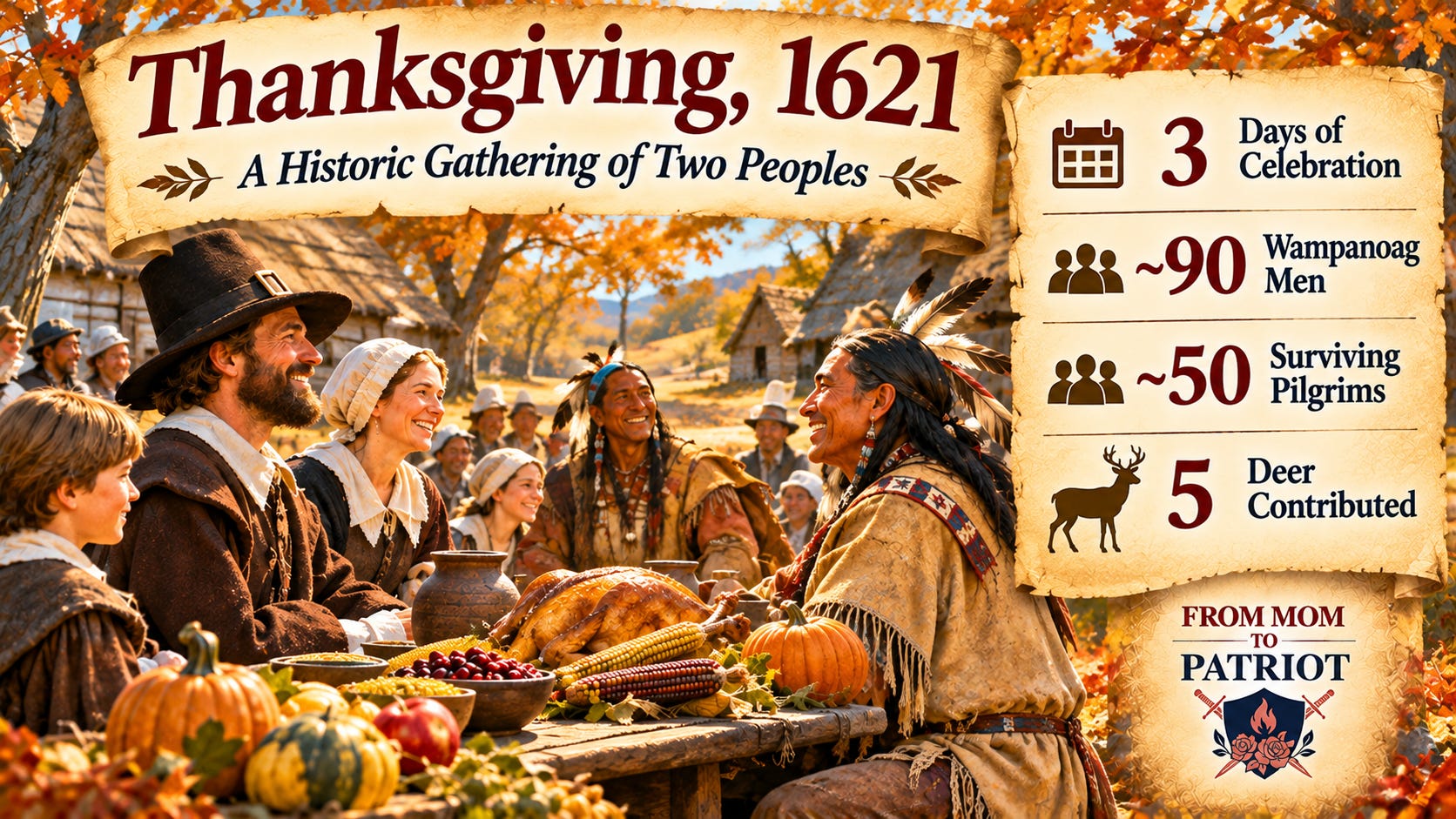
Approximately 90 Wampanoag men, including their leader Massasoit, joined the colonists for three days of feasting and festivities. The Wampanoag contributed five deer to the celebration.
One of the Pilgrims, Edward Winslow, documented the gathering in a letter that survives to this day. In describing their circumstances, he attributed their abundance to:
“The goodness of God.”
What I find particularly interesting about this celebration is that these people were not celebrating because everything in their lives had gone according to plan.
Quite the opposite.
They had suffered tremendous loss. They had experienced hunger, sickness, grief, and uncertainty. And yet, there they were, celebrating what they had been given.
It's also worth noting that the Wampanoag people had their own longstanding traditions of giving thanks for the provision of food and the changing seasons.
The gathering of 1621 represents a remarkable moment of cooperation between two very different cultures. Acknowledging that moment doesn't require us to ignore the conflicts and injustices that occurred in the generations that followed.
History is rarely as simple as we are taught to believe.
Another Thanksgiving You've Probably Never Heard About
While the 1621 gathering is what we typically refer to as the First Thanksgiving, something else happened in 1623 that I think is equally worth knowing about.
The Pilgrims experienced a severe drought that threatened their crops and, consequently, their ability to survive another winter.
They set aside time for fasting and prayer, asking God for relief.
Rain came, and the crops recovered.
In response, the colonists observed a day of thanksgiving to God.
This was consistent with a religious tradition the Pilgrims had brought with them from Europe: setting aside days of fasting and prayer during times of hardship and days of thanksgiving when they experienced what they believed to be God's provision.
Thanksgiving wasn't simply an opportunity to get together and eat.
It was an acknowledgment of their dependence on God.
Did You Know George Washington Issued a Thanksgiving Proclamation?
Let's fast-forward to 1789.
Our Constitution had recently gone into effect, George Washington was serving as our first president, and Congress requested that he recommend a national day of thanksgiving.
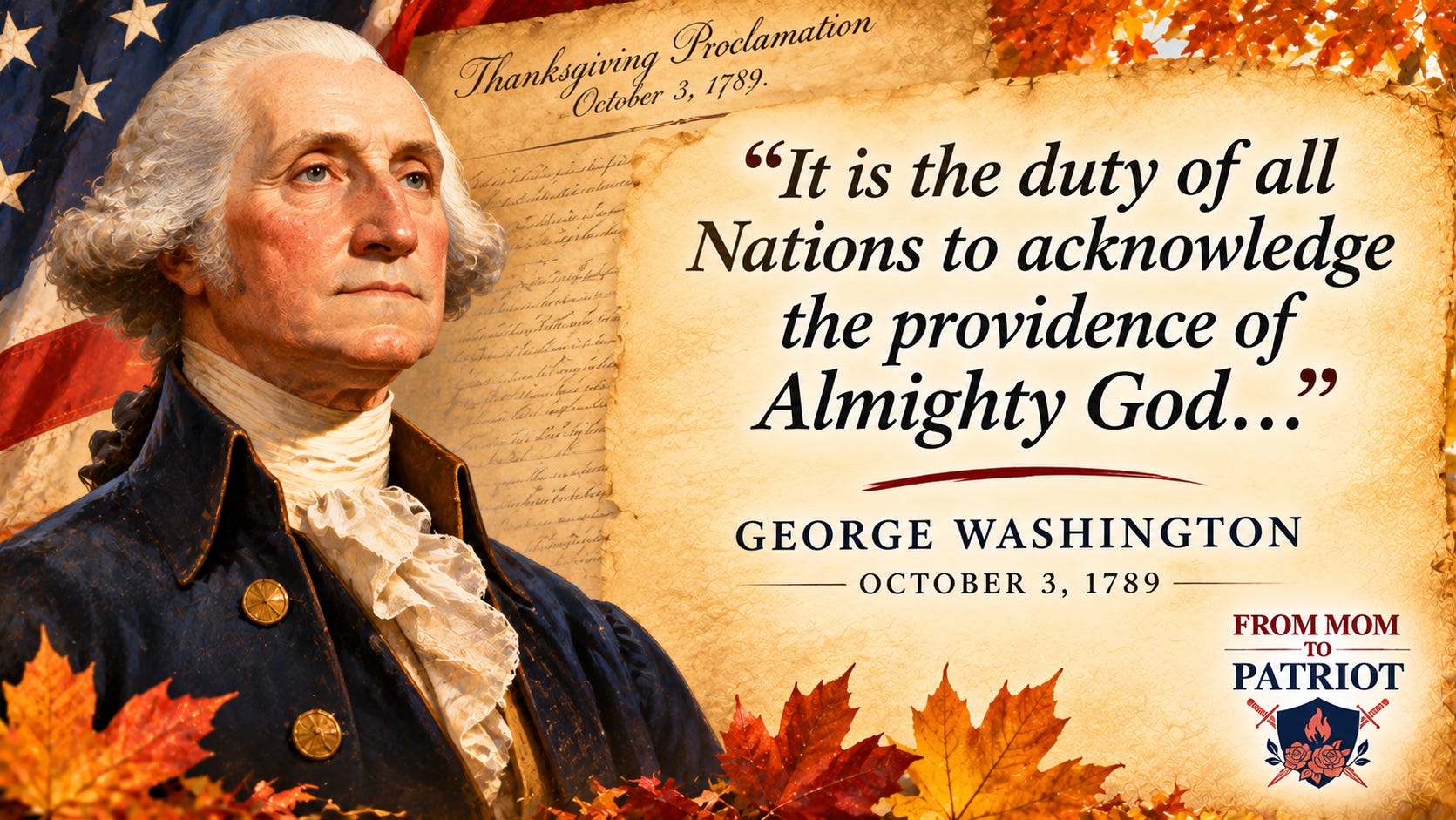
On October 3, 1789, Washington issued a proclamation designating November 26 as a day of public thanksgiving and prayer.
Here is how he opened that proclamation:
“Whereas it is the duty of all Nations to acknowledge the providence of Almighty God, to obey his will, to be grateful for his benefits…”
I encourage you to read the "entire proclamation" for yourself. It's not very long, and it provides a fascinating glimpse into the language and thinking of our first president.
Among the things Washington encouraged Americans to thank God for were their civil and religious liberties, their protection throughout the Revolutionary War, and their ability to peacefully establish a constitutional government.
But here's something else that caught my attention.
Washington also encouraged Americans to ask God for forgiveness for their national transgressions and to help them faithfully fulfill their individual responsibilities.
In other words, this wasn't merely about celebrating America. It was about recognizing our blessings while remaining humble enough to acknowledge our shortcomings.
I can't help but think we could use a little more of that today.
Thanksgiving in the Middle of a Civil War
Perhaps the most interesting chapter in the history of Thanksgiving came in 1863.
America was literally at war with itself.
Families were divided. Lives were being lost. The future of our Republic was uncertain.
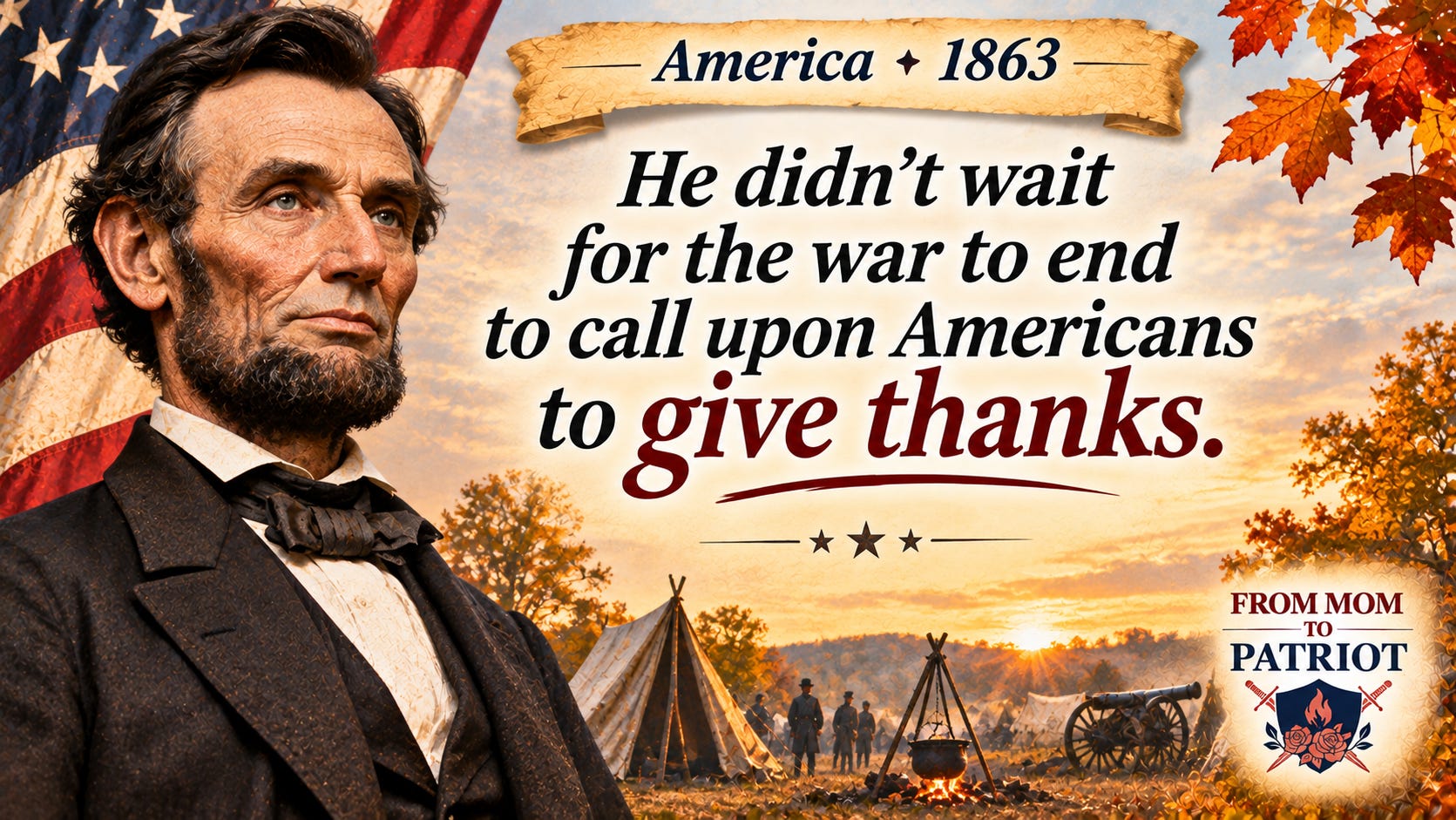
And in the middle of all of that, following years of advocacy by writer Sarah Josepha Hale, Abraham Lincoln issued a proclamation establishing an annual national day of Thanksgiving.
Lincoln encouraged Americans to recognize their blessings as gifts from God, to remember those suffering because of the war, and to pray for the healing of their nation.
Think about the timing of that.
He didn't wait until the war was over. He didn't wait until the country was reunited. He didn't wait until the political climate improved or until Americans agreed with one another again.
He called upon Americans to give thanks right in the middle of one of the darkest periods in our nation's history.
There is a lesson in that for every single one of us.
What Are We Actually Celebrating?
The more I learn about the history of Thanksgiving, the more I realize that there is a common thread running through all of these stories.
The Pilgrims gave thanks after losing half of their community.
Washington called upon Americans to give thanks after years of war and the difficult work of establishing a new government.
Lincoln called upon Americans to give thanks while the country was tearing itself apart.
None of them waited for their circumstances to be perfect.
And maybe that's the part of the history of Thanksgiving that we need to recover the most.
As someone who spends a significant amount of time paying attention to what's happening in our country, I know how easy it can be to become consumed by everything that's going wrong.
There are elections we wish had turned out differently. There are political battles that seem never-ending. There are things happening in our country that leave us concerned about the future our children will inherit.
Then there are the personal battles that many of us are fighting that no one else even knows about.
But Scripture doesn't tell us to give thanks only when things are going well.
It tells us:
“Give thanks in all circumstances; for this is God's will for you in Christ Jesus.” — 1 Thessalonians 5:18
Notice that it doesn't say to give thanks FOR all circumstances.
It says to give thanks IN all circumstances.
There's a difference.
A Challenge for Your Thanksgiving Table
Tomorrow, when you sit down with your family, I'd encourage you to do something a little different.
Tell your kids the story of Squanto. Talk about what the Pilgrims endured. Read a portion of George Washington's Thanksgiving Proclamation. Talk about why Abraham Lincoln wanted Americans to give thanks in the middle of a Civil War.
And then ask everyone at your table this question:
Can you think of a difficult circumstance in your life that God ultimately used to bring about something good?
I suspect that the answers might make for some of the most meaningful conversations you'll have all day.
And if we're going to pass something on to the next generation, I hope it's more than just our favorite family recipes.
I hope we pass on an understanding of our history, an appreciation for our liberties, a recognition of our dependence on God, and a heart that chooses gratitude regardless of the circumstances.
Because that, to me, is what makes the history of Thanksgiving so beautiful.
From my family to yours, Happy Thanksgiving!
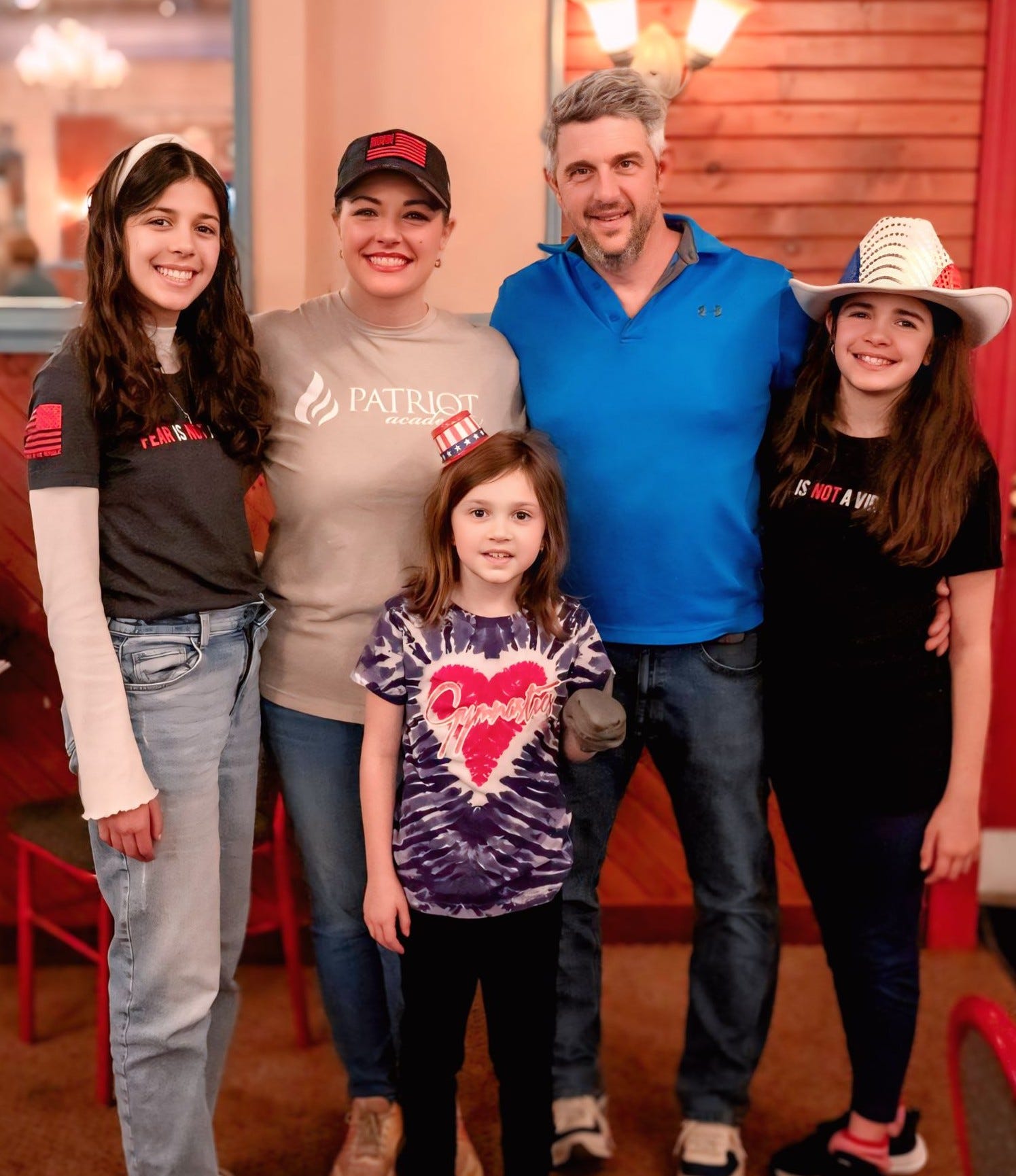
God bless you, and God bless America!