Depending on where you live, yesterday may have been a really good day politically.
Or a really frustrating one.
Across the country, voters headed to the polls, candidates won and lost, and social media quickly filled with the usual mix of celebration, outrage, analysis, and finger-pointing.

I’ve been around politics long enough now to recognize the cycle.
When our side wins, we’re tempted to think everything is finally getting fixed.
When our side loses, we’re tempted to think everything is hopeless.
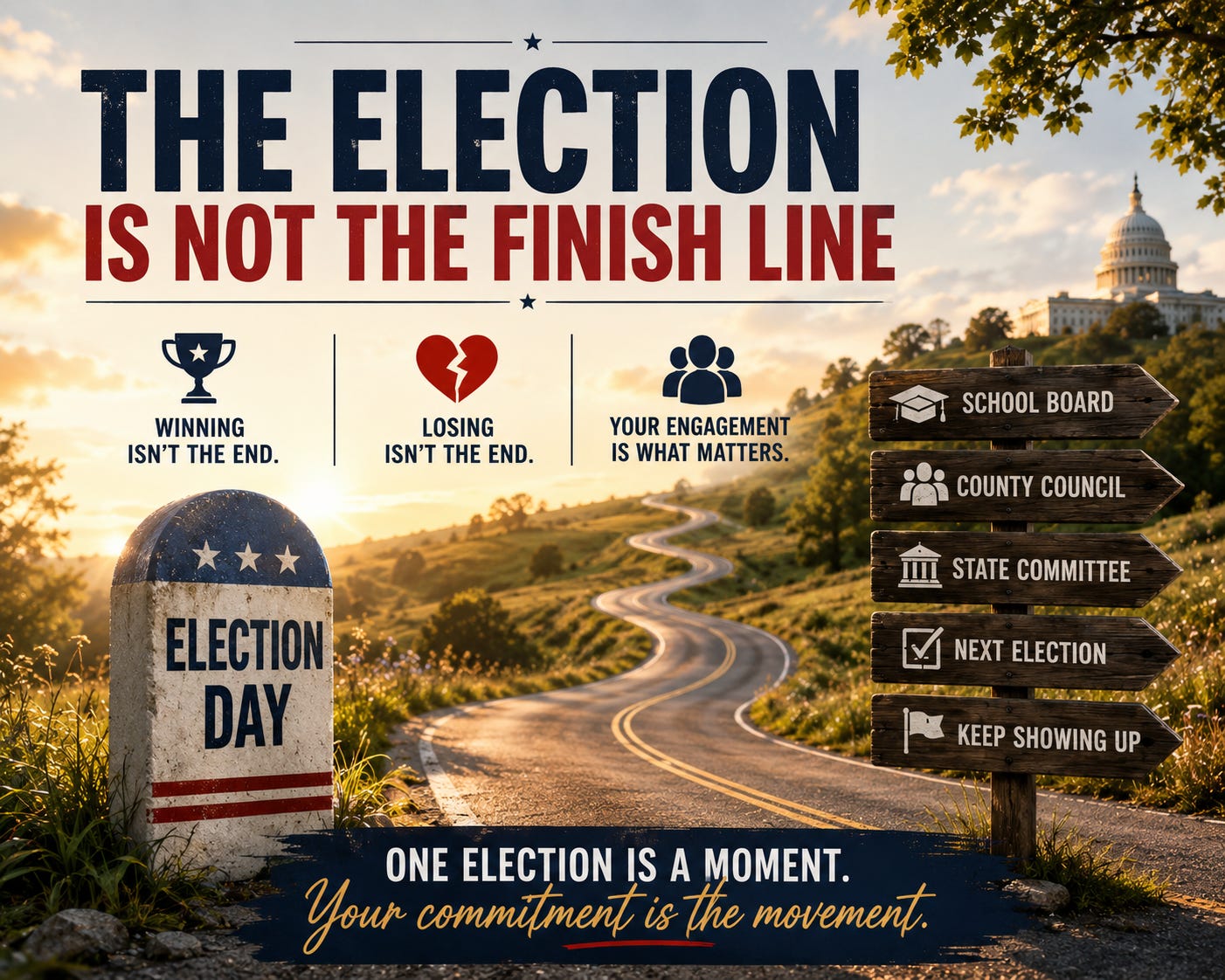
The truth is a mixture of the two… because while elections absolutely matter, an election is not the end of the story.
Winning doesn’t mean our work is finished and losing doesn’t mean our work is over.
The election that matters most is not the one that just happened—it’s whether we’re still engaged when the next one arrives.
In fact, one of the reasons we find ourselves facing so many challenges today is because too many of us—including me—spent years assuming someone else was paying attention.
Before 2020, I was doing what so many moms do—raising my daughters, running a household, and trying to find a little breathing room in the middle of it all.
I wasn’t studying the Constitution or attending local meetings.
I couldn’t have explained the difference between the mayor and the county commissioner.
I certainly couldn’t have told you why the Founders structured our government the way they did.
And if I’m honest, I don’t think I was alone.
Millions of Americans gradually disengaged from the process, assuming our institutions would simply continue functioning without our involvement.
Then one day many of us woke up and realized we didn’t understand the system nearly as well as we thought we did.
That’s one reason I keep repeating a phrase that probably sounds like a broken record by now:
Education is key, and the fix is local.
That lesson showed up again in a powerful way during Week 3 of Constitution Alive.
This week we studied Article I of the Constitution and the branch our Founders expected to be the most powerful branch of government:
Congress.
Ironically, it may also be the branch Americans trust the least today.
Why Congress Comes First
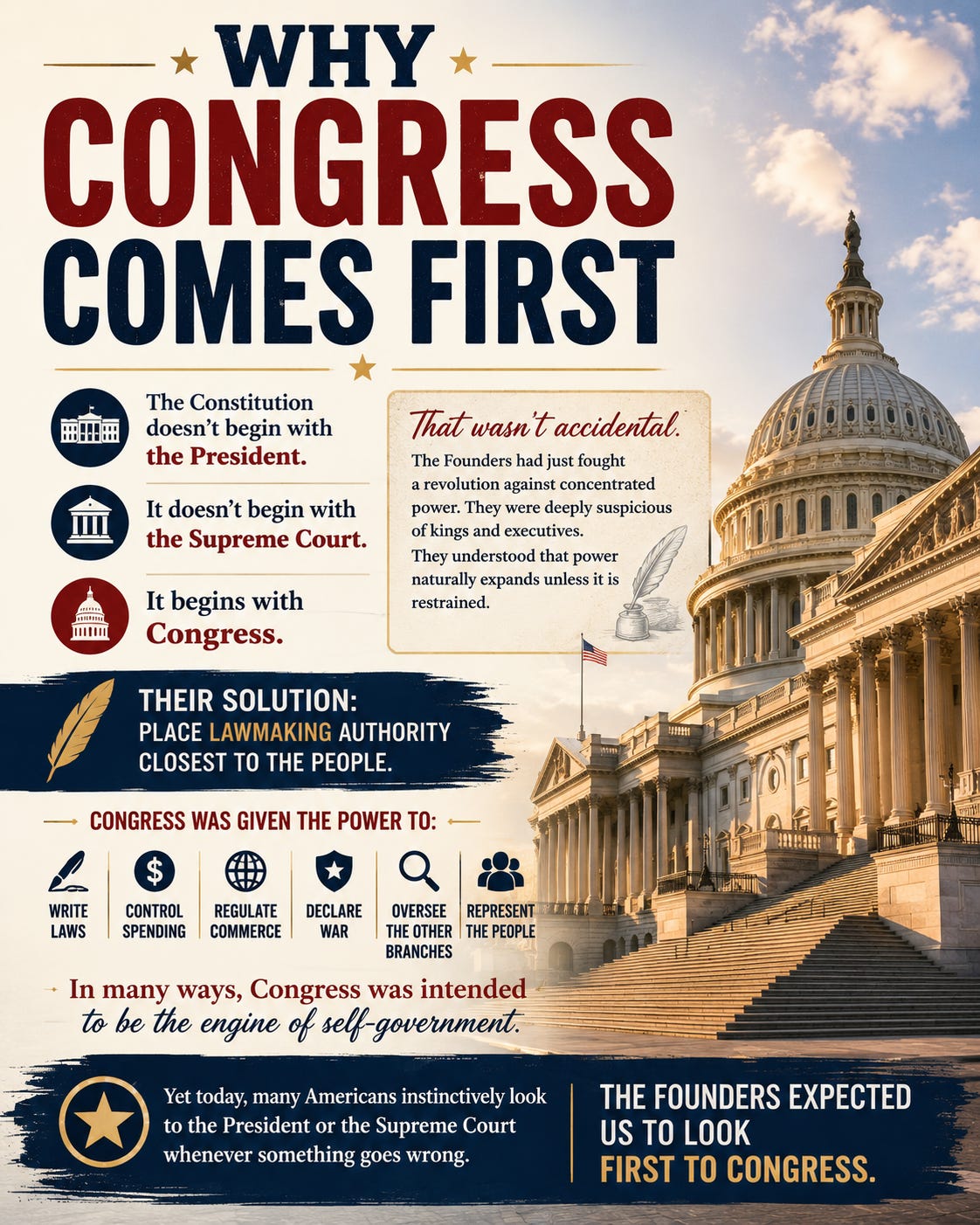
The Constitution doesn’t begin with the President.
It doesn’t begin with the Supreme Court.
It begins with Congress.
That wasn’t accidental.
The Founders had just fought a revolution against concentrated power. They were deeply suspicious of kings and executives. They understood that power naturally expands unless it is restrained.
Their solution was to place lawmaking authority closest to the people.
Congress was given the power to write laws, control spending, regulate commerce, declare war, oversee the other branches, and represent the people.
In many ways, Congress was intended to be the engine of self-government.
Yet today, many Americans instinctively look to the President or the Supreme Court whenever something goes wrong.
The Founders expected us to look first to Congress.
Hamilton’s View of the Courts
One of the discussions Rick Green highlighted during class involved Alexander Hamilton and the Federalist Papers.
In Federalist No. 78, Hamilton described the judiciary as the “least dangerous” branch of government because it possessed neither the purse nor the sword.
Congress controls funding.
The Executive Branch enforces the law.
The courts simply issue judgments.
Hamilton believed this structure would prevent the judiciary from becoming too powerful.
But he also understood that judges are human beings.
Any branch of government can exceed its constitutional limits.
So what happens if judges begin exercising will instead of judgment?
What happens if courts move beyond interpreting laws and begin effectively creating them?
Hamilton pointed to several constitutional safeguards, but one of the most significant was impeachment.
The Constitutional Remedy Most Americans Don’t Know About
When most people hear the word impeachment, they immediately think of a President.
But impeachment was never intended to apply only to Presidents.
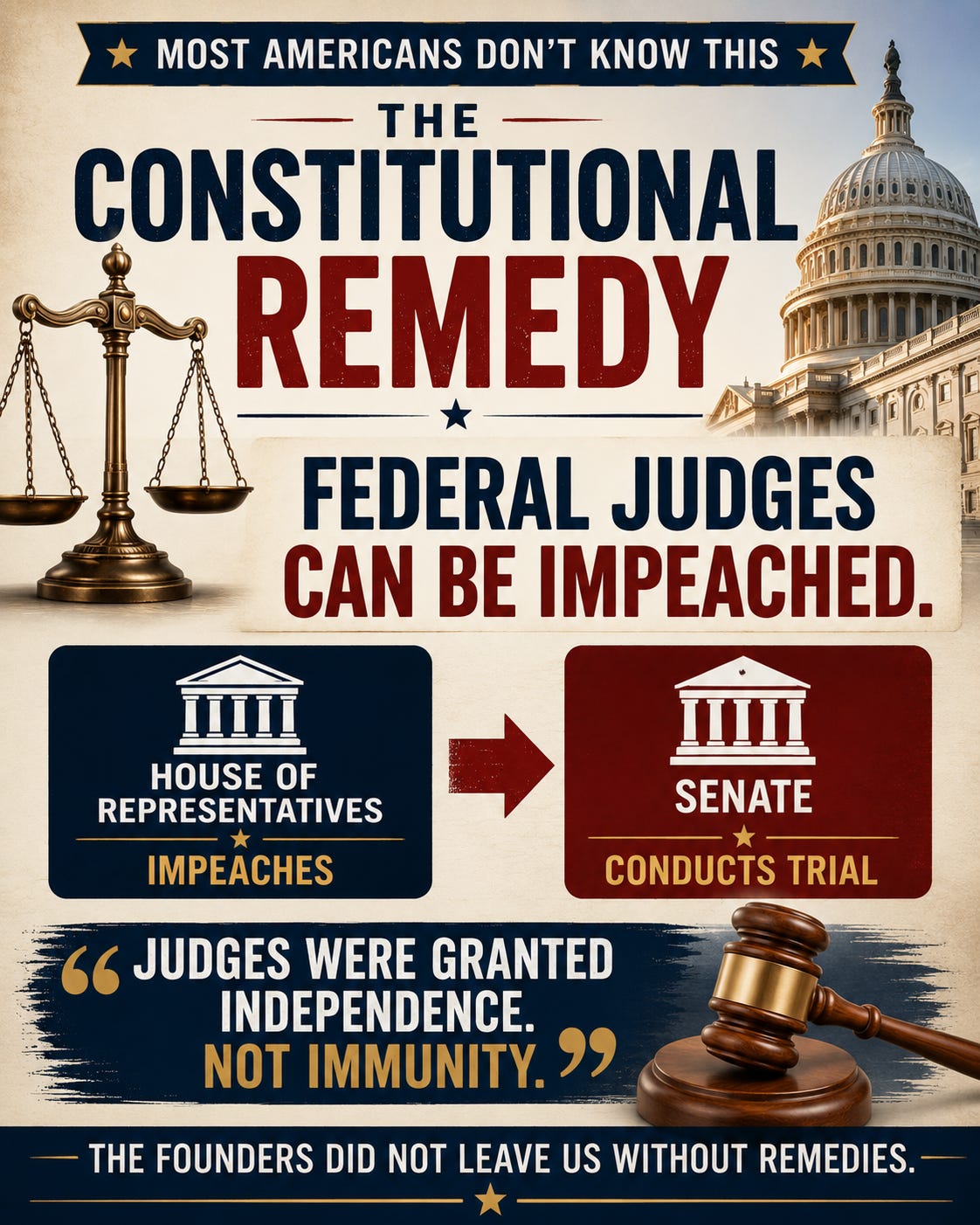
Federal judges can be impeached as well.
The Constitution grants the House of Representatives the sole power of impeachment, while the Senate has the sole power to conduct impeachment trials.
In other words, Congress was given a constitutional mechanism to address serious misconduct by federal officials, including judges.
Judges were granted independence.
They were not granted immunity from accountability.
Hamilton understood that no branch of government should exist without constitutional checks.
This is one reason the Speaker of the House occupies such an important position.
The Speaker leads the chamber that possesses the authority to initiate impeachment proceedings.
Whether that authority is used wisely is another question entirely.
The point is that the Founders did not leave us without remedies.
The Constitution Assumes Educated Citizens
One lesson keeps resurfacing throughout this class.
The Constitution assumes an informed citizenry.
It assumes citizens understand which branch does what and voters know where responsibility belongs.
It assumes the people will hold their representatives accountable.
When we don’t understand the structure, frustration naturally follows.
We blame Presidents for things Congress controls and courts for things legislators refuse to address.
We focus on Washington while ignoring what’s happening in our own communities.
And eventually many people reach the conclusion that nothing can be fixed.
Which brings me to what may be the most important lesson from this week’s class.
The Frustration Is Real
Let’s have a moment of truth.
A lot of Americans have lost faith in Congress.
Many people look at Washington and see endless spending, political theater, corruption, bureaucracy, and representatives who seem more interested in protecting their careers than serving the people.
Truthfully, I understand that feeling.
In many ways, I share it.
Today, while following election results and discussions on X, I saw that frustration on full display. Many of my friends in the J6 movement are growing weary, and I don’t blame them.
One person I know and follow closely is Derrick Evans from West Virginia. Another one is Brandon Straka from #WalkAway. Like many others, they’re becoming increasingly outspoken about what they see as a lack of accountability for those who weaponized government authority against ordinary citizens.
And honestly, I don’t blame them for being frustrated. FBI agents who hunted down innocent Americans still have their jobs. Prosecutors who pushed baseless charges still have jobs.
When President Trump returned to office, we expected that accountability would follow.
We thought the people responsible for weaponizing government would be exposed and that meaningful compensation would be provided to those whose lives were turned upside down.
And when efforts have been proposed only to run into resistance, delays, roadblocks, or outright opposition, it’s easy to understand why frustration continues to grow.
People begin asking:
“If even now nothing changes, will anything ever change?”
That’s a fair question.
In fact, history is filled with examples of people who justified bad decisions by saying:
“I’m just doing my job.”
“I’m just following orders.”
“I’m just enforcing the rules.”
My Firsthand Experience in Allegheny County
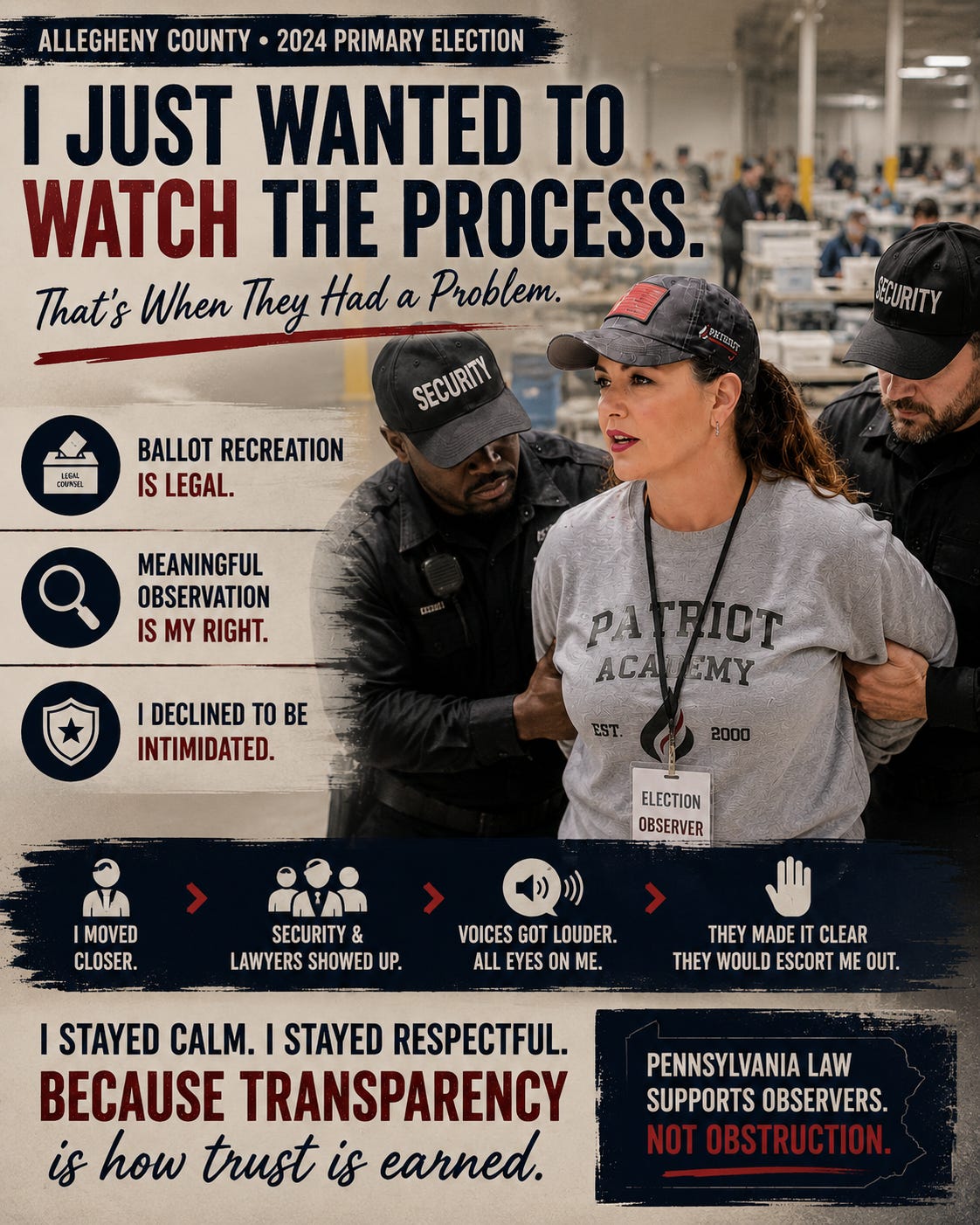
I was observing the mail-in ballot counting process and specifically watching election workers recreate ballots that had been damaged by the sorting machines.
Now, before anyone gets excited, recreating damaged ballots is a normal and legal part of the process.
That wasn’t the issue.
The issue was that I couldn’t actually see what they were doing.
Pennsylvania law allows observers to meaningfully observe the process, and from where I was standing, there was no meaningful observation taking place.
So I moved closer.
That’s when things got interesting.
Apparently, my desire to actually observe what I was there to observe created a bit of a problem.
I was told I wasn’t “allowed” in that area of the warehouse.
Security and lawyers showed up.
Suddenly voices were getting louder and a lot of attention was being directed toward a middle-aged mom who simply wanted to watch election workers do their jobs so that I could say I watched the process and it was legit.
At one point, the security made it clear that they were prepared to escort me out.
I remained calm even though my heart was racing.
I remained respectful even though I wanted to use choice language that I wouldn’t want my kids to hear.
And I declined to be intimidated, politely, when I wanted to throw a right hook instead.
But the part that has stayed with me wasn’t what happened inside the warehouse.
It was what happened afterward.
As I was leaving, a couple of the security officers who had been involved in the confrontation pulled me aside privately.
Here’s what they said:
“We agree with you.”
“We think you’re right.”
“But we’re just doing our jobs.
My jaw hit the ground and my heart started racing even faster than it had when I was in the warehouse mentally preparing to get handcuffed and escorted out.
I couldn’t believe what I was hearing.
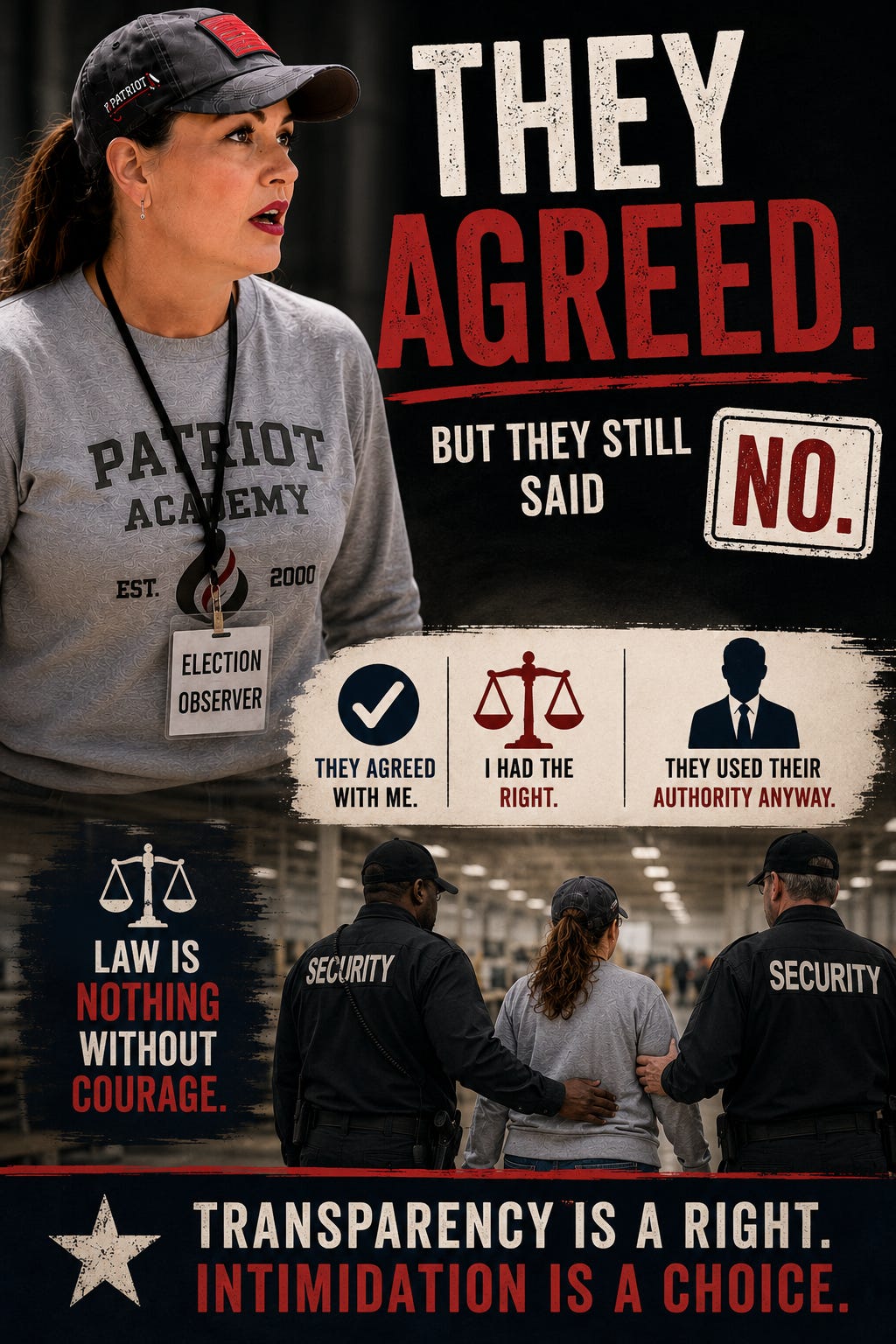
They AGREED with me.
They believed I had the RIGHT to be there.
They understood what I was saying.
Yet they were still willing to use their authority to prevent me from exercising a lawful right because someone higher up the chain told them to.
I remember walking away hoping they couldn’t see the fury on my face, and the more I thought about it, the more it bothered me.
Because that’s exactly how free societies slowly drift in the wrong direction.
Not usually because evil people take over.
More often because ordinary people convince themselves that their responsibility ends where someone else’s authority begins.
But successful self-government requires something more.
It requires conscience, wisdom, and moral courage.
Most of the time, the right thing to do isn’t easy. Choosing to stand on principle costs something and speaking the truth will likely make you unpopular.
Sometimes respecting authority means challenging authority when it exceeds its proper bounds.
That doesn’t mean being reckless or disrespectful.
And it certainly doesn’t mean abandoning the rule of law, but it does mean recognizing that morality matters.
Truth matters.
Character matters.
And courage matters.
That’s one reason I have so much respect for many of the J6 defendants I’ve gotten to know over the years.
Whether you agree with every decision they made or not, many paid an enormous personal price because they believed they were standing for something bigger than themselves.
Brandon and Derrick are understandably frustrated today. They’re losing hope that accountability will ever come, and I share their concern.
But I would encourage all of us not to let frustration become our identity.
The answer isn’t outrage and despair.
The answer is to educate more people, build stronger local communities, raise up citizens with courage and conviction.
And prepare the next generation to recognize the difference between lawful authority and blind obedience.
Because if history teaches us anything, it’s that free societies survive when ordinary people have the courage to stand on principle—even when it would be easier not to.
When power shifts again—and it inevitably will—we need more Americans who understand their rights, understand the Constitution, and have the courage to stand for what is right regardless of who occupies positions of authority.
When I look at Congress today, I don’t see an institution that’s going to be fixed overnight. Frankly, I think some of these problems have been building for decades.
But then I remind myself of something important.
We didn’t get here overnight and we’re not going to get out of it overnight either.
One of the mistakes many activists make is assuming that if we can’t immediately fix Washington, then nothing can be fixed at all.
The Founders would have disagreed.
The Fix Is Still Local
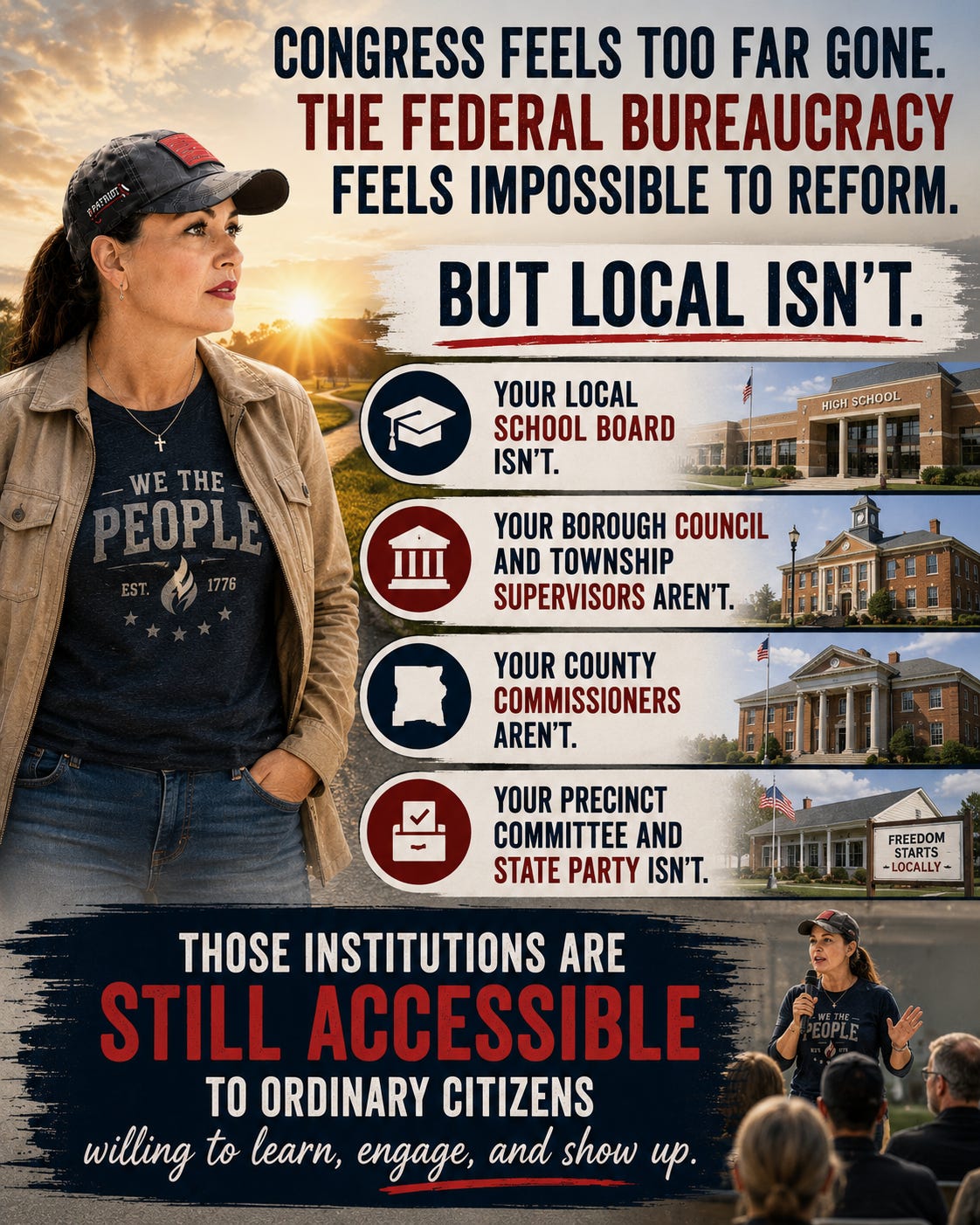
Maybe Congress feels too far gone and the federal bureaucracy feels impossible to reform.
But your local school board isn’t.
Your borough council and township supervisors aren’t.
Your county commissioners aren’t.
Your precinct committee and state party isn’t.
Those institutions are still accessible to ordinary citizens willing to learn, engage, and show up.
Healthy government begins closest to the people.
I’ll say it again.
Education is key, and the fix is local.
If we rebuild strong communities, informed citizens, accountable local government, and principled leadership at the local level, eventually those changes work their way upward.
Will it happen quickly?
Nope.
It may take a decade or more before we see the full impact.
But lasting change rarely happens overnight.
It happens one community at a time.
One county at a time.
One state at a time.
Why I’m Still Showing Up
In just a few weeks, I’ll attend my first meeting as a Pennsylvania State Committee member.
I’m excited, but I’m also realistic.
I have no illusions that I’m walking into a room where everyone suddenly agrees with me.
I don’t expect decades of problems to be solved in a weekend meeting.
Quite the opposite.
I expect it to be an uphill battle.
But that’s never been a good reason not to engage.
One of my favorite principles comes from John Quincy Adams:
“Duty is ours. Results are God’s.”
Our responsibility is not to guarantee success.
Our responsibility is to faithfully do the work in front of us.
That principle was echoed by another Founder whose words have become some of my favorites.
During this week’s lesson, Rick shared a quote from John Jay that stopped me in my tracks:
“The wise and the good never form the majority of any large society, and it seldom happens that their measures are uniformly adopted.”
Think about that for a moment.
John Jay understood human nature and politics.
He understood that doing the right thing would often be unpopular.
But he didn’t stop there.
He continued:
“All that wise and good men can do is to persevere in doing their duty to their country and leave the consequences to Him who made men only; neither elated by success, however great, nor discouraged by disappointments however frequent or mortifying.”
What a powerful reminder.
The work is difficult, the victories are often incomplete, and the setbacks can be discouraging.
But our duty remains the same.
Learn.
Engage.
Show up.
Serve.
Persevere.
And trust God with the results.
That’s how republics are preserved.
Not by people who are guaranteed success, but by people who continue doing their duty even when success is uncertain.
And perhaps that’s exactly the lesson America needs right now.